


SITS - The Service Desk & IT Support Show and The MSP Show to launch in the Netherlands
Following industry demand, event organisers Diversified Communications are delighted to announce that the highly successful portfolio of events is expanding to the Netherlands.
SITS – The Service Desk and IT Support Show, and the MSP Show Netherlands will take place at the world-renowned exhibition venue, Jaarbeurs in Utrecht on 16 September 2025.

The two new one-day events, which will be co-located, will showcase latest technology on the market alongside unrivalled education and training sessions, specifically tailored to the ITSM and the rapidly growing Managed Service Provider community. It will harness the experience, connections, and knowledge from the flagship London event, but to a completely new Dutch audience.
David Maguire, Group Event Director at Diversified Communications, commented: “We are incredibly excited to announce the launch of SITS – The Service Desk & IT Support Show and the MSP Show Netherlands! This is a direct response to requests from the industry who want us to branch out into the Dutch market.”

The exhibitor list will be made up of industry giants and up and coming start-ups who will be showcasing the latest IT Service Management tools and leading MSP solutions.
"Bringing SITS and the MSP Show to the Netherlands is a fantastic idea! We have been proud exhibitors at the UK conference for the past 10+ years and cannot wait to participate in the Dutch edition." Commented Gijs-Jan Huisman from PINK Elephant.
The event will host the industry’s most anticipated free-to-attended seminar programme. Featuring over 25 free education sessions and keynotes across three theatres. The programme will provide practical advice and industry insights that will educate visitors and ensure they leave feeling inspired.
Find out more about the event, here.


If AI is the future, that future is already here for ITSM
Artificial intelligence (AI) in IT service management (ITSM) has long been touted as the future of IT service delivery and support. It’s an unavoidable future, thanks to the benefits AI-enabled capabilities bring to ITSM and the ever-increasing challenges the corporate IT organization faces. However, all the talk of AI as the future of ITSM is now a little misguided. Not because it’s no longer something that will happen but because the AI-assisted future for ITSM is already here for many IT organizations.
This blog shares some recent insights about AI adoption in ITSM that show that the future of ITSM is already here.
Automation is still the leading ITSM trend for SysAid customers
Despite finding that employee experience has dramatically gone up in importance from 56% in 2022 to 73% in 2023, the SysAid 2023 State of Service Management Report, which collated the responses from over 1200 SysAid customers, showed that improving productivity with automation was still the highest scoring ITSM trend for 2023 at 76%. Additionally, using AI to predict and resolve issues more proactively jumped from 21% to 29%.
IT organizations are now ready for AI-powered ITSM capabilities, with generative AI solutions leading the way. For example:
- Virtual agents (often called chatbots)
- Email autoresponders
- Real-time assistance for IT support staff
- Ticket summarization
- Writing assistance
- Automated performance insights
- Sentiment analysis.
In addition to what we’re seeing with customers, the following statistics have helped to inform this view.
ITSM pros are already using free (and non-corporate) AI tools
Before considering how IT organizations already use the AI-enabled capabilities within their ITSM tools, it’s worth considering the following statistic. In a 2024 ITSM.tools Well-being in ITSM survey, 66% of respondents stated that they already use free AI tools such as ChatGPT to help with their work.
Viewed differently, this is two out of every three people in ITSM roles using AI – often generative AI – to improve their productivity and capabilities. It’s a massive uptake for AI in ITSM but a statistic that IT organizations should be wary of.
The IT industry has already seen two decades of “shadow IT,” which started with devices and evolved to cloud applications. Now, the AI version is a risk for IT organizations. First, there are the security implications, which are probably the last thing a productivity-seeking employee will think of. Second, using non-corporate AI capabilities can’t help but raise expectations of what the IT organization should provide to employees.
ITSM pros are also using corporate AI capabilities
The same survey also found that 36% of respondents already use corporate AI capabilities, i.e. one in three people in ITSM roles. This could be various use cases. For example, it could be the AI capabilities within the corporate ITSM tool or an enterprise-created ITSM offering that leverages AI. The survey respondents could also be using multiple AI-enabled capabilities.
This figure is expected to grow rapidly in 2024, with circa three-quarters of ITSM tools having already added some form of AI capabilities, according to ITSM.tools 2023 AI Adoption in ITSM survey.
What’s stopping corporate AI adoption in ITSM?
The delta between the ITSM pro use of free AI tools and corporate AI capabilities is significant. Given the time and resource investment required to get tailored ITSM capabilities (versus the generic use cases offered by free AI tools), it might not be surprising. However, the size of the delta might be.
To understand the delays in AI adoption, the ITSM.tools 2023 AI adoption data inquired about the main AI challenges holding back corporate initiatives. The four highest-scoring obstacles were found to be:
- Lack of skilled people (57%)
- Competing priorities for resources (44%)
- Legacy IT issues (43%)
- Employee resistance to change (40%).
These are likely relevant to your organization’s current and future AI adoption in ITSM initiatives.
One challenge omitted from the survey options was knowing where best to start with AI adoption in ITSM, with factors such as costs, risks, benefits, capability maturity, etc. all playing their part in this decision-making. While every IT organization will have its own unique set of drivers and challenges,
How AI is already helping with IT service delivery and support
The AI adoption in ITSM survey found the top three AI in ITSM use cases to be:
- Intelligent workflow automation – for example, Copilots that support incident and service request management from the work intake to ticket closure.
- Virtual assistants for employees (what many would call “chatbots”) – that offer speedy help services even when the IT service desk is closed.
- Virtual assistants for staff – in particular, the augmentation of IT service desk agent knowledge and skills with AI-powered Copilots. While many people will see this as providing relevant ITSM knowledge when needed, the opportunity is far broader. It also includes the opportunity to personalize service and invoke automation or service orchestration capabilities as required.
Hopefully, this blog has you thinking about how your IT organization should be using AI-enabled capabilities for ITSM. Such capabilities are no longer the future of ITSM. Instead, they are already it’s present. If you want to learn more about how Copilots will help with your organization’s IT service delivery and support, take a look at SysAid in action.
You can view the quoted survey here: ITSM.tools 2023 AI Adoption in ITSM survey
By Oded Moshe, SysAid

Strengthening data security through service desk-centric ITSM software
The looming threat of data breaches and cyberattacks compels organisations to adopt meticulous data privacy and management strategies to protect themselves and minimise potential risk. An often-overlooked defence against security threats is the IT service desk and the professionals that steer its direction, including Operators on the front line who do the day to day work, and the management who steer the strategic direction of the service desk. These professionals continually emerge as silent guardians of protecting organisation information and other assets.
If your organisation is not considering the service desk as one of the frontiers against cyber attacks, you may be missing a significant opportunity to leverage experience, know-how, and technology to take on these objectives. ITSM can help strengthen organisational front-line responses and manage user expectations, while the security professionals take on the task of restoring order.
While ITSM clearly doesn’t prevent against attacks, it can help those responsible for managing security events do so much better or more efficiently than without it. Your service desk, working within a framework of robust, security related ITSM processes, can manage the response to such attacks when they occur, and properly designed ITSM processes can help you create a comprehensive defence against targeted attacks. How so? ITSM can help provide first responders from the organisation’s mitigation teams with the ability to swiftly identify vulnerabilities, attack vectors, open doors, and other risks, and optimise the response.
Additionally, ITSM can be used to let users alert the service desk when there is a problem – not through random emails, calls, or knocks on the door, but through a self-service portal Security alerts can be created automatically, or logged manually by users. This could be through an SSP, or through a phone call. Once a breach or attack is identified, the service desk team can see what is happening in the organisation and its infrastructure, what assets you have in it, who is responsible for them, what happened to them or where employees have access. Modern service desk software can also include features like a panic button, allowing users to summon help promptly, ensuring critical incidents receive immediate attention.
Through integrations with security solutions, automated scans and real-time monitoring can also be incorporated into your ITSM tool and supporting processes allowing your service desk and security teams to communicate seamlessly through ITSM. Consequently, service desk teams gain the opportunity to neutralise security gaps and respond promptly to security events.
In essence, ITSM software can empower service desk teams to implement optimisation strategies, reinforcing data security proactively. The positive impacts of this are amplified when your ITSM tool is supported by strong, ITIL-aligned processes
By increasing the speed at which useful information can be accessed by your IT professionals and facilitating collaboration between teams, the whole organisation can benefit.
Attacks come to the service desk
Attack vectors are everywhere and anything that can be manipulated as a potential entry point will be exploited. Threats may come via malicious links in service desk tickets, putting service desk professionals on centre stage in the battle for the security of the organisation in which they serve.
Those who work on the service desk must remain vigilant against such social engineering attacks. Service desk leaders alongside their IT security colleagues should develop strong, robust processes used to respond to security incidents quickly. When developing such approaches, consider how the ITSM tool along with ITIL processes, and security protocols complement each other to respond to security incidents and be used to create a record of what’s happened during these incidents.
Likewise, pairing the service desk and security teams to meet attacks head on is possible through the points mentioned in this piece, as well as by employing intrusion detection systems that can be linked to the ITSM solution. Doing so means any high-priority incidents can then be acted on immediately by the operators on the service desk.
ITSM Data Security and Encryption
While dedicated security tools have advanced to meet much of the present need, they are not well suited for managing communication challenges during such an event. ITSM solutions can support any potential coordination holes that might arise when responding to such an event.
To further elevate data security, service desk software excels in access control management and managing role-based access. Authorised personnel can exclusively access sensitive information through granular access controls and role-based permissions built into the technology. ITSM software can also be configured to add further security steps, such as multi-factor authentication in order to enhance user account security.
Integrating ITSM tools, professionals and processes with security tools, professionals and processes creates the seamless collaboration needed to amplify efficiency. Your ITSM tool should integrate with your security tool, and your ITSM processes (which include their own security processes) should complement your security processes, and vice versa.
A Unified Approach to Data Security
Siloed ITSM and security solutions are not only inefficient but also create security gaps. And the service desk is increasingly under attack from threats. Common attack techniques leveraged against service desks in the last year include leveraging reused and stolen passwords, excess privileged access, and insecure remote access.
- Streamline secure remote support sessions to any device – including third party access – by initiating directly from within an incident or change record, without revealing plain text credentials.
- Standardise remote support procedures across Windows, macOS, Linux, iOS, Android, network devices, and peripherals.
- Apply least privilege and zero trust access across support sessions.
- Centralise endpoint privilege management: open tickets for new app requests, integrated approval workflow, and validate tickets before access is granted.
- Store and manage credentials so they are available within the integrated solution for discovery, orchestration, and easier automation of service ticket workflows.
- The ability to search for and retrieve session details and associated tickets or change requests – including access or permissions – on demand.
- Detailed change tracking and recording, including accessing configuration items directly from a change request.
- Auditing of who approved the request and to which privileged account and asset.
As organisations navigate the complexities of data security, ITSM tools tailor appropriate data protection workflows and strategies across the organisation. Even though service management is not often conflated with cybersecurity, this collaboration can help organisations develop a strong response to threats and can serve as an information hub for navigating responses, risk management, and mitigation efforts.
With a steadfast commitment to a holistic and robust approach to data security, organisational leaders can pave a path toward a secure future. Service desk professionals and their technology solutions become the stalwarts of safeguarding all data in the organisation.
By Chris Falshaw, head of IT support, TOPdesk UK

How ITAM 2.0 enables big opportunities for IT cost optimisation
IT Cost Optimization Strategy with ITAM 2.0
With socio-political changes, global pandemics, and increasing natural disasters, CIOs need to find innovative ways to manage and control costs, all while supporting organizational goals for the ongoing digital transformation in a sustainable way. Walking this tightrope requires striking a balance between short-term IT cost-cutting and long-term IT cost optimization. The answer that will tip the scales in your favour lies in using automated IT asset management that funds itself through a holistic approach.
Why IT cost reduction is not the way
To strike this balance between short-term IT cost reduction and long-term IT cost optimization, it is important to spotlight the difference. With cost reduction, you cut a company’s expenses in order to maximize profit and produce short-term savings. With cost optimization, you reduce costs while also optimizing your spending and business value.
Many companies still focus too much on cost reduction. Yet, in a 2021 report, Gartner states that only 43% of these companies achieve their cost reduction targets in the first year and only 11% manage to sustain that for the following three years. This is because short-term cost initiatives, such as hiring freezes or cutting training programs, do not pay off in the long run unless they are part of a broader strategy that aims to support a climate of continuous smart spending. And this is no different for IT. If you want to optimize your IT expenditures, you need to invest in a long-term IT strategy, even during disruptive times.
CIOs Must Balance Cost and Agility
Organizations that continue to invest strategically in IT during tough times and forge a strong CIO and CEO relationship are more likely to come out on top. Often, the potential benefit of long-term cost optimization justifies additional short-term investments in IT. Still, in communicating their cost optimization strategy effectively to C-suite executives, CIOs must demonstrate that a proactive approach will not jeopardize business continuity or innovation.
However, as the number of IT assets continues to explode, CIOs will need to find a balance between containing costs and providing the business with enough agility to innovate and compete. While agility will be mission-critical, it will lead to chaos if IT loses sight of the assets they have and the assets they are adding. Maintaining an overview of your IT Estate during a fast-tracked digital transformation process is key to optimizing costs. This is where ITAM comes in.
ITAM: All Assets, Any Use Case
The ITAM Forum suggests the cost-cutting benefits of ITAM must become a de facto business practice and discipline and can be leveraged in recession planning to help save jobs and maintain growth, reducing global IT spend by 5%, which equates to over $67.7 billion of potential savings from ITAM alone. A focus on minimizing asset-related investments and optimizing cloud spending can help alleviate immediate financial pressures. As a practical example, ensuring billed resources such as software licenses or cloud servers are being used and shutting them down if they are not used can eliminate unnecessary overhead, with no impact on business continuity.
But before you can eliminate waste and optimize your current infrastructure, you need to know what is there. Without visibility into the entire IT estate, you will not know how to make cost-cutting optimizations without disturbing business continuity. To put it simply: You need to know what you have, in order to manage it in a cost-effective way.
And while ITAM is often associated with a specific scenario such as license compliance, it is actually the foundation for a broad range of activities, including cloud migration, ITSM, cybersecurity, and more. In all of these use cases, knowing what software and hardware resources comprise the IT infrastructure is the essential starting point. Without that data, taking action around any IT use case is impossible.
The typical way of collecting data is per use case: IT needs to identify potential vulnerabilities to strengthen its cybersecurity posture, or there is an organization-wide software update that needs to be rolled out to all laptops, for example. Each time, a new ad-hoc inventory is collected, requiring dedicated resources. Although much of the data may overlap, not one of these scenario-specific inventories is complete, and when a new IT scenario comes up, the process begins again. Creating a usable IT inventory for every new scenario consumes a tremendous amount of time and effort on the part of IT, hurting the ROI of the specific project in case, or makes focusing on innovation or other revenue-generating activities difficult.
Would it not make more sense to begin with a single system of record that keeps an accurate, up-to-date inventory of all software and hardware assets that comprise the entire IT estate? In this model, all of the necessary data for any use case is available, accurate, and readily accessible. There is no duplication or rework needed, so IT can be much more efficient and cost-effective in responding to the needs of the business.
Take on ITAM Holistically
With a complete system of record for all of your IT assets — software, hardware, mobile devices, virtual machines, servers, and more — you gain visibility into your entire IT estate and have accurate, complete data to support multiple business scenarios. This holistic approach to ITAM leads to substantial cost savings while enabling IT teams to act more quickly and efficiently since the necessary data is already there. Learn more about our ITAM 2.0 Strategy.
With a dedicated ITAM system such as Lansweeper, organizations can leverage this holistic approach to create and maintain an always-accurate IT inventory, reducing costs, and empowering decision-makers to make informed tactical and strategic decisions for their organizations.
“Our approach is to build and maintain a single source of truth on the IT asset inventory. It is the baseline for recurring processes, projects of all kinds, and rapid action when needed. Creating a new inventory every time a new IT-specific use case is introduced is an enormous waste of time and resources.”
Maarten Saeys, CPO at Lansweeper
Make Your ITAM Self-funding
The reason why you should no longer talk about ITAM but should be talking about ITAM 2.0 becomes glaringly obvious when you look at how ITAM is maturing with organizations today. In a 2021 report, Deloitte indicated a severe lack of organizational progress in ITAM. 84% of organizations believe they do not have an effective ITAM in place. And 6 out of 10 organizations are yet to make their ITAM a self-funding program. The main hurdle? Ironically, 90% state that it is the rapidly changing business, regulatory, and technology environment that slows down their ITAM maturity. In other words: the disruption ITAM is meant to alleviate.
How does one explain that? Well, the same report shows that this is due to traditional approaches to ITAM. More than often, ITAM is still used for the aforementioned short-term goal of cost reduction. Yet, if anything, the covid pandemic has shown that a holistic approach is the way to go. Your ITAM solution needs to tackle multiple disruptions at once and needs to be part of a long-term strategy where it aims to bring value across the entire organization. In other words, cost optimization is the top driver for ITAM, not cost reduction.
So, how do you make your ITAM self-funding? The first step would be to estimate the ROI of an ITAM solution. If your program’s run cost is more than the cost reductions it produces, you need to either change your strategy or choose a different supplier. You can determine the program’s effectiveness over time if you know what the annual ROI is. Our ROI tool calculates your annual ROI automatically in 4 steps based on several parameters of your IT estate. In just a few seconds, you will know if Lansweeper is the ITAM solution worth investing in.
By Lansweeper

Global 2024 SIAM Survey
Can you spare five minutes to help build a picture of service integration and management (SIAM) adoption around the world?
Scopism, the home of SIAM best practice, is carrying out its annual SIAM survey to map how SIAM practices are transforming how organisations source and deliver their digital services.
The survey includes questions about demographics (country, industry sector, job titles, salaries etc.), and is then tailored towards organisations that have adopted SIAM, organisations that plan to adopt SIAM, and organisations that sell SIAM tooling, consultancy, and services. Now in its seventh year, the survey is helping to pinpoint key trends and identify the benefits, challenges and skills associated with a SIAM transformation. This year includes a new question set assessing the uptake of artificial intelligence in SIAM models.
The survey is open until August 15th. Once the survey closes, the results will be documented in the Scopism Global SIAM Survey Whitepaper – free for anyone to access in the online SIAM community.
You can view past whitepapers in the community here.
And the link to complete the survey is here.

The GenAI impact on the future of ITSM excellence
Generative AI has made waves across all industries, and ITSM is no exception. However, in a recent study by ManageEngine on the state of AI in ITSM, 71% of the surveyed organizations are still researching or have just begun piloting the technology. At ManageEngine, we decided to help shed some light on how the future of ITSM can be transformed with GenAI.
We crowdsourced opinions and insights about GenAI's impact on the future of ITSM excellence from ten ITSM industry authorities from around the world on five topics in particular:
-
Where and how they see GenAI transforming ITSM operations in the next three years
-
The biggest corporate challenges to GenAI adoption success
-
The guidance they would give an organization approaching GenAI use
-
The stories shared of GenAI success
-
Their use of GenAI for professional and personal purposes
The impact in the next three years
To begin, there is an unanimous agreement among ITSM experts that while the adoption of GenAI is inevitable, it will only augment people's productivity and efficiency—not replace them.
Our Director of AI Research Ramprakash Ramamoorthy vouched for the improvement in productivity, saying, “Although there’s a fear of AI displacing jobs, it will only help speed up processes and let employees handle other important tasks. For example, developers can be guided to better knowledge resources, and bugs can be resolved sooner. In the case of text-to-code, AI can give developers a leg up and save time. After the basic processes are done, the developers can just build on their code, giving them a head start."
The opportunities for people's productivity improvement would arise from the usage of chatbots and co-pilots for data gathering and presentation. Beyond these popular use cases, Roman Jouravlev, ITIL senior architect at Axelos, shares:
"If I’m correct in these expectations, generative AI will significantly improve incident management, service request management, service configuration management, IT asset management, knowledge management, availability management, and monitoring and event management. Other ITSM practices may also benefit from generative AI, but its role will be less transformative and more supportive.”
The corporate challenges for a successful adoption
The ITSM experts put forth several challenges on different dimensions for an organization when adopting GenAI for ITSM. While data security and accuracy was a commonly cited challenge, one of the standout challenges was AI ethics, highlighted by Simone Jo Moore, an independent ITSM consultant:
"By no means the only challenge, yet outstanding in the lack of focus, is the discussion from the executive to the operational level of AI ethics. The technology still exceeds governance and law by around five years."
The spotlight was also brought on financial issues as another key challenge for GenAI success. Roy Atkinson, CEO and principal advisor at Clifton Butterfield LLC, picked apart the cost challenges, noting that "As with previous ‘shiny objects,’ many organizations will buy AI-powered tools and technologies before honestly assessing how they will be used, what preparations are needed, how the effects will be measured, and what impacts they will have."
Guidance and tips on approaching GenAI
Industry experts offered guidance and tips on regulatory compliance, business outcomes, increased investment in people, and starting out with simple use cases.
For instance, Erin Casteel, convener at The ESG Exchange, states, "I highly recommend that any organization considering using generative AI reviews ISO/IEC 42001:2023 as a starting point . ISO/IEC 42001 is useful to AI providers, AI producers, AI customers/users, AI system integrators, and data providers."
Vawns Murphy, principal ITSM consultant at i3Works Ltd., offers, "My one tip would be to keep it simple. Start by automating some simpler service desk tasks by introducing chatbots and virtual assistants at the incident and service request frontend. This is a straightforward exercise for most organizations, and it has the benefit of creating a way of socializing the concept of AI to end users and the business while giving human IT support experts the time and space to focus on more challenging incidents, service requests, and project work. Everyone wins!”
Read perspectives on GenAI from more ITSM experts
We would like to thank the contributors for making this highly collaborative effort possible; you can read the entire e-book for free here.
By ManageEngine

SolarWinds 2024 IT Trends Report asks whether IT pros see AI as a friend or foe?
SolarWinds has released the findings from its 2024 IT Trends Report, AI: Friend or Foe? The report, based on a survey of nearly 700 IT professionals about their views on artificial intelligence, found that despite a near-unanimous desire to adopt AI technology, very few respondents have confidence in their organisation's readiness to integrate AI, pointing to limitations in data and infrastructure and security concerns.
The report found that while IT pros have a growing interest in embracing AI technology, with nine out of ten already using or planning to use AI, concerns remain about data quality, database infrastructure readiness, and - above all else - security and privacy.
"While talk of AI has dominated the industry, IT leaders and teams recognise the outsize risks of the still-developing technology, heightened by the rush to build AI quickly rather than smartly," said Krishna Sai, SVP, Technology and Engineering at SolarWinds. "With the proper internal systems in place and by prioritising security, fairness, and transparency while building AI, these technologies can serve as a valuable advisor and co-worker to overworked teams, but this survey shows that IT pros need to be consulted as their companies invest in AI."
Overall, the industry's sentiment reflects cautious optimism about AI despite the obstacles. Almost half of IT professionals (46%) want their company to move faster in implementing AI despite costs, challenges, and concerns, but only 43% are confident that their company's databases can meet the increased needs of AI. Moreover, even fewer (38%) trust the quality of data or training used in developing AI technologies.
To ensure successful and secure AI adoption, IT pros recognise that organisations must develop thorough policies on ethics, data privacy, and compliance, pointing to ethical considerations and concerns about job displacement as other significant barriers to AI adoption. The SolarWinds report found that more than a third of organisations (35.6%) still don't have these policies in place to guide proper AI implementation.
In keeping with SolarWinds' history of working alongside the IT community and to address these concerns about the development of AI, the company recently unveiled its AI by Design framework, a new industry model for the ethical and secure development of advanced AI technologies. AI by Design is built on four guiding principles: prioritising privacy and security, focusing on accountability and fairness to eliminate biases, emphasising transparency and trust, and ensuring simplicity and accessibility for seamless integration into workflows.
Built on the success of its Secure by Design initiative, the company believes that the new AI by Design framework will set a model for how the broader industry should approach AI. The company also recently announced its new SolarWinds AI generative AI engine, which was purpose-built using the AI by Design framework.
To read the full 2024 IT Trends Report, visit: https://it-trends.solarwinds.com
By SolarWinds

Simplify IT Automation with Kelverion's New Runbook Studio Packs
(Orlando, Florida) Kelverion, a leader in IT automation solutions, is thrilled to announce the launch of its innovative Runbook Studio Packs hosted in Microsoft Azure. This all-encompassing solution simplifies the building and integration of automation for IT tasks and processes, making it more accessible and less complicated for IT professionals and citizen developers, now available in Microsoft's Azure Marketplace.
Introducing Runbook Studio Packs
Getting started with automation has traditionally been a complex and costly undertaking, involving numerous moving parts and significant investment. Recognizing these challenges, Kelverion has developed the Runbook Studio Packs to provide a straightforward, cost-effective alternative.
The Runbook Studio Pack is comprised of:
- Runbook Studio: Kelverion's low-code/no-code, drag-and-drop, click-and-configure automation platform allows IT team members and citizen developers to build and edit automation runbooks without any coding knowledge.
- Ready to Deploy Automation Use Cases: Automate the 50 most utilized use cases, including:
- Employee onboarding/offboarding
- Standard IT tasks
- Microsoft 365 Management
- Event to Service Desk Incident Ticket Creation
- Remote Diagnostics and Remediation
- Comprehensive Integration: Seamlessly connect all your existing enterprise tools—from ServiceNow to Atlassian Jira, VMWare to BMC Helix—with Kelverion's 'smart' integrations. These modules discover the existing setup of your systems and reflect any bespoke configurations in easy-to-navigate drop-down fields.
The Runbook Studio Packs are available in two packages:
- Client Pack: Includes 2 PC client licenses, all integrations, and 50 use cases $1,095/£895 per month.
- Server Pack: Includes a multi-user server license, all integrations, and 50 use cases $1,995/£1,595 per month.
Both packs are designed to eliminate manual IT work and streamline service delivery.
David Wooster, Director at Kelverion said "we're passionate about simplifying automation for IT teams across the globe, whether you are brand new to automation, or have some manual IT tasks already scripted, Kelverion's new Runbook Studio Packs offer a complete, user-friendly solution for end-to-end IT automation."
Discover the ease and efficiency of IT automation with Kelverion's Runbook Studio Packs, now available on the Azure Marketplace.
By Kelverion

Navigating GenAI: Guidelines from an AI Expert
Do you consider implementing generative AI in your company, but want to ensure quality and performance while maintaining safety standards? Gain valuable insights and guidelines from an AI Expert and Professor with a background in ethics and compliance.
GenAI in service and support is primarily about streamlining work processes and facilitating easy access to information. This article features insights from Stephen Alstrup on the ethical considerations surrounding GenAI. Stephen is a Professor in Algorithms, Advisor for the Danish Data Protection Agency, and CEO & Co-founder of SupWiz, that delivers AI software used by millions of users across the globe,
Controlling how AI makes decisions
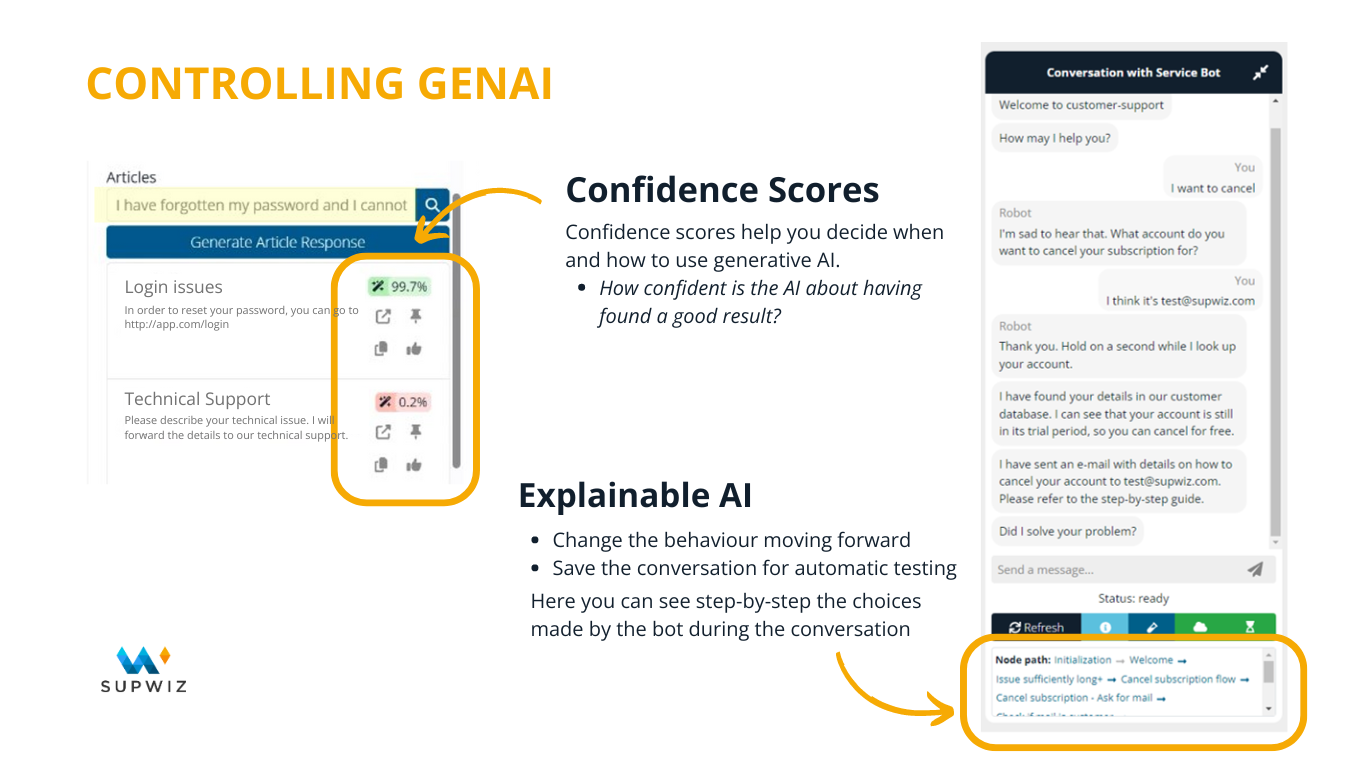
GenAI holds promise for innovation, but it also raises questions about ethics. For Stephen, transparency is key. When using AI-generated content, it’s crucial to be upfront about it. This transparency builds trust and accountability, ensuring that users know where the content comes from. Thus, consider using tools that show step-by-step how an algorithm/AI comes to conclusions, and where it’s possible to adjust individual steps.
Generative AI is not designed to find information, therefore without effective search capabilities, the GenAI will have difficulty providing accurate results to the user query. Therefore, incorporating confidence scores to indicate the AI's certainty in e.g., its generated answers it’s key to controlling it. These confidence scores empower users to make informed decisions about presenting results. For example, if the confidence is too low, generative AI should not present an answer to the user query, instead it can be forwarded to agents for human intervention.
Bias is also a significant issue. LLMs can carry on biases from the data they’re trained on from humans. Therefore, it is crucial to use AI that allows for bias elimination, rather than relying on black box systems. This approach ensures fairness and ethical practices, aligning with regulatory requirements such as the EU AI Act. This framework emphasizes transparency, accountability, and ethical standards in the development and deployment of AI systems.
Future-proof Security and Compliance
When implementing AI ensure upholding stringent data protection standards and complying with regulations, current and upcoming. This is relevant across all industries, especially when working with citizens or personal data. It’s important to be aware not only of where the data is stored but also of its intended purposes, including data usage for training, monitoring, and other applications.
Stephen Alstrup pictures a future where generative AI drives innovation while upholding ethical standards. Transparency, accountability, data privacy, and bias minimization are essential. By following these principles and implementing practical guidelines, your company can navigate the ethical challenges of GenAI and unlock its transformative potential for good.
If you are curious about learning more about generative AI and its positive impact on e.g., service and support processes, you can get more insights here: AI solutions for enterprises — Generative AI in SupWiz.
By SupWiz

SITS and the MSP Show welcome record-breaking number of attendees
SITS – The Service Desk & IT Support Show had a 36% increase in attendees from 2023, and welcomed the successful launch of the MSP Show, offering solutions and inspiration to the managed service community.

The exhibition returned to ExCeL London on 17-18 April 2024, attracting a global audience of visitors from as far as Estonia and the USA.
‘Year in, year out, this is my favourite event to engage with vendors and network with colleagues’
The event boasts the only free ITSM education programme in Europe, made up of seminars, panels, Breakfast Briefings and Hot Topic workshops.
Being the largest event in Europe focused on IT Service Management, 70+ ITSM vendors showcased the latest IT service solutions, aiming to enhance the efficiency of IT Service Delivery.
Event Director, Alice Fulton said “It’s fair to say that this was our best show yet! There was a real buzz with people excited to make connections, learning about the evolving industry and discovering new products.”
'See the entire ITSM market major players in one spot’

The exhibitors ranged from big name brands to start-ups, including Freshworks, Hornbill and ManageEngine. Visitors had the chance to get personalised demos of the latest ITSM tools, have all of their questions answered and compare service offerings.
“A day well spent looking at all the products available. Having one on one time with suppliers was amazing as I had all my questions answered. Next year I’m going for both days!” Said visitor Ty Hempton, Surrey County Council.
‘A great opportunity to hear, share and discuss current topics with our industry’
The education programme was made up of top speakers from the UK and beyond, who gave seminars on topics like ESM, AI and ITIL, as well as topics that affect people in the workplace, including mental health and diversity.
“I really enjoyed the two days full of interesting insights, discussions and opportunities amongst the best in the ITSM community. I highly recommend the show for any ITSM professional, whatever the stage and maturity of your framework.” Commented visitor Clayton Said, Head of IT Service Management, FIMBank p.l.c.
‘If you're an MSP owner you need to be at this show next year!’
The launch of the first MSP Show was a huge success, welcoming 1000+ visitors. The industry was excited to have a dedicated MSP event, with many commenting that the co-location of the two shows added unrivalled value.
 Sales Manager of the MSP Show, Alex Harris said “We couldn’t have asked for a better first show! The feedback from the industry has been overwhelming, with visitors and speakers already looking forward to next year and exhibitors also securing even larger stands for 2025.”
“With a natural increase in vendors coming on board, it’s looking like next year’s edition is going to be bigger and better!” Alex continued.
“It was a really enlightening experience. It was good to see the introduction of AI in so many seminar topics and in the products exhibited. I left feeling inspired and equipped with practical strategies to enhance how we do business as an MSP. I highly recommend the show for anyone looking to elevate their service delivery.” Commented Cyndi Crasto, Service Delivery Manager, Zuri Technologies.
‘A great opportunity to see everything and everyone in one place - Unparalleled.’
SITS, The Service Desk & IT Support Show and the MSP Show are back on 14-15 May 2025 at ExCeL London.
Find out more here: www.servicedeskshow.com, www.mspshow.co.uk