


From End Users to Agents: SysAid Continues to Innovate and Transform the IT Service Management Experience by Unveiling its AI Chatbot for Agents
SysAid, a leading provider of innovative IT and Enterprise service management solutions, announces the debut of its revolutionary AI Chatbot for Agents which will be unveiled at the Service Desk & IT Support Show (SITS) in London on April 17-18, 2024. This ground breaking add-on to the SysAid platform aims to reinvent the way agents deliver service, enhancing efficiency and productivity across organizations while solidifying SysAid’s position as a pioneer in the industry.
Earlier this year SysAid released SysAid Copilot, its comprehensive, innovative set of generative AI capabilities providing employees with a consumer-grade, self-service experience and redefining the employee experience. With a steady rollout of additional features driven by customer demand, the community of active SysAid Copilot customers is rapidly expanding and fueling business momentum. Additionally, adoption rates of the next-gen ITSM solution within their organizations are a clear indicator of SysAid’s commitment to fulfilling the needs of its customer base.
With the introduction of the AI Chatbot for Agents, SysAid continues to push the boundaries of innovation in the IT service management industry. The AI Chatbot for Agents instantly delivers tailored responses, addressing agents’ specific needs and inquiries while enabling them to resolve issues from within the admin portal. For example, if an agent requests help in prioritizing their tasks and tickets for the day, the chatbot will step in by evaluating the queue and providing a summary of tickets on which to focus based on titles, descriptions, prioritization, and even user sentiment detected by AI Emotion. Furthermore, the AI Chatbot for Agents suggests solutions contextually from within tickets, eliminating the need to search for solutions and resulting in a significant reduction in MTTR.
“We are thrilled to unveil our latest AI-driven innovation at SITS 2024,” said Avi Kedmi, CEO of SysAid. “Our mission at SysAid is to empower IT professionals with the tools they need to excel in their roles. With our new AI Chatbot for Agents, we are revolutionizing the agent’s role and leading the competition in delivering next-generation IT service management solutions.”
At the SysAid booth at SITS, visitors will be able to interact hands-on with both the AI Chatbot for Agents and the AI Chatbot for End Users, experiencing both sides of the service experience. They’ll see firsthand how features such as Guardrails, and Monitor and Fine-Tune ensure the quality of chatbot responses, that are generated based on a Data Pool that trains the chatbot on knowledge from extensive data sources including internal and verified external sources, including documents of different types, websites and SharePoint. They’ll also enjoy a full product demonstration and have an opportunity to chat with the product experts behind the innovation.
Meet the SysAid team at stand 525 at SITS, The Service Desk & IT Support Show, on 17-18th April 2024, ExCeL London. You can now register for your free ticket here.

Driving IT and Business Improvement with Experience Data
If you’re going to the Service Desk and IT Support Show (SITS), you’ll probably hear a lot of talk about experiences and experience management. But what are organizations like yours really doing to drive IT and business improvement with experience data and insights? This blog shares some of the opportunities HappySignals customers have already taken to leverage their experience data. Hopefully, it’s an eye-opening list. However, if you want more details on what’s involved, I’ll be co-presenting at SITS with a customer, Shaun Brown of GEA. The details are shared below before I get into examples of what’s possible with experience data and insights.
Our SITS education session – Driving IT with experience data: From a framework to reality
As the session blurb says, increasing employee happiness and productivity is now imperative for most IT organizations. We’ll discuss how best to know how end-users experience their IT and services. Plus how to improve IT in the right areas. How do we know? Our customers are already doing it.
Shaun will share how experience data gives GEA a different perspective, with more informed decision-making that now focuses on “what matters most” to employees and business outcomes. He will also share GEA’s journey to becoming an end-user-focused organization, including the lessons learned.
It’s an excellent opportunity to get real insight into how to drive IT and business improvement with experience data. Be warned, though, that if our previous SITS visits are indicative, it will be a well-attended session between 11:00-12:00 on day two (April 18) in Theatre 2. So get there early!
A quick experience management 101
Before sharing some examples, I don’t want to assume everyone knows how experience data differs from traditional IT performance data. If you already know, then please jump to the next section. If you don’t, here’s a quick summary.
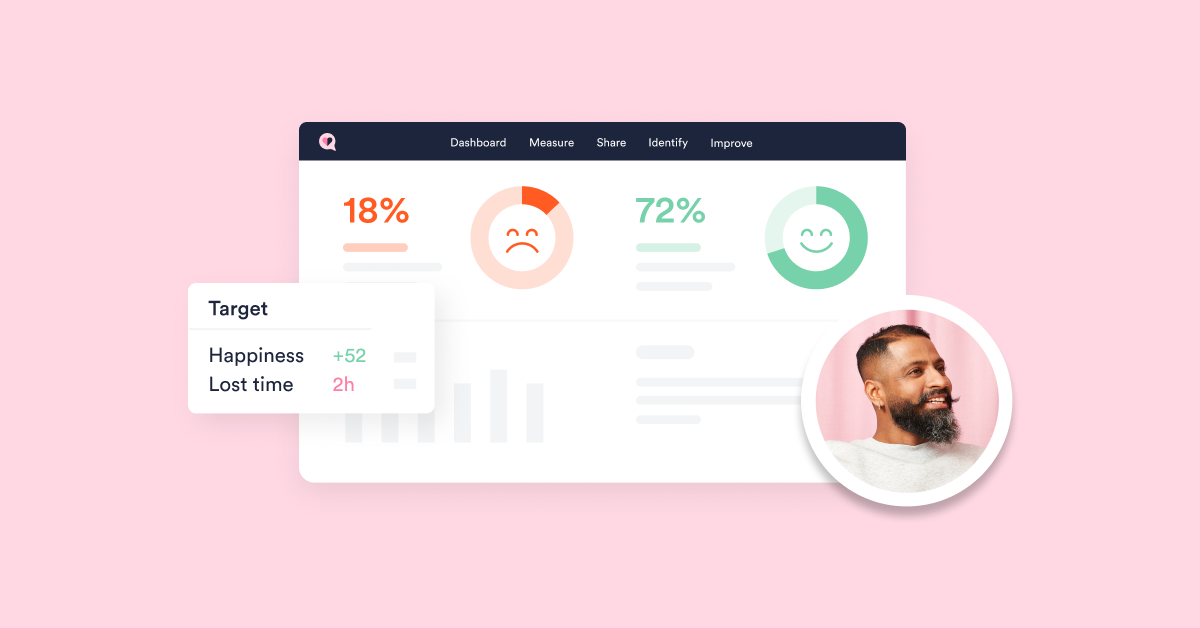
Experience data is end-user or employee feedback collected at the point of IT or service consumption. It’s their perception of the service delivery or support experience. HappySignals collects two key data points – an experience rating and the employee’s perception of lost time (productivity). These data points highlight various otherwise hidden IT service delivery and support capabilities issues. For example, traditional IT performance metrics might show that employees increasingly use the corporate IT self-service portal. It seems like significant progress. However, the experience data shows that employees lose more time with self-service than other channels and receive a worse experience.
If the collected experience data is from people rather than technology-focused tools, the experience management approach can also be applied to other business functions.
Examples of experience data and insights driving IT and business improvement
The use of experience management data not only allows service providers to identify (end-user-perceived) issues, but human-centric experience data collection also highlights what matters most to the end-users. Allowing your IT organization or other business functions, such as the Human Resources (HR) department, to focus their improvements and future strategies using data rather than gut feelings. This is what our customers are already doing, and examples of their successes include:
- Increasing end-user happiness by addressing the issues that adversely affect their experiences
- Significantly reducing the employee lost time by focusing improvement on the biggest causes of employee productivity issues
- Increasing end-user feedback response rates versus traditional customer satisfaction questionnaires to provide a more accurate view of service provider performance
- Making the business case for enterprise service management (ESM) or other changes to the IT or other business function status quo
- Consolidating duplicate or overlapping tool capabilities, which could be in IT or other business functions, with the decision based on experience data
- Flexibly prioritizing work based on experience feedback – for example, giving a higher priority to Finance tickets at the end of the month based on reported experience issues
- Training support agents to recognize support profile personas based on how end-users are engaging, allowing the end-users to feel they are really heard and to receive better experiences
- Transitioning from services being developed in silos to a shared view of experience that’s more holistic
- Prioritizing and tracking the impact of automation projects based on end-user experiences, including the use of artificial intelligence (AI)
- Making data-driven decisions related to strategies, improvements, funding, etc. – for example, only closing the email support channel once the portal channel receives better employee feedback
- Targeting negative employee IT experiences and lost productivity during personal-technology refresh programs
- Managing the introduction or changing of a managed service provider (MSP) – where experience scores usually drop, but experience data helps quickly correct the situation
- Proactively driving new automation opportunities – services where people are happy and don’t lose time are perfect for automation
- Using Office Environment and Remote Working experience data to identify where employees are most productive and losing time due to poor IT or issues controlled by other business functions.
So, if your organization is looking to start, or is already in, its experience management journey, come to our session and visit our stand to hear about customer successes and see the “art of the experience management possible.” Or find out more about us on our website.
By Sami Kallio, HappySignals CEO.
Meet the HappySignals team at stand 451 at SITS, The Service Desk & IT Support Show, on 17-18th April 2024, ExCeL London. You can now register for your free ticket here.
9 insights from crafting an enterprise-grade AI assistant
Transitioning an AI demo to production is a daunting task, requiring months of effort and expertise, particularly in enterprise contexts. While creating a demo AI might seem straightforward, the journey to production is quite complex. Most off-the-shelf solutions don't meet specific enterprise needs, necessitating extensive customization and refinement.
Enterprise challenges with AI adoption
Enterprise adoption of AI presents unique challenges, especially in sectors requiring accuracy and factuality beyond marketing and content generation. Compliance requirements in industries like healthcare and finance demand precise handling of data, making it difficult to rely solely on generic AI solutions. Additionally, some tools may not align with immediate enterprise needs due to privacy concerns and data sensitivity.
Generative vs Extractive approaches
Generative AI approaches, while effective in many scenarios, face limitations in enterprise use cases. Issues like rephrasing and hallucination hinder their applicability, particularly in delivering factual FAQ-like answers. In such cases, an extractive QA approach or traditional information retrieval solution may be more suitable.
Implementing Guardrails in Production
Implementing guardrails in production is essential to ensure accuracy and compliance. Enterprises require a layer for fact-checking, data verification, and sensitive information handling. Guardrails you build must include mechanisms for fact-checking, data verification, and data visibility segmentation to meet enterprise standards.
Layered Data Ingestion Approach
Handling diverse data formats requires a layered approach to data ingestion. Combining new tools like Azure Form Recognizer with traditional methods like web crawlers enables comprehensive data handling and processing.
Optimizing Production Processes
Optimizing production requires advanced techniques such as meta-data enrichment and auto-eval for accuracy monitoring. These techniques ensure the reliability and performance of AI systems in real-world scenarios.
Load Balancing for LLM APIs
Load balancing for LLM APIs is crucial due to provider rate limits and potential network outages. An LLM API load balancer monitors health and reroutes requests to ensure seamless operation.
Auto-Evaluation Frameworks
Auto-eval frameworks are essential for detecting improvements or failures in LLMs due to model updates. These frameworks enable continuous monitoring and adaptation to ensure AI systems remain effective and up-to-date.
Product Readiness Considerations
Product readiness considerations extend beyond prompt engineering to encompass input protection, dynamic prompt programming, and monitoring of LLM query latency. Various tools and models, including Microsoft Presidio for data protection and Azure OpenAI for embedding and summarization, are utilized to ensure robust and reliable AI applications.
Importance of Software Engineering
Building production-ready AI apps requires significant software engineering expertise, with AI being just a small part of the process. DevOps and Platform Engineering are essential for ensuring scalability, reliability, and performance in real-world deployments.
We hope this helps you in your own AI journey. All the best from Team Atomicwork.
By Kiran Darisi, CTO, Atomicwork
Meet the Atomicwork team at stand 595 at SITS, The Service Desk & IT Support Show, on 17-18th April 2024, ExCeL London. You can now register for your free ticket here.

The Future is Now: How Enterprise Service Management(ESM) and AI are Redefining Service Delivery
In a recent industry report, 72% of businesses identified departmental silos as a major hurdle in delivering a seamless customer experience. As the ESM Practice Head, I've witnessed first-hand the frustration these silos can cause for both users and service providers.
Enter - Enterprise Service Management (ESM). ESM builds upon the strong foundation of ITSM, extending its focus beyond the IT department to encompass all service functions within the organization. Think of your organization as a network of interconnected services, each playing a crucial role in the overall user experience. HR, facilities, marketing – these are all integral parts of your business functioning smoothly. ITSM, often focuses solely on internal IT infrastructure. ESM steps in to bridge this gap with its comprehensive strategy that manages all your services under a single umbrella. Imagine HR onboarding seamlessly integrated with IT support for new hires, or facilities repair requests working hand-in-hand with managing marketing automation tools. The benefits? Streamlined service delivery, faster incident resolution, and most importantly, a happier user experience across the board.
Jira Service Management: The Platform for Putting ESM into Action
Implementing ESM requires a central platform. Jira Service Management steps up, providing a comprehensive environment to unify your service delivery efforts. It gathers data from all departments, giving you a clear picture for data-driven decisions and optimized service desk operations. Moreover, as your organization embraces ESM, Jira Service Management leverages this comprehensive service data to provide even more intelligent recommendations and insights. This translates into a more efficient and proactive service operation.
Unlocking the Power of AI in Jira Service Management
By harnessing the power of AI, Jira Service Management has elevated its capabilities, enabling predictive analytics, automated incident resolution, and intelligent recommendations. AI's role in Jira Service Management is not just about automating tasks; it's about augmenting human intelligence, enabling teams to anticipate needs, streamline operations, and offer unparalleled service quality by:
- Automating repetitive tasks:No more wasting time on ticket routing, incident classification, and initial troubleshooting. AI can handle these repetitive tasks, freeing up your service desk team to focus on complex issues and provide exceptional customer support.
- Predictive maintenance, not reactive fixes:Imagine AI analyzing past data to identify potential service disruptions before they even occur, minimizing downtime and keeping business operational.
- Empowering users with smart self-service:AI-powered chatbots provide instant answers to frequently asked questions empowering users to help themselves and deflects simple tickets from the service desk, keeping things efficient.
- Deeper User Insights Through Sentiment Analysis:AI can help analyze user feedback to pinpoint improvement areas, deepening understanding of user satisfaction for continuous service enhancement.
Revolutionizing Service Delivery with ESM and AI
ESM offers a holistic approach, breaking down silos and fostering collaboration across the entire organization. AI integration in solutions like JSM promises to further revolutionize service delivery through automation, proactive maintenance, and enhanced self-service capabilities. By embracing ESM and AI, organizations can ensure a future of efficient, streamlined service management that delivers exceptional user experiences.
By Valiantys
Meet the Valiantys team at stand 135 at SITS, The Service Desk & IT Support Show, on 17-18th April 2024, ExCeL London. You can now register for your free ticket here.

Speaker Q&A: Simone Jo Moore
Top 25 Thought Leader Simone, pushes boundaries. A well known IT practitioner, she is Editorial Director of the Era of Humanising IT and Youth Rise in Power docuseries. Her OCM/HR experience brings together the technology of the human brain, emotional agility and the digital journey in adapting to Humanising IT and ethical/emotion AI.
Learn more about Simone before she takes to the stage at SITS to deliver the seminar ‘Sassy CHAOS’ and joins the panel 'Post Office – A National Scandal: What can we learn from IT?'.
1. How did you get into the profession?
I became involved as a natural evolution of service. A brief snapshot is going from being a soldier in the Australian Regular Army to various national management and support leadership roles in serviced offices, communications and media organisations and eventually combining my HR, OCM and complementary health practitioner expertise as a consultant, trainer, eventually becoming the Business Development and Training director of an IT industry body. It’s been a wide and varied experience across multiple industries which is a source of great inspiration and resilience building.
2. What do you enjoy most about what you do?
Most of what I do is about standing at the edge of what’s happening yet remaining in the current day-to-day and helping others move into their next space. There is an immense joy in seeing their wonder turned into a practical reality. Something they can sense, feel, touch and express in their experiences and achievements.
3. What’s your most memorable work moment?
When I think of the most memorable, I think of the most impact. There have been a number of them and the impacts have been both disastrous as well as successful. Given the focus on empathic leadership, I’d like to mention one of the most surprising.
Even now, it is rare and an issue for IT Team leaders or first time managers to be given guidance in people matters, specially in regards to our administrative care and burden for our people. The word ‘burden’ not meant in a negative facet but one of responsibility both legally and morally.
It became apparent through the weekly reviews in our probation training program, one of our Service Desk Analyst’s was not going to achieve the final grade of assessments. We discussed this openly in our coaching sessions, not just the performance specifics but also about her focus and career.
A good human, she really tried but in our final assessment meeting, she came to her own realisation it wasn’t the type of role for her. She knew in that meeting we were ready to let her go. We provided her with the avenues she could use to follow her path and said our farewells. As I walked her to her car, her box of personal things in hand, she put them down and although in tears, unexpectedly she gave me the biggest hug and thanked me for the opportunity, the time and guidance I had given her. Firing someone is never easy, but it is the first time I’ve been thanked for doing so. We should always be as helpful to people as they leave as we are in brining them in.
4. What are the key points you’ll be covering in your seminar session at this year’s SITS?
It’s a first time collaboration with my industry colleague, Vawns Murphy. We both have a long history in this space and are excited to bring to the audience something a little different. With a title like Sassy CHAOS, it’s a twist to the mindset and adventure of what’s happening with the relationship between machine and human facets. You can expect a cocktail of both thought leadership and practical focus.
5. Where and how do you see generative AI transforming ITSM operations in the next three years?
GenAI in ITSM is already here. From SelfService developments, chatbot buddies to AI colleagues, the design and integration into our everyday is a combination of wonder and cautious optimism as well as mitigating the fear of the risks. A wondrous adventure!
6. What are you looking forward to the most at SITS?
It’s been a few years since I’ve had the opportunity to be at SITS so my expectations are much higher than previous visits. The reasoning being that the tech has taken a few leaps and bounds since then so I’m quite intrigued to see in person the vendors present what's new, what's the same, what's the most extraordinary evolution of the technology out there to help us do what we do.
I’m very excited to be exploring my network as I’ll find new industry colleagues, catch up with old ones, and meet some virtual ones face-to-face for the first time. It’ll be a butterfly wave of interesting conversations and learning something new. This year’s speaker program certainly has a good mix.
See Simone speak at SITS, The Service Desk & IT Support Show, on 17-18th April 2024, ExCeL London. You can now register for your free ticket here.

Mastering ISO 27001 deployment with IT Service Management tools
What is ISO 27001?
ISO 27001 is a modern data security standard establishing rules for an Information Security Managed System (ISMS). It guides you in defining the security scope, managing risks, controlling access, evaluating the system’s performance, and more. This article explains how popular ITSM tools can help you with that.
Why use ITSM tools?
Incident Management
Managing incidents is one of the mandatory ISO 27001 requirements. Companies need to keep track of breach events and weaknesses in order to solve and learn from them quickly and effectively. And with certain types of infractions, authorities and affected parties must be informed.
An ITSM tool serves as an incident tracking system that allows you to report, evaluate, resolve and archive security breaches. Coupled with an on-call alerting feature that briefs your service operators immediately when such an event occurs.
Risk Management
A major part of ISO 27001 is assessing and mitigating risks. You need to constantly monitor your IT systems for new threats and vulnerabilities, decide how to treat them, and document these actions. The service management tools allow you to log these potential risks as tickets, which is crucial for identifying and assessing them.
Change management
Change management is another important aspect of ISO 27001 – changes to the ISMS must be documented, assessed for risks, approved by the relevant stakeholders and tested before being deployed into the production use.
This process is well supported by popular ITSM tools’ predefined, ITIL-compliant change tracking workflow. You can assign approvers that will assess and authorize the change.
Access management
This module covers the need for an access control process defining how permissions are granted or revoked. The goal of this is to ensure only the authorized people can access the necessary systems..
ITSM tools make this as transparent and simple as possible. Access requests and revocations are kept as tickets with a clear description and audit trail, making access is granted to authorized personnel only.
Automated Audits
Periodically reviewing your IT systems for new threats, correct access rights, an accurate scope and compliant assets is necessary for your information security to stay in top shape. Automation is the stronghold of many ITSM tools. They help to create tasks for IT security stakeholders at regular intervals as a reminder of upcoming ISMS reviews, automating a crucial part of the ISO 27001 implementation.
Collaborative Documentation
Keeping clear documentation is necessary for ISMS systems to work. You need to track your risk assessment processes, the scope of the ISMS, results of treatment actions and auditing results, along with the points we mentioned previously for each of the modules.
Some Service Management solutions provide a documentation platform, which can easily work as a knowledge repository for this purpose – it keeps all information about your systems in one place.
Conclusion
ITSM solutions, can support all the important ISO 27001 modules and provide a platform for continuous improvements
By Kamil Beer, VMotion IT Solutions
Meet the VMotion IT Solutions team at stand 175 at SITS, The Service Desk & IT Support Show, on 17-18th April 2024, ExCeL London. You can now register for your free ticket here.

Slash support costs in half with our Generative AI helpdesk
In the last years, employee support costs have soared to record highs: the average helpdesk ticket cost is $26.51, a 30% increase vs two years ago, leading to greatly increased operational costs. The Mean Time to Resolve has increased to 9.72 hours, while the days tickets are backlogged are an average 12.1 now – resulting in high downtime costs. This is just a preview of how much agents’ and employees’ productivity hurts due to inefficient support – let alone the missed opportunities for revenue generation. Productivity loss ultimately leads to higher business costs, damaging the company’s profitability.
That’s why companies are now turning to Generative AI: AI-powered solutions offer instant employee support and enhance efficiency, reduce costs, and improve the employee experience. Let's delve into how Gaspar AI, our Generative AI helpdesk, can significantly cut the costs of your company’s employee support.
Eliminate Level 1 support issues
Gaspar AI automates the resolution of the most common issues faced by employees. From mundane tasks like password resets and account unlocks to more intricate matters such as accessing specific folders or editing email lists and groups, Gaspar AI ensures these L1 issues vanish into thin air, along with their cost. Our Generative AI helpdesk solution leads to significant savings in labor costs, as it promotes self-service solutions where there is no need for human support agents to intervene.
By instantly resolving 40% of routine issues via automation or by surfacing the most relevant solutions from various systems and knowledge bases, Gaspar AI empowers employees to address common requests independently. This not only reduces the burden on the helpdesk but also minimizes downtime and opportunity costs. For example, delays in resolving technical issues that can easily be autonomously addressed may prevent employees from accessing critical systems or tools, hampering their productivity and hindering business operations.
Maximize ROI on your existing investments
Investing in self-service resources is a common strategy for helpdesks aiming to empower employees and reduce ticket volume. Yet, without proper guidance, employees may still resort to submitting tickets for even the most basic issues. Gaspar AI addresses this issue head-on by meticulously combing through all available resources within the organization to provide tailored solutions. By leveraging existing investments in ITSM, Identity and Access Management systems, and knowledge bases through seamless integrations, Gaspar AI ensures that every support dollar yields tangible returns.
Offer 24/7 employee support at no extra cost
Unlike traditional human-operated helpdesks that work within specific business hours, Generative AI helpdesks are available round-the-clock. Employees can access support whenever they encounter an issue, no matter the time. This not only improves employee satisfaction by providing timely assistance but also reduces the need for additional staff to cover extended support hours, cutting all related costs.
At the same time, it helps reduce downtime costs: every minute of downtime due to IT issues can result in lost productivity and revenue for businesses. By offering instantaneous responses and 24/7 availability, Gaspar AI minimizes downtime and its associated costs. By resolving issues quickly and efficiently, it helps companies maintain operational continuity and avoid the financial repercussions of extended downtime.
Streamline the ticket lifecycle
Gaspar AI accelerates the entire ticket lifecycle even for complex issues requiring expert attention. Our AI chatbot facilitates handoff to human agents: it helps users create a ticket by simply filling in a form on Slack or MS Teams, and then routes it to the right agent, alongside with any useful information and categorization. It sends notifications when needed and allows end users and helpdesk agents to follow up and check the status either on the ITSM platform or on Slack and Teams, until the ticket is resolved. This automation helps close the tickets faster, and minimizes the time and resources spent on escalations, resulting in cost savings for companies.
Take command of software spend
The inefficiencies surrounding software licenses can lead to significant financial waste for large companies. Gaspar AI empowers organizations to take control of their software spend by provisioning licenses instantly, just by requesting it from our Virtual Agent. It also accelerates the process of obtaining the necessary approvals and helps reclaim unused licenses. This approach not only reduces costs but also ensures that employees have timely access to the software they require to excel in their roles.
Scale employee support with no additional spend
Gaspar AI’s Generative AI helpdesk offers scalability and flexibility to adapt to changing business needs and fluctuating support demands. Whether supporting a small team or a large enterprise, our AI-powered platform can efficiently handle a high volume of support requests without compromising on quality or performance. This scalability ensures that companies can effectively manage support costs without sacrificing service quality or needing additional headcount.
By Marilena Nikou, Senior Marketing Manager, Gaspar AI
Meet the Gaspar AI team at stand 484 at SITS, The Service Desk & IT Support Show, on 17-18th April 2024, ExCeL London. You can now register for your free ticket here.

SymphonyAI’s Gen AI-First Design Evolution
User-led design in combination with predictive and generative AI, creates a high-performance combination rarely seen in vertical software applications.
The core value proposition of predictive and generative AI is speed and increased accuracy of decision-making to drive a wide range of productivity improvements. This concept has universal appeal across all industry verticals, but realizing the benefits is led through innovative design-thinking approach to ensure users can harness and be delighted by the powers of AI.
As AI has disrupted the way we think about interacting with data and technology, SymphonyAI has brought the same pace of innovation to its user experience philosophy, allowing for highly usable innovative experiences. Through design-thinking methodology, initially established at Stanford’s d.school, a short walk from SymphonyAI’s headquarters in Palo Alto, the SymphonyAI design team looks to solve true industry problems using AI integrated into the UX/UI and workflow versus simply putting AI onto a product.
The backbone of SymphonyAI’s product design strategy is a well-established design system, providing all industry product teams a core set of components. These components also accelerate development time and consistency across product suites.
As generative AI gathered momentum throughout 2023, because SymphonyAI embraced a design system approach, it was able to launch highly usable and focused industry copilots at a rapid pace. The first SymphonyAI copilot, for financial crime investigators, was released in April 2023 and is a benchmark in the industry not only for being one of the first enterprise AI copilots available, but as a tool that seamlessly connects to investigator workflows, supporting their needs through AI.
We at SymphonyAI believe it shouldn’t take a data scientist with an advanced degree to realize the benefits of increasingly powerful predictive and generative AI solutions. The technology’s complexity should be upstream from users who can intuitively execute commands and achieve results regardless of their skill level. This view underscores the reality that the value creation potential of AI technology is proportional to its ease of use and accessibility to those of varying skill levels.
Mobile-first to Gen-AI-first
Once mobile devices went from a second screen to a primary way to interact with many applications, designers adopted a new philosophy of ‘mobile-first design’, with focus on the primary experience on mobile and secondary larger web experiences from that. This was a revolution in the design industry, allowing many innovative mobile experiences to take the forefront. Today, we are in the transition again, where generative AI can create new content and screens on the fly. This new way of working and thinking is quickly elevating to be a primary experience path. With that priority, SymphonyAI’s UX team is bringing a new generative AI-first approach to design. Primary workflows assume and use an AI approach, allowing us to compose functions and screens and transform the way we think about creating dashboards and workflow tools.
Accelerating the adoption of AI automation
SymphonyAI’s creation of a design system and the application of design thinking to product development elevates our industry leading capabilities, to simplify how workers interact with predictive and generative AI. Through a set of frameworks that have been validated through end-user testing, the goal is to have AI infused across out entire product portfolio with flexible and intuitive interfaces, helping users to quickly understand complicated data and drill into it for insights and recommendations.
As mentioned previously, one example of this generative AI-first approach is the Sensa Copilot for financial crime investigators. The interface uses the natural language capabilities of generative AI to capture investigator queries. AI results are brought right into the user flow to serve up the highest relevant information to the user at the exact right time.
By Jonathan Carpenter, SymphonyAI
SymphonyAI will be exhibiting on stand 178 at SITS, The Service Desk & IT Support Show, on 17-18th April 2024, ExCeL London. You can now register for your free ticket here.
Employee helpdesk trends in 2024: what to expect
As we step into 2024, the world of employee helpdesks is undergoing a transformative wave, driven by cutting-edge trends that promise to redefine the way we approach workplace support. Let's dive into the exciting trends shaping the future of employee helpdesk services and explore the possibilities that await.
AI Excellence: The rise of Intelligent Assistance
AI isn't just a buzzword anymore; it continues to revolutionize the employee helpdesk landscape, becoming an indispensable ally for internal support teams. In 2024, we anticipate a surge in the adoption of AI-powered solutions that go beyond routine ticket resolutions. These advanced AI systems leverage natural language processing (NLP) and machine learning to provide more personalized, human-like interactions, enhancing the overall support experience. Imagine an AI companion streamlining processes, offering data-driven insights, and contributing to operational excellence. It's not just employee support; it's a strategic business enhancement.
Proactive issue prevention: Anticipating needs before they arise
A notable trend is the shift towards proactive issue prevention. AI algorithms are becoming adept at analyzing historical data to predict potential problems, allowing employee helpdesk teams to address issues before they escalate. By leveraging predictive analytics and machine learning, employee helpdesks can identify patterns, foresee potential disruptions, and implement preventive measures. This not only minimizes downtime but also contributes to a more stable and reliable IT environment.
Cybersecurity vigilance: Safeguarding business integrity
With the increasing frequency of cyber threats, employee helpdesks are reinforcing their commitment to cybersecurity. In 2024, a key trend is the integration of robust cybersecurity measures within AI-powered systems. These measures ensure the secure handling of sensitive data, fostering a digital environment where employees can trust the helpdesk to protect their information. From encryption protocols to real-time threat detection, the focus is on creating a secure and resilient workplace support infrastructure. It's about safeguarding the essence of the business.
Large Language Models in the business lexicon: Taking center stage
Large Language Models (LLMs) are stepping into the limelight as crucial assets for professional communication. These sophisticated language models, often built on advanced deep learning architectures, are becoming integral to enhancing the capabilities of AI-driven helpdesks. They transform tech jargon into articulate natural language. In 2024, the integration of Large Language Models represents a paradigm shift in how AI-powered employee helpdesks understand, process, and respond to user queries. This trend not only enhances the user experience but also solidifies the position of AI helpdesks as intuitive, efficient, language-savvy assistants in the dynamic world of tech support.
LLMs at the forefront of issue resolution automation
In 2024, we also anticipate an increased role for Large Language Models in automating employee issue resolution. These advanced language models will capitalize on extensive knowledge bases, past ticket resolutions, and historical data, enabling them to provide more efficient, accurate, and personalized responses. LLMs are set to empower employees, allowing them to swiftly and seamlessly address their concerns, thereby alleviating the workload on human support teams.
Further embracing the Cloud
A noteworthy 2024 trend in employee helpdesk evolution is the further migration to the Cloud. By harnessing cloud-based solutions, employee helpdesks are poised to offer enhanced scalability, accessibility, and flexibility. This shift ensures that support services can adapt seamlessly to the dynamic needs of modern workplaces, providing a more agile and efficient support ecosystem.
The role of the CIO expands
CIOs and IT Managers are taking on transformative roles. Beyond traditional IT oversight, they now serve as strategic innovation advocates, driving technological advancements for efficiency and growth. Embracing data as custodians, they leverage it to provide strategic insights. As cybersecurity guardians, they protect against evolving threats. Facilitating seamless remote work, guiding digital transformations, and fostering collaborative cultures, these leaders embody a multifaceted approach crucial for navigating the complexities of the AI age.
By Marilena Nikou, Gaspar AI
Gaspar AI will be exhibiting on stand 484 at SITS, The Service Desk & IT Support Show, on 17-18th April 2024, ExCeL London. You can now register for your free ticket here.

4 Ways the Service Catalog Benefits ITSM for Remote Employees
The traditional workplace setting has gone through a seismic shift, with an increasing number of employees working remotely. As of 2023, Forbes Advisor states that 12.7% of full-time employees work remotely while 28.2% work in a hybrid environment. This number is expected to grow exponentially by 2030.
While companies benefit with remote work models, it is also important to ensure a smooth, intuitive employee experience with ITSM systems to prevent challenges like unplanned downtime, employee frustration, and lack of a communication process when incidents occur or service requests need to be made.
ITSM software combined with a service desk provides a centralized system for incident management, change management, IT asset management, etc.
Many ITSM and service desk providers take this a step further with the Service Catalog, to enhance the employee experience—vital for business success–and streamline service provision processes for IT support staff and help desk agents.
Companies such as Cisco, Slack, Atlassian, GitHub and Dropbox are all popular users of the Service Catalog for their remote workforces.
Here is how the Service Catalog enhances remote employee experience:
- Provides a centralized platform for access to services
The Service Catalog provides a list of all software applications and hardware allocated to each employee for clear visibility and transparency.
It also includes a list of available services that the employee can access and benefit from ranging from hardware, software installation, and access requests and more.
This enables the employee to easily browse and choose the services they need without having to explore different platforms. The catalog also provides service descriptions and service level expectations to ensure remote employees are equipped with all necessary information to choose an appropriate service and plan their work effectively.
- Offers tools to strengthen cybersecurity
The Forbes Advisor states that 73% of executives believe that remote employees pose a more significant cybersecurity risk.
The Service Catalog can include services and tools to prevent and counter vulnerabilities and strengthen cybersecurity protocols for remote workers such as VPNs, antivirus software, user-behavior analytics tools, etc.
This can ensure that a cybersecurity culture prevails and organizational data and devices are safe and used securely.
- Facilitates self-service
The Service Catalog can reduce the burden on IT support staff by enabling self-service for some specified services. Instead of requesting IT support staff to provide access or to install a certain software, users may have immediate access when choosing the service in the catalog, expediting the process and providing a seamless user experience.
- Improves visibility and transparency
With the Service Catalog, employees can track and view the status of their requests, measure progress, and can easily receive updates to ensure that they are fully aware of where their request is in the support process.
This transparency improves communication, strengthens motivation, and fosters a culture of trust and collaboration.
The employee experience is vital to business success as it is directly linked with morale, productivity, retention, and then spills into the customer experience. Invest wisely in your employee experience!
By Anam Jalil, EZO
EZO will be exhibiting on stand 481 at SITS, The Service Desk & IT Support Show, on 17-18th April 2024, ExCeL London. You can now register for your free ticket here.