



Organizations are shifting rapidly to implement AI in the enterprise to improve operational efficiency, productivity, and the customer experience. In 2024, organizations invested $252.3 billion in AI, yet the impact is mixed. While most organizations see positive financial impacts, most reported cost savings of less than 10 percent and revenue increases below five percent. Forward-looking leaders aren’t asking if agentic AI will reshape their business, but how they can prepare their service operations environments to deploy it safely and effectively.
Agentic AI relies on continuous, high-quality context and predictive and casual AI insights. Collectively, these capabilities enable agentic AI systems to observe and explain system behavior in real time, and recommend remediation plans effectively. This in turn helps human IT teams make better decisions.
Context in agentic AI
For an agentic AI agent, context is far more than just the user input. It is the full operational environment that the AI agent uses to reason and coordinate and execute complex workflows. Context allows AI agents to make decisions that go beyond simple rules.
An AI agent triaging an application performance issue, for example, will use context about the relationship between the application and the supporting infrastructure, log insights, recent deployments, and knowledge articles before acting. This requires reconciliation of application,network, and infrastructure topology, which is very difficult to do. Starting with a strong service modeling strategy—the practice of creating a service infrastructure model that stays up to date in real time—provides teams with a single source of truth for end-to-end observability. The first step is to ingest topological data from sources across your environment, including third-party monitoring tools such as AppDynamics for application topology discovery and mapping.
Our world-class BMC Helix Discovery product continuously identifies and catalogs all hardware, software, and services in your environment. This includes servers, storage, network devices, container platforms like Kubernetes, and cloud services from providers like Amazon Web Services (AWS) and Microsoft Azure. Next, the topology reconciliation capability merges all of your ingested data into a single, unified model of your service environment. Reconciliation identifies differences in topology reports and standardises element names and relationship representations. What began as a group of disconnected topology reports is merged into a unified model that clarifies dependencies and relationships.
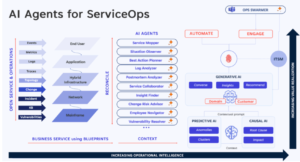
Figure 1. BMC Helix’s multi-agent system approach for reducing service downtime in ServiceOps environments.
After reconciliation, dynamic service modeling uses blueprints to build the data structure of the services, including information about configuration items (CIs) and their relationships. These modeled services provide critical context for AI to perform root cause analysis, continuous optimization, and continuous compliance. Service models also allow site reliability engineers (SREs) or DevOps engineers to pinpoint an application performance degradation to the network interface flapping.
Building on predictive and causal AI
Building on the predictive and causal AI capabilities of BMC Helix AIOps extends its foundation of historical data and machine learning (ML) to generate advanced insights, simulations, and recommendations. Integrating causal reasoning limits or eliminates hallucination and the use of outdated information. This helps agentic AI systems deliver consistent, precise, and reliable outcomes that are easier to trust, explain, and verify in real-world applications.
Causal AI is a branch of ML that emphasizes the understanding of cause-and-effect relationships versus solely processing patterns in data. Causal AI integrates knowledge-graph-based and transformer-based AI techniques to understand and model relationships across telemetry data variables. Casual AI can reason about casual relations or patterns using topological data. A knowledge-graph–based causality analysis analyzes how causal relationships change, depending on how the variables influence one another. This is crucial because, without causality, AI agents will not perform well in dynamic environments.
On the other hand, predictive AI uses historical data, ML, and statistical algorithms to forecast potential issues like performance bottlenecks and capacity shortages before they disrupt services. By integrating with predictive AI, agentic systems can use forecasts to act, often correlating a series of actions to complete the task, like optimizing cloud capacity based on resource shortage prediction.
Context and a composite AI approach
The next step in AI requires a composite AI approach that complements agentic AI with predictive, causal, and generative AI. We expect enterprises to deploy ecosystems of large language models (LLMs), knowledge graphs, and predictive and causal models that architecturally augment each other to create capable agentic AI systems.
Enterprises looking to deploy AI agents must have strong IT service and operations management (ITSM/ITOM) capabilities and accurate data to extract value from AI agents, including:
- CMDB: Make sure your configuration management database (CMDB) is accurate.
- Reconciliation: Ensure your reconciliation rules are protecting your CIs.
- Service models: Provide domain-specific knowledge as input to the AI pipeline.
It’s also important to have enough surrounding information to understand why systems are behaving the way they are, like knowing that high latency in service A happened right when service B released a new version. Without that context and a composite AI approach, AI agents won’t be effective digital partners.
Written by ServiceOps.