


How THG manages over 200,000 requests without skipping a beat
THG unified service delivery across IT, HR, warehouse, and facilities, handling 200,000+ tickets from a single platform.
THG Ingenuity is a Manchester-based, end-to-end e-commerce technology and services provider that enables brands to scale globally. Through its core solutions, THG Commerce, THG Fulfil, and THG Studios, it partners with leading international brands such as Nestlé, Coca-Cola, and LOOKFANTASTIC.
As operations scaled rapidly, the tools supporting THG's service delivery failed to keep pace. Since IT and other business teams like HR, finance, warehouse, and facilities worked from their own mailboxes, it resulted in requests getting lost, duplicate tasks, and disjointed collaboration. And as request volumes grew, delays became inevitable and requests slipped through the cracks. It was clear that its service delivery needed to evolve beyond its legacy tools.
One platform for the whole business
True to its culture of experimentation and solution-first thinking, THG looked beyond short-term fixes. It needed to standardize how work moved across teams, adapt to peak demand, and extend seamlessly beyond IT into the wider business. ServiceDesk Plus provided that foundation, supporting both internal teams and external clients from a single, unified platform.
IT makes the first move
IT became the first function at THG to pioneer a more structured path to service excellence. No matter how employees reach out, whether through email, phone, SMS, or the self-service portal, all requests are now funneled into a centralized system. Every internal request is tracked, assigned, and resolved in one place, giving teams complete visibility into each request's lifecycle. Incoming requests follow end-to-end workflows that enforce clear standard operating procedures by stage-gating the entire request lifecycle.
Other business verticals are quick to follow
As the IT team demonstrated clear ROI, other functions quickly saw the broader potential. HR saw immediate value in enhancing onboarding workflows, while the warehouse team recognized its ability to bring structure to high-volume operational requests. Seeing it in action encouraged finance and facilities to move away from mailbox-driven processes and come on board too.
Two things were critical when unifying service management across the business: enabling effective collaboration across teams, and recognizing that a certain level of siloing was essential, especially for sensitive data such as their HR and payroll information.
To make this expansion possible, the IT team built autonomous instances for each business vertical. Each department could use a unified platform but still operate independently with its own workflows, service catalogs, and data access, maintaining strict data segregation.
Excellent service delivery for external clients
THG works closely with a diverse range of third party brands, which meant it needed to extend the same service standards to its external clients too. But when clients needed help, there was no efficient way to funnel those requests into a centralized system. They came in through scattered emails and informal channels, and THG's account managers had to bear the brunt of these requests, capturing details manually.
This all changed when THG started to use ServiceDesk Plus in conjunction with Zoho Desk, Zoho's customer support software, integrating the two with Zoho Flow. Client requests raised in Zoho Desk now get logged automatically into the service desk, where internal teams handle execution. ServiceDesk Plus remains the system of action, with all status updates and ticket closures automatically synchronized back to Zoho Desk, so clients stay informed without account managers switching tools.
Quicker and error free joiner, mover, and leaver workflows
With a workforce of over 2,000 employees, joiner, mover, and leaver (JML) workflows are critical to day-to-day operations; the HR team alone handled close to 4,000 HR requests in a span of little over a year. Moving away from the emails and spreadsheets that had made this tedious and time consuming, THG streamlined its JML workflows. Employee onboarding is now enhanced end to end, from automating Active Directory user account creation and preparing hardware assets to provisioning the right access and privileges from day one, reducing manual errors and giving new hires a consistent onboarding experience.
Finessing their way through the festive frenzy
During the festive season, the sheer volume of requests and incidents can naturally spike, making efficient incident response more important than ever. When high-priority tickets such as P1 or P2 incidents arrive, a custom script automatically creates a problem record and links all the related incident tickets. Relevant Senior Leadership Team (SLT) members are pulled into the problem record to review and approve the IT team's post-incident reports, and if a report isn't approved, the workflow notifies the relevant team members.
Change requests follow the same discipline, routed to the relevant approvers and implemented stage by stage through structured workflows. But during peak trading periods such as Black Friday, even small changes, if not carefully managed, can open a whole new can of worms and trigger cascading issues. To mitigate this, THG has configured conditions that prevent any changes from being approved without SLT review during these scheduled windows.
The team has also given itself room to experiment, using the platform's code generator to create low-code scripts for custom functions without heavy development effort.
Looking ahead
By improving visibility and accountability, THG has shifted from reactive service management to a structured, proactive approach that supports the diverse needs of teams from IT and HR to warehouse and facilities.
THG runs its service operation on ManageEngine ServiceDesk Plus. To see how it supports service management at scale, visit servicedeskplus.com.


McLaren Racing announces Freshworks as an Official Partner of the McLaren Formula 1 Team
Freshworks (NASDAQ: FRSH), today announced a multi-year partnership with McLaren Racing, joining as an Official Partner of the McLaren Formula 1 Team. McLaren has integrated Freshworks' ITSM solution, Freshservice, to boost productivity through more efficient and improved IT services within the team.
With AI-powered Freshservice, the McLaren Formula 1 Team is able to ensure its global IT operations run smoothly by addressing service requests quickly and seamlessly, even when spread across the globe during a busy race season – eliminating complexity and driving operational efficiencies across all aspects of the team.
Freshservice supports McLaren’s IT team to reduce tech-based issues so the team can maximise its efforts on performance on the track. Efficient and uncomplicated processes reduce friction and allow the team to resolve issues and deliver services faster.
Freshworks branding will feature on both McLaren Formula 1 Team race cars and the team kit for the remainder of the 2025 season and beyond – starting with this weekend’s Belgian Grand Prix.
Zak Brown, CEO, McLaren Racing, said, “Boosting our efficiencies off the track is a key factor in improving our performance on it. With industry-leading partners such as Freshworks, we’re able to do just that, and I’m delighted to welcome them to the team.”
Dennis Woodside, CEO, Freshworks, said, "We partner with McLaren Racing to optimize their IT operations, enhancing their critical support for winning performance. Our enterprise-grade solutions are designed for ease of implementation, use, and configuration, accelerating McLaren IT's capabilities with AI. We’re proud to deliver intuitive software that directly supports their mission to eliminate complexity on and off the track."
By Freshworks

Why every ITSM team needs an AI coach
As AI becomes more embedded in IT service management (ITSM), many organizations discover that technology alone isn’t enough. AI’s true value depends on how well it’s integrated, maintained, and aligned with human workflows. This is where the AI Coach comes in — a role quickly becoming essential for delivering reliable, effective AI-driven services.
The AI Value Gap in ITSM
Recent studies, like the 2024 Total Economic Impact™ (TEI) report from Atlassian and Forrester, show that AI can deliver major benefits:
- 30% reduction in ticket handling time
- Up to 55 minutes saved per incident for IT ops teams
- Higher customer satisfaction thanks to faster, more accurate service
These results stem from tools like Atlassian Intelligence and Virtual Service Agents powered by generative AI. But without the right human structures in place, organizations often face a gap between AI’s potential and its real-world performance. Common challenges include:
- Outdated knowledge bases
- Poorly configured AI outputs
- Lack of trust in automated responses
- AI providing technically correct but unhelpful answers
What Is an AI Coach?
An AI Coach isn’t yet a common job title but is increasingly recognized as a critical function. This role blends responsibilities from knowledge management, automation strategy, and service design. Key responsibilities include:
- Curating and maintaining knowledge bases for AI training
- Designing intent flows and conversation models for virtual agents
- Monitoring AI outputs and continuously improving response quality
- Ensuring compliance, governance, and responsible AI usage
- Acting as a bridge between service agents, developers, and automation tools
- An AI Coach ensures AI doesn’t just function — it adds value in real-world contexts, aligned with organizational processes.
Who Can Take This Role?
Many organizations don’t need to hire a new person immediately. The AI Coach role can often be added to existing positions such as:
- Knowledge Manager
- Service Desk Lead
- Automation Engineer
- ITSM Process Owner
- Platform Owner (e.g., Jira or Confluence)
- AI Product Owner or Conversational Designer
The most important step is assigning clear ownership for AI quality, training, and continuous improvement.
Why This Role Matters Now
Organizations are under constant pressure to improve service speed, reduce costs, and scale efficiently. AI can help, but without someone responsible for managing it, AI tools risk becoming underused or even distrusted. An AI Coach ensures that AI-powered solutions evolve alongside business needs rather than stagnating after implementation.
Getting Started
Building AI coaching capability doesn’t require a massive transformation. Many organizations begin by identifying someone already passionate about knowledge management, process improvement, or automation. A simple maturity model can guide progress:
1. Ad-hoc: AI is active but unmanaged.
2. Emerging: Someone starts tracking usage and quality.
3. Structured: AI Coach responsibilities are formalized.
4. Optimized: AI is tuned continuously based on feedback and data.
Final Thought
AI in ITSM isn’t about replacing humans — it’s about augmenting them. The AI Coach plays a vital role in ensuring that AI delivers on its promises, enabling faster service, better experiences, and more efficient teams.
By Magnus Sundset, Eficode

SITS 2025: “Engaging talks, insightful discussions, and fantastic vendors”
Over 6,000 attendees were welcomed back to SITS – The Service Desk & IT Support Show and the MSP Show on 14-15 May at Excel London.
With a visitor increase of 18%, this year’s edition was the busiest in SITS history.
SITS boasts the only free ITSM education programme in Europe, made up of seminars, panels, Breakfast Briefings and Hot Topic workshops.
Being the largest event in Europe focused on IT Service Management, 75+ ITSM vendors showcased the latest IT service solutions, aiming to enhance the efficiency of IT Service Delivery.
‘My first time attending SITS and I’ll definitely be making it an annual trip’
Event Director, Alice Fulton said “It’s fair to say that this was our best show yet! There was a real buzz with people excited to make connections, learning about the evolving industry and discovering new products.”
Event Director, Alice Fulton said “SITS has a long and successful history of being THE show for ITSM professionals, and this year not only lived up to all expectations but knocked them out of the park!”
‘I gained practical knowledge on the latest tools, technologies and techniques in service desk management’ 
The exhibitors ranged from big name brands to start-ups, including Freshworks, Hornbill Valiantys, TOPdesk and ManageEngine.
Services covered by exhibitors covered everything from SIAM and security to asset management and data analytics.
Visitors had the chance to get personalised demos of the latest ITSM tools, have all of their questions answered and compare service offerings.
“SITS is an awesome ITSM event. All the big-name vendors were present showing their latest AI features. I can't wait to attend next year!” commented Andrew Hopkins, Application Services Vice President, Epiq.
‘SITS left me with new ideas and broadened perspectives’
 The packed seminar programme was delivered across four theatres and was full of practical takeaways and industry updates. Speakers from across the country shared their knowledge, fresh perspectives, and new technologies.
Topics covered everything from agentic agents and problem management to security and automation. As well as the challenges affecting day to day life, including workplace culture, mental health, time management, resilience and diversity.
“The range of seminars was fantastic, and we gained valuable insights. I attended with two colleagues; we split up to attend as many talks as possible. Each of us returned with positive takeaways and meaningful discussions to share.” Commented Deborah Jones, Support Case Manager and Escalations, KHIPU Networks Limited.
‘The MSP Show is revolutionary’ 
The second edition of the MSP Show took place alongside SITS, and welcomed 1,700+ attendees, double the number of seminars and 80+ exhibitors.
“The show has a brilliant mix of exhibitors; everyone has been busy learning about their products and solutions and how they can bring value to your business. And the seminars provided unmissable knowledge to help you grow your business.” Said Dan Scott, IT Nation Community Director – Europe, The IT Nation / ConnectWise.
SITS – The Service Desk and IT Support Show, and the MSP Show take on the Netherlands 
SITS and the MSP Show Netherlands will take place at the world-renowned exhibition venue, Jaarbeurs in Utrecht on 16 September 2025.
The two new one-day events, which will be co-located, will showcase the latest technology on the market alongside unrivalled education and training sessions, specifically tailored to the ITSM and the rapidly growing Managed Service Provider community. It will harness the experience, connections, and knowledge from the flagship London event, but to a completely new Dutch audience.
SITS, The Service Desk & IT Support Show and the MSP Show are back 13-14 May 2026 at Excel London.
Join the mailing list to find out more.

The Hidden Cost of Staying in Disconnected Systems for MSPs
In an MSP environment, service providers must respond quickly to critical issues.
But here’s the irony: the very tools designed to help service providers deliver exceptional services can sometimes be the reason their services aren’t up to par. For many MSPs and MSSPs, one of the greatest challenges is managing multiple client environments, each with different service desk portals, workflows, and practices.
This leads to missed tickets, duplicated information, miscommunication, and hours wasted on manual updates. In an industry where minutes matter, such behaviour can be risky.
So, what’s the solution?
Leading MSPs fix this with smart integrations. By connecting their platform with their customers’ platform, both parties work in their native environments, while updates sync automatically. No jumping between portals or getting forced to use unfamiliar systems.
This improves response times, reduces errors, and allows teams to focus on solving real problems, not chasing down information.
Imagine a client reporting a threat in Jira Service Management (JSM) portal that needs to be logged in the MSP’s ServiceNow. With integration, the ticket triggers an automatic, high-priority incident in ServiceNow, starting the MSP’s response workflow without delays or errors.
With time, this setup starts to grow consistently within the MSP ecosystem. What begins as a point-to-point integration evolves into a network of connected systems spanning organizations and geographies. Plus, MSPs can customize the integration for each client separately while maintaining control over their environment.
As clients experience the benefits, they request more integrations, turning MSP services into a scalable hub.
This is how the network effect kicks in, where each new client integration becomes easier to replicate. As more clients connect, the network’s value increases, creating a classic network effect in motion.
And here’s where things get interesting: some MSPs no longer treat integrations as just a means to improve their services, but package them into their service offerings, opening new revenue streams.
Also, positioning integrations as a service differentiates them from competitors and adds value to their portfolio.
But before diving in, a few essentials:
Assess if your current systems are integration-ready
Choose integration tools that allow client-specific customization
Make security and compliance non-negotiables
Integration tools like Exalate connect multiple systems and can tailor integrations to client needs. With script-based, AI-powered setups, MSPs can ensure real-time sync across platforms like Jira, ServiceNow, and more.
Learn how QuorumCyber improved their average incident response and resolution time using Exalate.
In fact, some of our clients saw a 60% rise in service desk integration demand from both existing and new customers.
Yes, there are challenges to this setup like security, compliance, and contractual obligations. But, for high-growth MSP environments, the payoff is significant.
So the real question isn’t whether integration is worth it. It’s: what’s the cost of not doing it?
In the MSP industry, where rapid response defines success, the ability to connect, automate, and scale systems becomes a must-have.
It’s time to rethink whether your existing tools are helping you respond faster or are quietly slowing you down.
By Teja Bhutada, Exalate

Can ITIL Problem Management Really Reduce Incidents?
Key takeaways
- IT incidents are unexpected disruptions or reduced quality in IT services.
- IT problems are the underlying causes that may give rise to several incidents.
- Efficient problem management identifies and resolves larger IT issues, reducing incidents caused by them.
- Workarounds can be used to reduce the impact of incidents or problems before they can be fully resolved, helping to maintain service and uptime while working on a permanent solution.
- While ITIL problem management can significantly reduce incidents in many cases, it cannot prevent or fix all incidents. That’s why problem management and incident management should work side by side.
- Proactive problem management is a key part of overall problem management. Incident records are analysed to identify potential problems or trends that may lead to problems. This enables IT teams to reduce the impact of problems before they occur.
- The IT Care Center platform integrates problem and incident management to provide a more proactive and comprehensive solution for IT incidents in an organization.
For IT agents, incidents are a fact of life.
Around 20% of organizations have more than 20 IT incidents per day. At the same time, 70% of businesses get 100 or more ‘warnings’ every day about dangers that could lead to potential incidents.
As the saying goes, “an ounce of prevention is worth a pound of cure”. Whenever possible, it is better to prevent incidents before they strike rather than fix incidents after they occur.
Of course, many incidents can’t be predicted or prevented. But many can. That’s where problem management comes into the picture.
How are “problems” and “incidents” related to one another?
In the ITIL framework for IT service management, problems and incidents are separate concepts but closely related.
An incident is an unplanned disruption to an IT service or a reduction in the quality of an IT service. For example, if a user’s email service is down, the IT agent must resolve the incident quickly to restore service. This is “incident management”.
A problem is the underlying cause of an incident or several incidents. The cause is usually unknown at the time. A problem record is created, and the problem management process begins.
Problem management entails identifying and resolving the root cause, ensuring that future incidents are prevented. For example, if an email service outage occurred because of a server misconfiguration, then correct reconfiguration would solve the problem that caused the incident.
A single problem often gives rise to multiple incidents. For example, a failing server might cause various services to go offline for multiple users. When similar incidents occur, it should trigger a problem investigation or root cause analysis to uncover whether a larger underlying issue is to blame.
Seen this way, it is clear that efficient problem management will go a long way to reducing the number of incidents.
How ITIL problem management affects incident rates?
Frequent or severe incidents can indicate the need for a problem investigation. For example, if users repeatedly say that website performance is low, the root cause may be inadequate server resources. In this case, increasing server capacity could solve the problem completely or relieve it to a certain degree. Once the problem is solved, it may even highlight other problems that were masked by the server capacity issue. This helps to reduce the incident rate even further.
Workarounds: Maximizing service while solving problems
A key aspect of problem management is to provide workarounds to incident teams to restore service while the root cause is addressed. Workarounds reduce or can even eliminate the impact of an incident or problem for which a full resolution is not yet available. For instance, restarting a failed configuration item could be a suitable workaround.
Workarounds are documented in “known error” records. A known error is a problem that has a documented root cause and a workaround. Problem management handles known errors throughout their lifecycle. Workarounds for incidents that do not have associated problem records are documented in the incident record.
Workarounds enable organizations to stay productive with minimal downtime, even when problems take a lot of time to resolve.
Proactive problem management: a step ahead
Proactive problem management is a process that identifies problems that might otherwise be missed, enabling IT teams to mitigate problems before they occur or escalate.
Proactive problem management analyzes incident records and uses data collected by other IT service management processes to identify trends or significant problems.
Incident management is key to enabling a proactive approach to problem management, providing invaluable data for root cause analysis of problems. Incident logs, error reports, and user feedback collected in incident management and response are critical to predicting and diagnosing problems and pinpointing the underlying cause of failure.
So, does problem management reduce incidents?
Bottom line: problem management does reduce incidents – not in all cases, but in many. To maximize the prevention and resolution of incidents, however, it is important to integrate problem management and incident management in responsive workflows. Problems and incidents are mutually related, and therefore, a streamlined and proactive approach will deliver the best results.
Reduce incidents with ITCC’s integrated approach
IT Care Center features all ITSM modules in one agile, low-code platform, including incident management and problem management, that are expertly integrated to ensure proactive problem management and streamlined reduction of incidents.
With ITCC, IT teams can identify which incidents are related to a specific problem and receive instant updates about a problem, including up-to-date statuses and available workarounds or solutions. ITCC’s problem management capabilities support in-depth root cause analyses based on comprehensive data, highly effective in reducing recurring incidents and minimizing the overall incident rate.
Looking to reduce incidents with an integrated approach to problem management and incident management? Talk to ITCC today.
By Michael Hayet, IT Care Center

The challenge of doing more with less
At some point, every organisation faces the daunting task of achieving more with the same or fewer resources. Whether driven by market pressures, regulatory requirements, or simply the need to refresh ageing products, this challenge is universal. It requires a thoughtful approach to ensure that resources are used effectively while still meeting customer needs.
Understanding value streams
In response to these pressures, many organisations are turning to value streams. This concept is centred around maximising the value delivered to customers, both external and internal. It starts by identifying customer needs and follows through to meet those needs efficiently.
The role of service management
Service management solutions are pivotal in helping deliver this value stream. The process can include gathering customer feedback, suggestions from employees, and channelling them into actionable ideas. In today's tech-driven world, IT often plays a critical role in this process, with developers creating new solutions that align with customer demands.
As a solution is developed, the role of service management remains a part of the process. Each release must be carefully controlled through effective change management. This ensures that every deployment, whether to production or test environments, is thoroughly controlled to prevent unforeseen issues.
Continuous improvement and incident management
Even after a solution goes live, the work isn't over. Organisations must track and address bugs and incidents, constantly refining and enhancing their offerings. This ongoing process is essential for delivering high-quality solutions that meet customer needs and expectations.
Leveraging service management solutions
Many organisations have already honed their service management practices over the years, often integrating established frameworks like ITIL or developing customised systems tailored to their unique needs. The key is to keep the customer's needs front and centre, ensuring that every action taken co-delivers value.
By investing in robust service management solutions, organisations can achieve a twofold benefit: they improve the efficiency of their value streams while also maximising the returns on their service management investments. It's a strategic approach that not only meets current demands but also positions organisations for future success.
On Wednesday 14th May at 11am at Theatre 1, Phill Fox will be looking into real-world examples of how you can use best practices to embed service management into value streams, boost efficiency and enhance customer satisfaction with service management.
See you there!
By Phill Fox, Adaptavist
What ITSM Professionals Need to Know About GenAI Capabilities
The IT service management (ITSM) world is consistently awash with trends related to new ITSM thinking and technology. Unfortunately, these trends often take a long time before they become mainstream in ITSM. However, generative AI (GenAI) is the exception. This has accelerated the existing ITSM interest in AI capabilities, with the most technology-capable ITSM tool vendors and their customers adopting new GenAI capabilities at an unprecedented rate in the history of ITSM evolution.
This blog covers much of what ITSM professionals want and need to know about how GenAI is changing the ITSM landscape – from what it is to how organizations already benefit from it.
ChatGPT played a big part in GenAI’s accelerated growth
Before getting into how GenAI is already helping organizations with “better, faster, cheaper” IT operations and outcomes, it’s worth understanding the drivers for the rapid adoption of GenAI capabilities for ITSM.
Before 2023, ChatGPT was relatively unknown, even though OpenAI introduced GPT-1 in 2018 and GPT-2 in 2019. The critical mass happened once ChatGPT was made public in November 2022 as a version of GPT-3.5. It allegedly achieved 100 million users within two months and was getting 2 billion monthly visits at its peak in April 2024.
More importantly than these numbers, ChatGPT did something for GenAI that technology doesn’t usually achieve. The global media brought the opportunity of GenAI to company board attention worldwide and raised GenAI up business to-do lists, including those of IT and ITSM leaders.
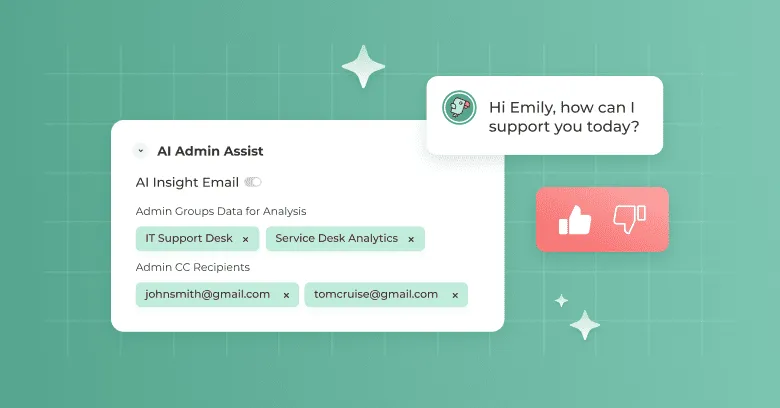
GenAI allows your IT organization to improve its IT service delivery and support capabilities. In particular, it offers native support experiences (rather than requiring end-users to search for support), 24×7 availability, speedier responses to end-user issues and needs, and the ability to scale IT capabilities without a corresponding uplift in staff numbers and costs.
What GenAI is and how it works
A key piece of knowledge for ITSM pros is the difference between traditional AI and GenAI. While traditional AI capabilities employ algorithms and models designed for specific tasks, GenAI capabilities employ models and algorithms to generate new data or content. These outputs are generated via algorithms that learn patterns and relationships in the input (training) data and use the learned patterns to create new data or content.
GenAI systems employ advanced neural network architectures. For example, the transformer-based model that’s used for ChatGPT. Here, ChatGPT uses large language models (LLMs) to learn linguistic structures, patterns, and facts to generate human-like text. In delivering a response, it predicts the next word in a sequence relative to the input prompt using what it learned.
The term Copilot has been adopted to describe using GenAI capabilities through assistive technologies. For example, SysAid offers a Copilot for Agents and a Copilot for End Users.
How GenAI is being embedded into ITSM tools
GenAI capabilities have been rapidly added to some ITSM tools, including SysAid ITSM. Example GenAI capabilities that are already available to customers include:
- GenAI-assisted workflow automation. A good example is IT service desk ticket triage, where a GenAI Copilot automatically classifies, prioritizes, and routes tickets to the right resolution group. GenAI can also offer a solution for some issues and requests.
- Self-service simplification. GenAI-powered chatbots handle basic requests like troubleshooting connectivity issues or guiding software updates, empowering users to resolve common problems independently. These chatbots can be embedded within work collaboration systems such as Microsoft Teams.
- Judgment-free assistance. Create a safe space for users to ask questions they may feel embarrassed to pose to human agents, such as “How do I reset my email signature?”
- Focused content creation. For example, creating ticket summaries, drafting knowledge articles for human verification, and composing contextual email responses to end-users.
- Employee augmentation. Augment IT service desk agent knowledge, skills, and experience. The GenAI capabilities serve up real-time recommendations (knowledge and actions) to the agents to help speed up ticket resolution and effectiveness.
- Better performance management capabilities. Provide regular automated updates to IT leadership and service and support staff on team and individual performance relative to agreed targets.
- Automated device health checks. Track endpoints and undertake diagnostics to identify and potentially address end-user device issues.
- Automated incident clustering that exposes new insights. For example, the GenAI capabilities automatically correlate similar incidents to identify problems that might otherwise go unnoticed.
- GenAI escalation management. Predict whether incidents or requests will breach their SLA targets, escalating such tickets to appropriate personnel.
- Actionable analytics. Provide insights such as performance predictions, improvement recommendations, and service level agreement (SLA) breach forecasts, ensuring proactive incident management.
While these examples might be viewed as opportunities for better outcomes and faster operations, GenAI capabilities can also lower operational costs.
What ITSM professionals need to do to get started with ITSM GenAI capabilities
The availability of these GenAI capabilities is all well and good. However, ITSM professionals must ensure they and their peers are suitably prepared for adoption and use.
Activities to consider in doing this include:
- Sell the opportunities of GenAI. Educate people on how GenAI will enhance ITSM capabilities (such as the opportunities outlined above) and that they will help across “better, faster, cheaper” IT operations and business outcomes.
- Understand your current opportunities. Assess the GenAI capabilities available in the current corporate ITSM tool or platform. As I’ve said before, not all ITSM tools are born the same – with GenAI capabilities a new differentiator.
- Focus on value. Identify and prioritize the areas where GenAI can bring the most value to ITSM operations and outcomes. This is key regarding time to value and gaining buy-in from end-users through demonstratable benefits.
- Implement governance and ethical standards. Ensure that GenAI models are transparent and auditable and reduce the risks of bias or non-compliance with regulations. Data security and privacy experts will also need to be involved.
- Start small. Run GenAI pilot projects to test its effectiveness – with feedback loops used to improve incrementally. These pilots help refine the GenAI implementations, prove the benefits, and help ensure smooth integration with existing workflows.
- Provide suitable training. People must know how to interact with GenAI systems – from interpreting AI-generated data to implementing offered recommendations. They must also know the limitations and the potential for issues.
To learn more about the GenAI opportunities in ITSM, take a look at our SysAid Copilot solution.
By Jasmine Chiu, SysAid
Meet the SysAid team on stand 531 at SITS, The Service Desk & IT Support Show on 14-15 May 2025 at Excel London.
Xurrent’s C5 attestation strengthens data protection
C5 attestation includes security controls assessment across multiple domains, including organization, cryptography, physical security, and operational security.
What makes C5 particularly important is its focus on transparency about where data is processed and stored, which is crucial for companies operating under EU data protection laws.
C5 also:
Examines organizational processes, technical controls, and physical security
Produces detailed reports that organizations can share with customers/stakeholders
Requires independent third-party auditors to verify all required controls and security measures have been met
If you are a current (or future) Xurrent customer, you’ll want to keep reading.
Why ITSM customers should care about C5 attestation
If you care about …
Cloud security.
Compliance.
Operational resilience.
Data protection.
… then C5 attestation is a big deal.
1: Enhanced security & compliance: Customers, especially those in regulated industries (see finance, healthcare, retail, government, etc.), can confidently use Xurrent, knowing it continues to meet high-security standards.
2: Stronger data protection & privacy controls: Since C5 is aligned with European GDPR and other stringent regulations, Xurrent customers can be assured of strong data integrity, strict confidentiality, and high availability. This includes controls for encryption, access management, logging, and monitoring — all to protect customer data.
Note: BYOK in Xurrent is a significant enabler of this attestation.
3: Simplified risk & compliance management: Since C5 attestation is a trusted validation of security controls, the burden on customers for conducting vendor security assessments on C5 attested companies is significantly reduced.
4: Increased trust & transparency: Thanks to Xurrent’s commitment to transparency and security documentation, aligning with the C5 framework gives customers and prospects unified and consistent visibility into our security measures. This also reduces the possibility of third-party risks.
5: Stronger business continuity & Incident Management: Xurrent is known for our simplified Incident Management processes. With C5 attestation, Xurrent customers can now be even more assured of our high service availability and reduced risk of disruptions.
6: Alignment with international security standards: Many Xurrent customers operate across multiple jurisdictions. With C5 attestation, customers can be assured of Xurrent’s commitment to seek compliance with European and international security regulations. C5 maps closely to other global security frameworks, including ISO 27001, SOC 2 Type II, and FedRAMP.
Security is paramount at Xurrent
We take our commitment to security, data protection, and privacy very seriously.
As we share here, the protection and privacy of customer data is our #1 operational priority. They are key to our customers’ success as well as our own.
C5 attestation means that an external auditor has verified that Xurrent’s security controls “were suitably designed and implemented to meet the applicable cloud computing compliance criteria (C5).”
Xurrent customers shouldn’t have to worry about its ITSM platform being secure.
We’ve done the hard work of meeting these strict security requirements so you can focus on what you do best — running your business.
By Jim Hirschauer, Xurrent
Meet the Xurrent team on stand 521 at the MSP Show and SITS on 14-15 May 2025 at Excel London. Register for free here.

Modern Service Management: Start Fast, Scale Smart
It’s no secret, today’s organizations are under pressure to do more with less. Whether it’s delivering seamless employee experiences, automating internal services, or simply running more smoothly behind the scenes, expectations around service delivery have changed dramatically.
While IT teams have long had systems to manage incidents, requests, and changes, other departments like HR, Facilities, and Finance are now facing similar challenges. They’re handling high volumes of requests, juggling approvals, and trying to keep up with growing service demands.
This shift is pushing many organizations to rethink their approach—not just to IT, but to service management overall.
It Starts with a Simple Question: “What If We Could Do This Better?”
That’s how it often begins.
Someone in IT realizes their tools are outdated or too complex. HR wants a better on-boarding process. Finance needs transparency in budget approvals. Teams are solving similar problems using disconnected systems, siloed workflows, and inconsistent processes.
That’s when Enterprise Service Management (ESM) comes into focus.
Rather than limiting service management to IT, ESM expands the model across the business ,giving every team, from HR to Facilities, tools and structure to manage services effectively. Most importantly, it creates a consistent, intuitive experience for the people relying on those services.
Start Small, Move Fast
A common misconception about ESM is that it requires a massive, organization-wide overhaul. In reality, successful transformations often start small, with a focused pilot that delivers quick, visible results and sets the tone for broader change.
Introducing the Service Management Accelerator.
Think of it as a Launchpad; a way to deploy a minimum viable product (MVP) targeting high-impact service areas without the overhead of a full rollout. Instead of transforming everything at once, you begin with key priorities like:
- Handling IT incidents more efficiently
- Streamlining equipment or access requests
- Building a modern self-service portal
- Automating repetitive tasks
- Gaining quick insights through basic reporting
This accelerator approach gets you running in weeks-not months, delivering real value early while minimizing complexity.
It also creates a working model of great service delivery, something teams can see, use, and rally around. It’s not just a better ticketing system, it’s a demonstration of what connected service management looks like.
Why Accelerators Work
Accelerators go beyond speed, they build scalable foundations.
You’re not just replacing systems. You’re introducing smarter ways of working. By proving early impact, you gain:
- Stakeholder buy-in (results, not just roadmaps)
- User adoption (intuitive design and benefits)
- Clarity on what works and where to improve
You also learn about your data, processes, and pain points before scaling further.
From Momentum to Transformation
Once the foundation is in place, broader ESM becomes much more achievable.
HR can manage onboarding. Facilities handle maintenance requests. Finance creates transparent approval workflows - all aligned to a shared goal: making work easier. The tools help ,but it’s the structure that enables scale, control, and continuous evolution.
Start where the value is obvious. Build where momentum is strong. Scale where impact multiplies.
By Valiantys
Meet the Valiantys team on stand 241 at SITS, The Service Desk & IT Support Show on 14-15 May 2025 at Excel London.