

Three Key Employee Experience Insights from 2022
Most IT organisations are under pressure to meet business needs better and increasingly need to deliver more while reducing costs. To help, HappySignals recently released The Global IT Experience Benchmark: H1/2022 Report, which includes a wealth of insights into the employee experience of various aspects of global IT service management (ITSM). It’s based on the operations of, and improvements made by, HappySignals customers. So, while the data and insights are helpful, an organisation that’s new to experience management needs to remember that these averages reflect a mix of experience management journey states – from the organisations just starting to those “a few years down the road”.
So, hopefully, you’ll click through to read the full report to see where other organisations are identifying issues and addressing improvement opportunities. If you’re unsure about what the report covers, here are three key employee experience insights from this latest data set.
How The Global IT Experience Benchmark Report is created
The Global IT Experience Benchmark: H1/2022 Report data is collected from HappySignals customers, including large enterprises and managed service providers (MSP) who use the HappySignals Platform with their customers. All the feedback responses are from IT end-users (employees) and reflect their feelings and perceptions about IT.
This latest report shows the findings and analysis based on 840k end-user experiences with IT.
Employee experience insight #1: Incident-related employee lost time is unevenly distributed
If you’ve read a management book, you might have encountered the Pareto Principle. This principle states that for many outcomes, roughly 80% of consequences come from 20% of causes (the “vital few”).
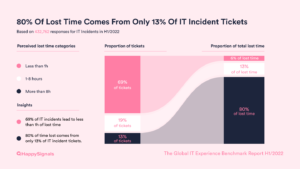
The Global IT Experience Benchmark: H1/2022 Report identified something similar for incident management – that 80% of the perceived employee lost time (caused by incidents) comes from only 13% of tickets (based on 433k pieces of feedback). The chart below shows not only this but also that 69% of tickets account for just 6% of perceived lost time.
This situation has changed slightly over time, as shown in the chart below.
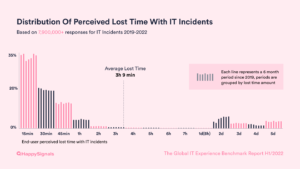
The Global IT Experience Benchmark: H1/2022 Report chart offers other interesting insights. For example, the high level of incidents with only 15, 30, or 45 minutes of lost time. So it’s also important to appreciate that the perceived lost time average doesn’t reflect the typical lost time. Or the growth in incidents that are perceived to incur two days of lost time and the polarisation of perceived lost time across the scale.
However, in interpreting this data, it’s important to understand that the way end-users report their lost time is on a non-linear scale that starts with greater granularity of choice. This scale can be experienced in this demo feedback form.
An interesting consideration of this polarisation is whether the experience data goes against the traditional incident priority and resolution-time matrices such as:
- P1 = 4 hours
- P2 = 8 hours (one day)
- P3 = 24 hours (three days)
- P4 = 40 hours (five days)
Resolution times might either well exceed these service-level targets (in the main) or fail to hit them, but perhaps few are close to the right side of the targets. However, the HappySignals insight relates to perceived lost time data rather than the logged resolution-time data. Nonetheless, it’s still worth checking via your ITSM tool and with end-users as to whether the agreed priority-based service levels are still relevant.
However, the big question is “Why?”, i.e. why the lost time feedback is distributed like this. Currently, we don’t know the answer and need to undertake more analysis. It could be that once a service-level target is breached, there’s no incentive for a service desk analyst to resolve that incident quickly. I’m told this is a little like the British late-running-train theory where an already-delayed train is delayed even further because on-time trains are given priority and allowed to pass it to ensure they aren’t late too. But right now, this is just a hypothesis that we need to investigate further.
Plus, this insight doesn’t differentiate the feedback based on incident priority. For example, understanding the percentage of P4 incidents resolved within an hour or P1 incidents that take longer than two days to resolve would add valuable insight (including to the causes of the above lost-time distribution).
So, what do you think are the likely causes of these extreme perceived delays in resolution? Please let me know.
Plus, is this view representative of your organisation’s incident backlog? Perhaps with delayed incidents waiting on problem management activity for a resolution or workaround.
Finally, do you currently have the capabilities to understand how your end-users lose time to incidents and in the IT support they receive? I’d be willing to bet that things differ from what your traditional IT service desk metrics tell you.
Employee experience insight #2: Employee remote-working experiences are improving
If, like many organisations, your Human Resources (HR) department elected to continue the opportunity for employees to work remotely post-pandemic, do you know how this impacts employees? Whether from an employee productivity or wellbeing perspective, or how IT service delivery and support capabilities are either helping or hindering employees as they work from anywhere.
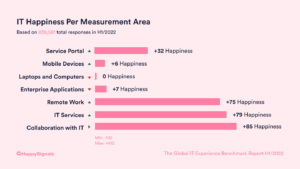
At the outset of the pandemic, the HappySignals Platform added the ability for customers to gain insight into employees’ issues and experiences when working remotely. The H1/2022 feedback dataset offers valuable insights into the IT contribution to employee remote working – with this a high-scoring IT area (as shown below). Our customers have also increased employee happiness with remote working from +60 to +75 over the past year.
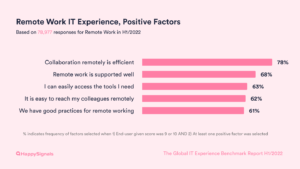
But the granular report data offers the most helpful insights – showing what’s working well, and not so well, for remote-working employees. It’s also indicative of what might be most important to them. The chart below shows the positive factors that influence good experiences.
While the next chart shows the negative factors that cause poor experiences.
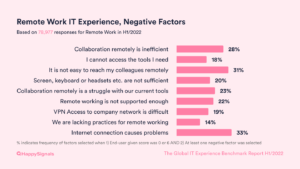
It’s interesting to see collaboration capabilities high in both lists. But it’s important to appreciate that there’s no one-size-fits-all approach to how IT teams can optimise remote working for their organisation’s employees.
The only way to find out is by collecting data directly from your own end-users. For example, employees may have different needs in different locations or work in areas where the internet access and cultural differences make remote work more or less challenging.
So, now that remote work is normalised in many regions, IT teams can use experience data to find pockets of improvement to optimise remote work for all employees and specific groupings with issues.
Employee experience insight #3: Geography is important with employee experience
The dangers of looking at averages in isolation highlighted earlier (with the perceived lost time data) can also be extended to demographic-based factors. For example, an organisation’s size and industry vertical. However, one of the most interesting insights relates to geography.
Previously, The Global IT Experience Benchmark Report showed analysis by country, but for the H1/2022 edition, we took a region-based view to highlight the differences (and feel free to contact me to access the country-based data and deltas).
As shown in the chart below, some regional differences are significant. For example, Western Europe has by far the lowest Happiness score. But, they also have the lowest level of perceived lost time (caused by IT incidents). Or when North America and Africa are compared, the Happiness scores are close – +77 and +78, respectively – but end-users in Africa perceive that they lose close to 2.5 hours more time than their North American peers (and are still slightly happier than their North American peers).
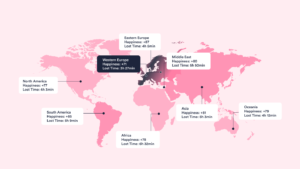
This chart (and the data that feeds it) highlights the impact of geography and culture on employee experience, which organisations need to bear in mind when aiming to improve their scores. For example, Western European organisations would struggle to get close to the Eastern European Happiness high of +87 from their current +71 score. Or viewed differently, an organisation in Brazil with a Happiness score of +79 might celebrate beating the global Happiness score of +77 until informed that the South American average is +85.
If you would like to understand more about The Global IT Experience Benchmark: H1/2022 or how experience management will help your IT organisation, please view the full report here.
By Sami Kallio, Happy Signals


The what and why of service management – and what it needs to be successful
Why does an organisation need to understand what service management is, what it does and what it achieves when done well?
This has been a recurring question over the past 10 years, not least with the arrival of newer models such as DevOps and Agile and the general ‘digital’ revolution.
To get straight to the point, effective service management is about running technology in a business-focussed way – to keep the organisation running and including managing business continuity, integrity, risk and efficiency.
Despite increasing use and promotion of automation, Service Management remains necessary and vital as a means of managing delivery of technology, to guide, identify and review performance and value, and provide governance. Therefore, service management is still a critical business function; and although delivered primarily by IT, its governance needs to be a joint IT and organisational responsibility.
Of course service management (ITSM) can also be about wider enterprise management (ESM), whereby the discipline straddles the organisation; led by IT in many cases, but not restricted to the IT department.
What service management isn’t
A common misconception about service management is that it’s just a set of processes, revolving around the service desk and IT support: perceived as a response to failure rather than helping an organisation attain optimal business performance.
Any good engineer will tell you that – when building something new – the greatest value is created by understanding how people will use what you build and how it will be delivered day to day.
In service management, you need to consider how something will run once built and this involves much more than a service desk, an IT tool and processes.
Deriving value from service management
Above all, service management is focused on achieving what is expected of an IT product/service, which may include allowing an organisation to transact or a public sector service to deliver against its charter. So, if you’re spending 20% of turnover on IT, you want to know that it’s delivering what it should.
For the people at the receiving end of the product/service, that means an improved user or customer experience and more successful business outcomes. The emerging new and vital concept is experience management, which applies also to the people delivering the product or service – employee experience is becoming increasingly recognised as a key element.
And an emerging issue is innovation: this is about service management helping people to work better by, for example, the service desk moving from a basic ‘break-fix’ function to an enabler for people to improve their work environment, experience and performance.
In each facet of its role, service management is about bringing out and understanding the human element – something that, until the arrival of more recent models such as ITIL 4, hadn’t really been defined in the IT service management lexicon.
Service management in practice
If service management is about seeing the “big picture”, this means viewing the whole, end-to-end delivery of a service or a particular delivery activity.
But how does that differ from the status quo?
Many organisations have created silos around processes, such as the service desk, incident management, problem, change, etc. Unfortunately for them, issues don’t happen according to siloed processes.
Instead, if the understanding of an organisation’s target operating model extends across the enterprise, then service management that operates throughout allows people to see their work in context: i.e., what’s coming towards you and what comes after you in the value stream.
This requires that people and organisations see service management as a collaborative venture, all being involved in design and build as well as run, operate and respond.
The capabilities for modern service managers
If you’re going to collaborate, you must be interested in what’s happening around you.
And that involves having good relationship management people bridging the gap between IT and its customers; managing demand and engaging with people to understand their technology needs now and in the future. The value is then derived from capturing feedback and any good/bad experience.
These relationship-driven people are good communicators, flexible and adaptable to working with different people/stakeholders across an organisation and with the ability to apply business skills, including sales; finding opportunities and working with people to build trust and offer solutions.
What does success look like in effective service management?
Service management is a creative activity and definitely something that should be noted for the value it delivers. Without undue exaggeration, it keeps the business world running; for that along it deserves kudos.
The Covid-19 pandemic has brought home the way in which service desk and operations professionals support people’s work lives, especially when working from home.
And increasing collaboration between service management and development means that both disciplines can innovate and collectively decide what will work in the customer’s best interest.
Effective service management should be visible and understood among senior leadership. this requires good skill to translate operational and technical information into business contexts and simple messages – however this is a vital activity in order to garner support and increase visibility at the C-level.
Cultivating the right culture
Good service culture is about assembling the right, diverse mix of people to stand a better chance of meeting the needs of the diverse people they serve – understanding who your customers are and how to relate to them.
But culture also comes very much from the top. The tradition of senior leadership using a command and control approach has, mostly, had its day. Instead, the principle of servant leadership – in which management is there to enable people to be successful – has shown itself to be far more empowering.
ITSM22: getting back together again
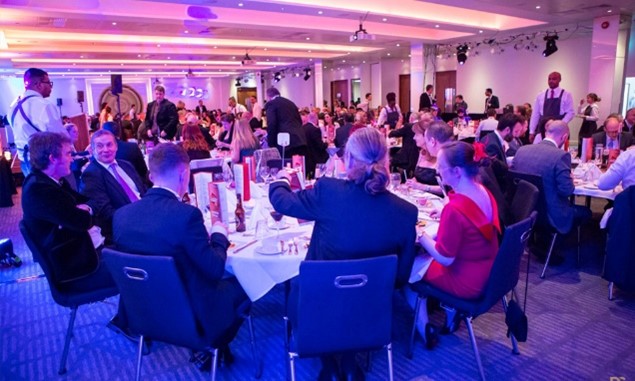
There’s mounting excitement in the service management community about the return of itSMF UK’s in-person annual conference, after two years online during the Pandemic.
Taking place this year on 14-15 November at the Madejski Stadium, the home of Reading FC (two of the breakout rooms overlook the pitch!), the conference offers an unparalleled range of topics across three tracks, exploring every angle of practical service management.
Despite the convenience of Zoom, nothing compares with the face-to-face experience, and at ITSM22 the emphasis will be firmly on networking and interaction. We know that not everyone will be comfortable with close contact in a post-COVID world, and that’s why we’ve introduced or traffic-light badges to let others know whether to greet you with a hug or an elbow.
But whether you wish to mingle or keep your distance, we’ll be providing every opportunity to interact with other attendees. From the informal reception when you arrive on Sunday evening, to our panel discussion on skills and new talent and themed tables at lunchtime, ITSM22 is all about two-way communication.
We’re very pleased to welcome Linda Moir as our opening keynote, a great motivational speaker with a passion for inspired customer service. Among other things, Linda has served as head of Event Services for the London 2012 Olympics, was employed by Virgin Atlantic with a remit to “make flying fun”, and helped steer NATS from public to private ownership. So look forward to a thought-provoking start to day 1!
One of the highlights of ITSM22 is the wide range of case studies and war stories from our corporate members. We have subject matter experts from organisations as diverse as Danske Bank (asset management), the Ministry of Defence (value stream mapping), Legal & General (value during a pandemic), BT Enterprise (problem management) and Vodafone (DevOps/ITSM integration). Then there’s Vitality (service agility), Kingfisher (journey to mature ITSM), cinch (service without the faff), DFS (putting people first), the Home Office (delivering new blue passports), Experian (portfolio management) and the University of Oxford (root cause analysis).
No service management stone is left unturned, as Roman Jouravlev brings us up to date on ITIL 4, Claire Agutter and Michelle Major-Goldsmith reveal the State of SIAM in 2022, Barry Corless helps us to penetrate the C-suite, Rob Akershoek focuses on hybrid management, and Suzanne Galletly asks whether AI will take away our jobs!
But it’s not all about the process and product. Several of our sessions consider whether we’re really looking after our people as well as we should. We hear from Katrina Macdermid on humanising IT, Claire Drake and Rosemary Gurney are back by popular demand to discuss mental health in the office, Helen Morris joins us to consider menopause management in the workplace, and Simone Moore covers living in ebb and flow – something that most of us have experienced over the last three years.
We are of course indebted to our sponsors – ServiceNow, PeopleCert, Happy Signals, CGI, KTSL, 4me and SITS – without whose support our annual gathering would not be possible. You can hear from them all in the course of the two days, as well as visiting them in the networking zone to find out more about their plans and directions.
Last but not least, the PSMA awards dinner will be back in its rightful place this year on the Monday evening of Conference. Once again our aspiring finalists in the Team of the Year, Service Innovation, Young Professional, Ashley Hanna Contributor of the year, and Thought Leadership categories will be gathering to hear the judges’ decisions. Check out the list of finalists and look out for their nomination videos on the website in the next few weeks.
We hope you can join us at ITSM22 and enjoy the in-person experience once again. Further details at https://www.itsmf.co.uk/itsm22/

From ITIL v3 to ITIL 4: A Collaborative Evolution
Almost exactly three years ago, ITIL 4 succeeded ITIL v3 in one of the biggest updates to the framework since 2007.
Since then, ITIL 4 – developed in response to the changing face of IT operations and service management – has brought things up to date by aligning with high velocity IT, delivering end-to-end services and taking a more holistic approach.
Looking back now, the launch of ITIL 4 couldn’t have been better timed. Those practitioners who have applied ITIL 4 principles to managing the impact of the pandemic have shown they were much better equipped to deliver strategic change at pace.
From hybrid working, through the introduction of eCommerce supply chains, adopting applications and the cloud, early adopters of ITIL 4 have had an edge; helping them remove the lines between IT and the rest of the business and create more agile ways of working.
Delivering high velocity IT needs a new partnership approach
While some companies have been agile enough to adopt and adapt ITIL 4, for many companies it takes time to transition from ITIL v3. The process of moving from owning processes to creating a service-focused value chain is an evolution. It’s not as simple as flicking a switch, especially true if your job roles and departments are named after processes from v3.
That’s why advocates of ITIL 4 agree that moving from ITIL v3 requires cross-functional collaboration, within and beyond the IT function, and broader stakeholder management.
This ensures that not only is IT delivering business change but that the change has a definite impact on the top line company strategy. IT is seen less as a cost by leaders, but rather a true partner and an enabler of great customer experience.
Creating a collaborative culture can’t be underestimated. In fact, ITIL 4’s guiding principle ‘collaborate and promote visibility’ is testament to this. When full transparency exists, people will continually think about the bigger picture and the overriding company goals - they feel valued and add value.
This is especially important today as people evaluate their career. People don’t want to be robotic; they want to know how their efforts fit into overall success and that it’s worth it. I’d go as far to say that investing in ITIL 4 is a way to retain talent and skills.
Adopt and adapt
It’s important to note, that every company is different and ITIL adoption works best when it is adapted. That’s why making the move to ITIL 4doesn’t necessarily mean leaving everything you know about ITIL v3 behind.
Evolving how you do things and adapting ITIL v3 principles to work with the best practice of ITIL 4 is still a valid approach. This evolution tends to happen naturally if you’re a service- focused organization.
But ITIL 4 supersedes ITIL v3 when companies are faced with the risks of delivering services quickly while optimizing costs. That’s because ITIL 4 provides both agility, structure and a safety net. You can move through iterations, even making mistakes in the process, but ensure they are ‘owned’ by the organisation and invisible to the customer. Service levels are far less likely to dip when building on strong service foundations and implementing remedies and new solutions that are based in continual service improvement.
Start where you are
I think the most important thing to remember, no matter where you are in the journey, is that ITIL 4 says ‘Start where you are’. Understand where you want to be and what you need to do. That mantra should always be considered regardless of how mature the company’s service management culture is.
Importantly, you must always set out to establish a shared vision between IT, HR, marketing, sales, customer service, finance, supply chain and so on – and ask how IT will support the functions in their quest to deliver an impeccable, end-to-end service to the customer. In short, what does the value chain look like?
Companies who invest in their people, including leaders, to complete an ITIL 4 Foundation level certification will tend to have a greater understanding of risk and how best quality services can and should be delivered. This embeds the value the ITIL framework and the expertise it gives them.
In turn, people throughout the company will make different and better decisions for the organization and ensure customers get the service they need and, more crucially, want to use.

ManageEngine ITSM survey shows shifting priorities for IT teams in the era of hybrid work
ManageEngine surveyed 437 IT professionals to understand how well organizations have coped over the now two-year-long pandemic, the impact on operations, and which factors have influenced success across a range of topics. This survey is a follow up to our 2020 survey titled "The state of ITSM in the COVID-19 pandemic."
This survey, titled "The state of ITSM two years into the pandemic," focused on seven key areas that relate to ITSM: work locations, the impact of employees working remotely, financial and asset management implications, the business view of IT, security and governance issues, third-party services and technology assistance, and business continuity success levels. The survey yielded key insights that can help organizations and teams continue to work efficiently and securely despite a distributed workforce.
Key findings from the report
Employees are better equipped: Compared to the beginning of the pandemic, an additional 47% of organizations are now providing mobile assets to employees.
IT teams see their value rise: Fifty-two percent of respondents think IT is now viewed and treated better because of the pandemic, and another 14% think IT has always been highly regarded.
BYOD policies are still absent: Two years after workplaces were totally disrupted, 40% of organizations still do not have a BYOD policy.
User experience falls short: Thirty-four percent of organizations still do not offer users self-help capabilities, and 52% do not have chatbots.
Read the full survey report here.
The Rise of ESM
ESM (a.k.a. Enterprise Service Management) sprang into the spotlight when people started realizing just how valuable ITSM was and wanted more of it. A service, after all, is a service—whether it’s for IT or not. And ESM extends ITSM practices to business processes, enabling you to:
- Standardize service delivery across the company.
- Improve service experiences for all functions.
- Increase service and support performance.
- Cut service costs and accelerate time to value.
But how does ESM actually work in the real world? What kinds of projects yield the highest value to the business? For answers to these and other questions, we turned to Dean Clayton, international product manager and ESM expert at Micro Focus.
Question: How does IT go about extending ITSM to other lines of business?
Dean Clayton: Let’s take a simple example: Human Resources. All HR departments handle requests and queries from employees—whether for hiring purposes (that’s a service) or to clarify benefits (that’s support). HR departments also have a wealth of information (like knowledge articles) for employees.
Other than handling some HR access control requirements, which a good service management solution will do, you can get your HR team up and running on your ITSM solution just as you would any other team within IT. From the HR perspective, there’s an extra bonus—they now have a full audit trail of the requests they receive.
Question: What other lines of business can benefit from ESM?
Dean Clayton: Facilities Management is another low hanging fruit that’s ripe for adding into your service management solution. When it comes to tracking support requests, what’s the difference between sending an IT engineer to fix a printer jam or a maintenance engineer to repair a faulty air conditioner?
Of course, existing Facilities Management tools or processes might slow you down. But beyond that, the key is to showcase quick time to value by finding opportunities for strengthening operational efficiency.
Question: Can you talk more about showcasing quick time to value?
Dean Clayton: A good service management solution allows you to build your own apps with low code/no code capabilities, so you can showcase quick time to value. In most organizations, there are countless business processes being tracked or managed via Excel that could easily be implemented within your service management solution in just a few hours. Not days, but hours.
One example that highlights value for Facilities Management relates to site visitors. Typically, Reception needs a list of everyone coming to a site on a given day. They need to know who the host is, who needs parking, who needs security clearance, who’s checked in, who’s checked out. While this use case may not be at the top of the Facilities Management priority list, you can use it to demonstrate the benefits of piloting ESM at a single office.
Low code/no code capabilities also make it possible to quickly fine-tune processes based on feedback, allowing for a continual improvement journey. For example, perhaps Facilities Management wants to automatically send out notifications when someone arrives on site. Or maybe they want to auto-allocate or manage parking spaces. When the line of business sees what’s possible, they’ll start coming to you with more ideas on how they can leverage your service management solution for other processes.
Question: What are the benefits to employees?
Dean Clayton: Let’s take the HR example. Now employees can go to one place for everything they need. And because IT and HR are integrated, hiring managers no longer need to think about who to contact first for onboarding a new employee. They can raise a single request and tasks can be allocated to the appropriate IT and non-IT teams.
For the Facilities Management example, imagine an employee who has someone coming to visit next week. You can easily configure the visitor registration app, then the employee can easily register the visitor from the service portal. Simple. There’s no need for the employee or the receptionist to consolidate details sent via emails or phone calls.
Question: The key takeaway for me is that ESM simplifies processes and delivers quick time to value for the rest of the business. Do I have that right?
Dean Clayton: That is exactly right. It changes the way that IT interacts with other departments, and that’s a good thing for any business.
SMAXTEMBER 2022—Your Chance to Learn More
Given the rise in ESM, we decided that now would be the perfect time to bring you SMAXTEMBER 2022—a month of fun, informative activities (including daily webinars with live Q&As) centered around proven service management solution Micro Focus SMAX. At SMAXTEMBER, we’ll cover three key themes:
- Getting started with SMAX
- Automating with SMAX
- Integrating with SMAX
Also—mark your calendar for Tuesday, 20 September, because that’s when we’ll hold the SMAXTEMBER 2022—London Forum. This is your chance to meet in person with Micro Focus experts, our partners, and your peers to discuss trends, challenges, and best practices for IT and ESM.
It doesn’t matter if you’re new to SMAX, already a SMAXPERT, or somewhere in between. There’s something for everyone and it’s going to be SMAXCITING! We look forward to seeing you there.
Register for SMAXTEMBER 2022—London Forum


How to Elevate Your Remote Support
When it comes to meeting customers’ expectations and ensuring their satisfaction, IT Service Managers are faced with numerous challenges these days. The good news: Thanks to the on-going digitisation of many business areas, it is now easier to optimise processes in customer support.
What Keeps IT Service Managers Awake at Night?
Why do so many Support Teams struggle with inefficiencies? Oftentimes, it is a combination of several factors, including outdated technology or complicated workflows that require too much time and therefore result in long reaction times.
Typically, IT Service Managers try to find a good balance between customer satisfaction and employee satisfaction while ensuring a stable performance of the technology that is used.
While the focus should lie on customers, it is important to keep an eye on employee satisfaction and to listen to the feedback that they give.
Some of the questions that keep IT Service Managers awake at night:
- How to improve the performance of the Customer Support Team?
- How to improve the ticket quality?
- Which technology to use for in-house support?
Self-Service: A Win-Win for Everyone
Customer support may look very differently from company to company, depending on the nature of an organization’s service and its structure. While customer centricity is becoming increasingly important, we must be aware of four essential aspects that add to a successful customer centricity strategy:
- Self-Service: 24/7 available customer portals
- Service Desk: Experts that are available when self-service is not enough
- Customer Success: Guiding customers through their journey from onboarding to regular check-ins, always ensuring they get full benefits from the products and services
- Professional Services: Deep-dive training academy concepts and courses, for instance for enterprise customers
Many companies have incorporated self-service tools in their services, for example portals or even chat bots to speed up communication and make important information available clients all the time, no matter which time zone they are in.
There are a lot of advantages to self-service tools as they facilitate automation within customer support. Discover more benefits and examples in the Remote Support Guide.
Remote Support Software: Overcoming Distances
With the right Remote Desktop Software in place, IT support can be provided in a fast and easy manner, regardless of the customer’s and IT specialist’s physical location.
When looking for suitable solutions, the focus of the desired software should like on ease of use, security, and reliability.
Download the Remote Support Guide
Interested in discovering more about efficient IT Service Management and how technology can aid to elevate the service experience for customers? Download the AnyDesk Remote Support Guide to help you:
- Implement efficient Customer Support
- Find the right Remote Support Solution
- Increase customer centricity
- Explore new Service Desk trends
About AnyDesk
Founded in 2014 in Germany, AnyDesk is an innovative provider of fast and secure Remote Desktop Software. Our unique video codec DeskRT allows a virtually latency-free collaboration and fluent on-screen experience. Trusted by millions of people and more than 100,000 companies in 190 countries, we are growing internationally transforming from Start-up into Scale-up. Until today, our software has been downloaded 500 million times. It is used by enterprises, organizations, and government institutions from all over the world to streamline their Service Desk Management and provide efficient Remote Support, in-house as well as externally.
Lean more about AnyDesk.

What is Enterprise Service Management (ESM)?
What is Enterprise Service Management (ESM)?
When the capabilities of IT service management are applied to other business functions like HR, Finance, Facilities, Legal, Sales, or Marketing to improve service delivery, it is known as ESM (Enterprise Service Management)
We no longer live in the ‘traditional’ era of ITSM when technology is only a requirement for IT teams. The goal of the IT function is more strategically focused on delivering business value. Picture an organization today, most employees have the ability to work and are either opting for hybrid or remote working. Without an enterprise-wide service delivery engine in place, it will undoubtedly be difficult to equip employees with the right resources needed to do their job or “keep the lights on”. Whether HR or finance, facilities or legal, the business-centric use cases for ITSM are manifold.
In fact, according to The Hackett Group’s 2022 Key Issues Study, 61% of organizations have enterprise digital transformation on their agenda. This goes to show how digital workflows, implemented throughout the organization, can truly benefit all teams. Overall, the most compelling reasons to have ITSM support all business functions are: improved efficiency, effectiveness, control, and insight.
Difference between ITSM and ESM:
ESM essentially differs from ITSM because of its use cases. ESM is used to support multiple business functions and departments. You can even say that ESM has evolved out of ITSM. However, there are still some fundamental differences between ITSM and ESM that are important to consider. They are:
| ITSM | ESM |
| ITSM is primarily concerned with managing technology and its components. | ESM is focused on products, organizational structures, supplier networks, and other business-related objectives. |
| Most ITSM software have a technology-oriented user interface built for technically strong professionals | ESM is more business-oriented and as a result, the user interface is a lot more intuitive with a shallow learning curve. |
| ITSM software is constrained for use by an IT organization/IT team internally. | ESM has a broader user base, across the organization and even beyond. |
Click here to continue reading…

How Can I be More Confident? - Here Are Some Tips to Help
Can you behave confidently if you don’t have confidence?
Is there a difference between doing something confidently and having confidence?
Can you really 'fake it till you make it’?
What is the difference?
Having confidence is defined as your level of certainty about your ability to do something. You believe you can achieve the activity ahead of you and you have the self-belief in your impending success.
To do something confidently means that you are doing it in a self-assured way. You express little to no doubt in your ability.
They sound the same, are you sure there is a difference?
Can you do something confidently without having confidence? It is argued that you can.
One is an action (To do confidently) and one is a feeling (With confidence).
If you can complete the action then the feeling will come, with time and experience.
‘I delivered the presentation confidently, however, I lacked confidence in being able to get my message across to the audience’
This means that we can give the perception of having confidence, despite not feeling it, hence the phrase ‘fake it till you make it’.
How do you do one without the other?
To do something confidently and in a self-assured way means expressing little to no doubt. Body language plays a big part here.
How we stand, how we hold ourselves, how we move. If you can display body language that indicates self-assurance then these are the nonverbal cues that people you are communicating with will pick up.
-
Standing up straight
-
shoulders back
-
chin lifted
-
eye contact
-
smile
These are all key indicators of whether someone appears to be confident. There may be some differences in body language for different cultures, ensure that your body language is aligned with that of your audience.
Pay attention to your voice. Your tone, pace and inflection can also express self-assurance.
-
Take a deep breath and pause before you speak.
-
Slow down the pace a little and don’t rush your sentences.
-
Alter your tone and inflection to keep the listener engaged.
-
Words should be clear, not mumbled, project your voice towards your listener not to the floor.
We can practice and rehearse and display all of the above even if we don’t have confidence in our ability …Yet!
Practice makes permanent
The more we consciously practice different behaviour the more the behaviour becomes unconscious. This behaviour then becomes a habit, and in time we no longer have to think about it.
It's as easy as 1, 2, 3...
-
The more we place ourselves in situations where we have to do something confidently, the more we achieve.
-
The more we achieve, the more we validate our ability to do something.
-
The more we validate our ability, the more we have certainty that we can achieve.
This certainty is confidence.
Make the self-fulfilling prophecy a positive one
Whilst we can adapt our body language and verbal cues to do something confidently, we must also adapt the internal conversation.
Our minds are a powerful tool.
"Whether you think you can, or you think you can’t. You’re right"
~ Henry Ford
This is such a powerful quote. Our internal conversation is often the key to success. Check the conversation you are having with yourself. Is your head full of self-limiting beliefs? Are you the blocker to your own success?
‘I’m rubbish at interviews’
A common statement. Rarely true.
Most people who say this are in employment, meaning that they have had at least one successful interview!
What they actually mean is that they don’t like interviews. However, if they prepare and practice they can do well in the interview.
Self-limiting belief:
‘I’m rubbish at interviews’
Enabling belief:
‘I am good at interviews when I practice and prepare, as this gives me confidence’
You can turn it around
Identify your self-limiting beliefs. Get them down onto paper and spend some time re-writing them into enabling beliefs and positive statements.
Ask yourself if the original belief has any validation, or is it something that you have just said to yourself out of habit?
Be conscious of when you use them. Be conscious of correcting yourself and rephrase the sentence so that is positive.
-
Start in your head.
-
Speak to yourself confidently.
-
Change your language to one of self-assurance.
-
Be conscious of when you are expressing doubt.
-
Challenge the validity of these thoughts.
Finish with your body. How are you likely to be perceived? Is your body language showing any limiting beliefs that have been running through your mind or are you conducting yourself with body language that gives the appearance that you have confidence?
Nobody said it would be easy
None of this happens in your comfort zone. You will have to take that first step outside to make this happen. The more you practice the more you become comfortable and at some point, it will become your new comfort zone.
Once you can do things confidently then your confidence across all areas will grow, and so will you!
“Your beliefs become your thoughts, Your thoughts become your words, Your words become your actions, Your actions become your habits, Your habits become your values, Your values become your destiny.” ― Mahatma Gandhi
For more on confidence and self-development, find out more about our services and products.
If you would like to have a conversation about how Coaching can support you then book in a free, no-obligation clarity call and we can talk things through.
By Zoe Thompson, www.phoenixlifecoach.co.uk
Spark Festival – SDI's Conference of the Future
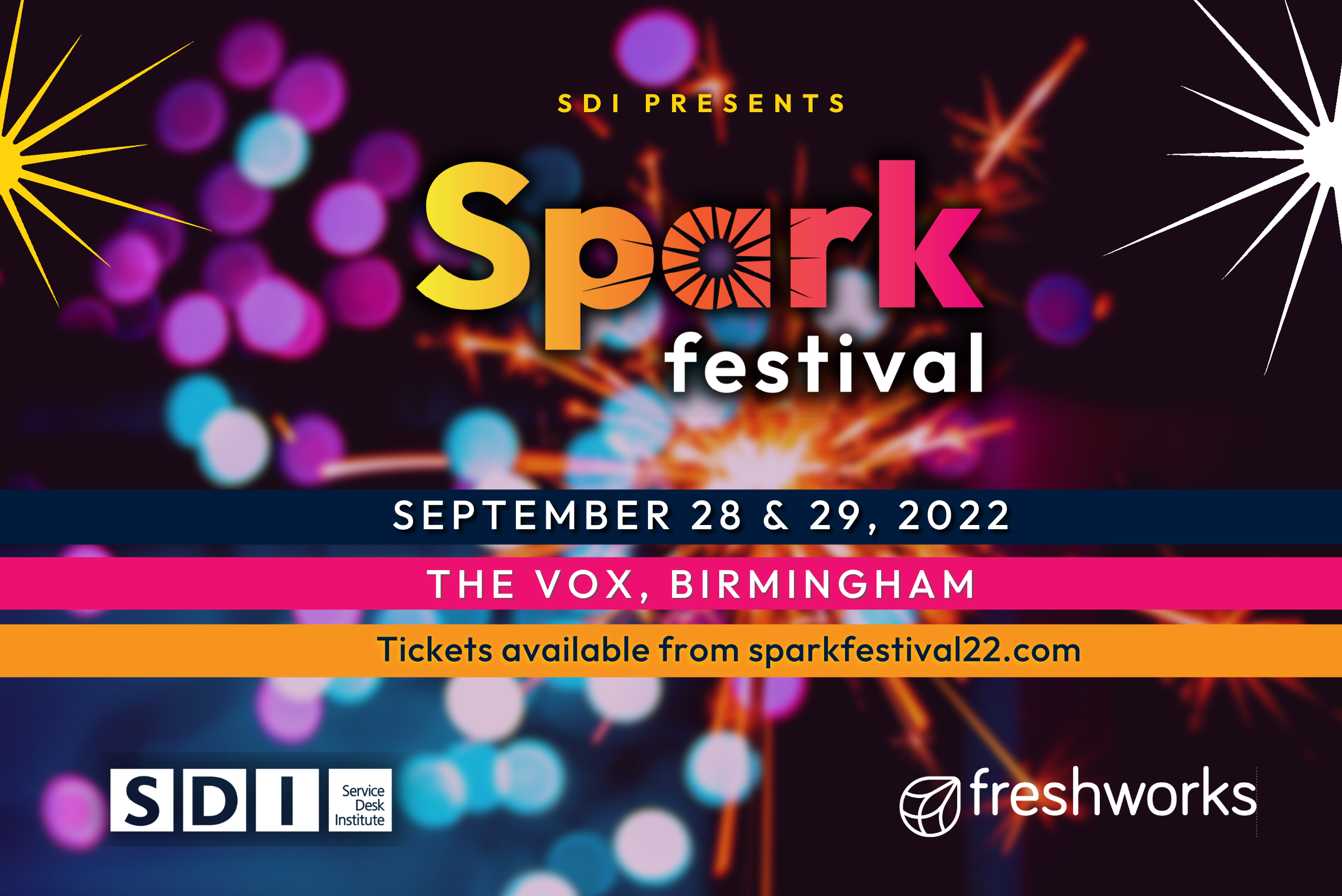
The Service Desk Institute (SDI) has welcomed over 12,500 people and hosted over 750 fantastic speakers across more than 25 annual SDI conferences. This year, SDI is back with a brand new festival-style IT Service conference, Spark Festival!
Spark Festival is an exciting evolution of the conference format, building on the sense of community and energy associated with the SDI Conference. Designed around three key themes, Discover, Pioneer and Inspire, Spark Festival’s open-plan festival feel and layout enables attendees to create a personalised festival experience and pick the sessions that suit them.
With a vibrant mix of inspiring keynotes, immersive presentations, practical workshops, discussion roundtables and live entertainment, Spark will help guests discover new ideas, empower them to be a pioneer in their services and inspire them to engage in the new.
Industry Thought-Leaders & Memorable Headliners
The Spark Festival line-up features a spectacular mix of speakers, including SDI Conference favourites like James Dodkins (Customer Experience Evangelist), Award-winning Digital Illusionist Keelan Leyser, Digital Workplace Solutions specialist Patrycja Sobera, Future of IT expert and media spokesperson Dan Sodergren, and many more!
Join SDI this September for the most exciting and refreshing Enterprise Service Festival of 2022!
View the full Spark Festival line-up and get your tickets at www.sparkfestival22.com