


Top 5 Service Management fails & how to fix them
This video covers the top 5 areas IT leaders are highlighting as areas in service management and operations that are holding them back in supporting the big digital transformation programmes.
- Incoming workload to the service desk is exceeding resourcing capacity, resulting in missed SLA and frustrated customers.
- Increase in workload when most activities are manual results in high costs and very slow response times.
- Consumer relevant services are not accessible via self-service, forcing users to call and email the service desk which impacts customer experience and self-service adoption.
- Fragmented and poorly implemented self-service drives customers to the costly and slow phone and email channels.
- Too costly to maintain (taking away funding from more productive areas) and too slow to keep up with modern service management technology such as chat, mobile, Microsoft Teams (overtime become irrelevant to the business).
To help IT departments address these challenges quickly we have developed a set of offers using 3 key principles:
The first is to take the guess work out and use Fusion’s AI Talos to benchmark your current circumstances and Service Management maturity.
Here are some insights that can be uncovered within a day:
- Common services requests from your customers.
- Identify missing knowledge.
- Configure critical a mass service catalog
- Identify automation candidates
- Identify process inefficiencies
- Identify data quality issues
These insights are then used to power up differentiated technologies such as BMC’s Helix platform to leverage the latest capabilities in connected workflows, automation, and great customer interfaces to create contact strategies supported by a critical mass service catalog which can be accessed via digital channel including mobile, portal, Microsoft Teams and much more.
But nothing we have done so far is of real business value, unless the solution is adopted by wide range of users and customers quickly. That is why we have created several industrial strength methodologies and pre-packed content to onboard organisations and provide access to 100 plus common services within 4-6 weeks. The speed of delivery and sheer volume of relevant content will have a big impact on consumers’ perception of the service.
Over the years we have assisted many global and mid-size organisations with their transformative initiatives who have reported these types of business outcomes:
- A global oil company reduced its Service Management manual activates by 40% in 3 months
• A global gaming company increased self-service adoption by 30% 3 months
• A global manufacturer changed its contact strategy from old manual methods to modern consumer focused automated methods within 6 months
• A global telecoms operator reduced missed SLA by 25% within 3 months
• A healthcare provider increased service desk capacity by 60% through automating mundane activities
By Fusion


SITS announces the only free ITSM programme in Europe
The education programme for SITS – The Service Desk & IT Support Show is now live, as the free exhibition returns to ExCeL London on the 10-11 May 2023.
Over two days, three theatres will hold 60 free educational sessions, alongside a Keynote theatre, Breakfast Briefings and Hot Topic workshops. Sessions include everything from AI and digital transformation to Experience Management and ITIL 4. With presentations from big industry names, including Marval Software, Hornbill, SysAid Technologies Ltd., ServiceNow and Ivanti.
‘Learn and discover the latest thinking in ITSM’
A big focus this year is automation and agile working, as both employees and customers want a smooth online experience, where they can easily request and consume services regardless of what business unit delivers that service.
Another significant theme returning this year is diversity and inclusion, with presentations on neurodiversity, mental health and menopause in the workplace. With sessions highlighting issues that affect people inside and outside of work.

‘I implemented changes I had learnt as soon as I got back to the office.’
Valerie Wilson from BT Group will be presenting her session ‘Coming together is the beginning; Keeping together is progress, working together is success…’ She will be delving into the merits of the service desk working much closer with the key associated ITIL functions, while reflecting on BT Enterprise’s journey to merge the functions.
Rinat Gil from SolarWinds will be looking at how using ITSM, ITAM and ITOM and connecting them is essential to accelerating Mean Time to Detection and Mean Time to Resolution, in the session ‘Why unifying ITSM+ITAM+ITOM is essential to achieving today’s service levels.’
SITS 2023 will bring visitors a carefully curated group of top speakers from the ITSM world and beyond, with presentations on people, process, technology and business.
You can view the full conference programme here.
SITS, The Service Desk & IT Support Show, is back 10-11 May 2023 at ExCeL London. You can now register for your free ticket here.

The Application of Large Language Models in Service Management
ChatGPT, OpenAI’s brainchild that launched in November 2022, seems to have generated more interest in the last couple of months than any other technology or trend has in the last couple of years. The industry titans have certainly taken notice, with Microsoft putting its weight behind ChatGPT both financially and technologically while Google announced Bard, its own artificial intelligence (AI)-powered chatbot.
Based on GPT-3 and powered by humongous data sets backed by heavy computing requirements, some have claimed this as one of the biggest technology-based disruptions that will fundamentally alter the economics of information, while others have pointed out the limitations of GPT-3-like large language models (LLMs), and then there are all sorts of opinions in between.
Where did all these enthusiasts come from suddenly? LLMs are not the new kid on the technology block.
One LLM differentiator is that it can be used to consider very large volumes of data such as text, and understand the overall context, versus natural language processing (NLP) that only looks at the immediate context between words.
BMC has been experimenting with LLMs for years now. It might seem like a new entrant into the market, but there’s still a way to go before it reaches maturity, as we cover in this blog post. Will it serve as a lamp post that can be used not only for support but also for illumination, or will it fade out alongside other hyped,-but-failed technologies? Only time will tell.
In this post, we explore three leading use cases from a service management standpoint that makes us believe that the democratization and widespread use of AI has just begun. The traditional tradeoff between “richness” and “reach” might be a thing of the past. Generative-AI has the power to deliver both—to all participants and on demand.
-
- Ticket text summarization
In the service management world, we deal with large volumes of text that could be part of activity or work logs, chat conversations between agents and subject matter experts (SMEs), meeting transcripts or notes, feedback forms, knowledge articles, or even resolutions submitted for hundreds of thousands of tickets. When we use an LLM that is trained on more than one billion parameters, it can lead to a rich summary of information collected from piles of data that can now be presented to the service desk agent.
The insights generated from that summary would then help them to arrive at the root cause or the solution within minutes, thus saving valuable time that could now be spent performing value-added tasks. Also, summarizing text from user feedback forms can succinctly point service managers to areas of improvements and can be used by them for training purposes. This would ultimately lead to increased efficiencies in the service desk, a streamlining of the operating model, and eventually, a positive improvement in end-user experience.
-
- Generating knowledge articles
Knowledge management is important to the service desk because it allows teams to capture, retain, and share knowledge that—when used effectively—can decodify the tribal knowledge that lies with a few specialists. That makes it easier to upskill and enable the workforce to make the right decisions throughout the service lifecycle. ITIL® 4 also defines knowledge management as one of the central processes responsible for providing knowledge to all other IT service management functions.
So, though this is of high importance, it leads us to ask a question: How many times does a technician document the solution(s) that they provide when resolving a ticket?
The response would vary from organization to organization, but what we have seen is that not all solutions become a knowledge article. In fact, most of the time, only a small fraction of them gets converted, which creates a knowledge gap between an average agent and the subject matter expert. This is where generative-AI technology can assist with the heavy-lifting.
By looking at the combination of incident and problem data such as activity logs, solutions provided, resolutions entered, and identified root cause, the model can generate drafts of knowledge articles that can be submitted for review by the agents or experts. Instead of starting from scratch, agents and experts can now review and revise the contents of the generated knowledge article within minutes and submit the article for approval and publishing. Undoubtedly, automatically generating knowledge articles using AI technology will lead to better and greater dissemination of information across the organization.
-
- Data cleansing
Data is the holy grail of machine learning. But predictions based on bad data usually results in a case of “garbage in, garbage out”. If the quality of outcomes must be improved, then the underlying data needs to be parsed, standardized, matched, and cleansed. For example, spelling mistakes made while logging an incident can result in matching wrong knowledge articles or no knowledge articles being recommended.
Properly trained LLM models can provide the right level of inputs for data cleansing. Some examples could be during a product upgrade where all form data is spell-checked; pre- or user-populated content is verified; or jargon and abbreviations are converted into layman language. This can ultimately help secure the right data and context to ensure that a machine learning (ML) project is using cleansed, standardized, and trusted data.
The “art of the possible” with LLMs also extends to use cases where the search experience can be improved on a vast underlying dataset; with chatbots that can combine data from within and across the organization; or even by developers who can convert screens into documentation. In conclusion, we would like to say that a new era of AI has dawned upon us. This one is super-exciting and the one that we will be watching with bated breath.
BMC will be exhibiting on stand 375 at SITS, The Service Desk & IT Support Show, on 10-11 May 2022 at ExCeL London. Register for your free ticket here.

Proof That There’s No “One-Size-Fits-All” with Experience Management
We often use the phrase “one size doesn’t fit all” in IT service management (ITSM). An obvious use case is ITSM tool selection, where an organisation’s needs will depend on various factors, including organisational size, industry, geography, and ITSM “maturity”. Often organisations forget or overlook this “one size doesn’t fit all” mantra. Or, to be more precise, the people within the organisation making decisions do.
But what about employee experience? Is employee experience universal across countries and regions, or do cultural differences affect perceived experiences? Plus, for larger organisations spanning multiple regions, should their IT service provider(s) allow for different experience perspectives across the regions?
You might think there are regional and country-based differences, but you’re probably not expecting these to be as wide as our experience data shows they are. Plus, what about the experiences related to incidents versus those for service requests? Please keep reading to find out what our latest experience data shows.
Global differences in IT experience and productivity
We have long seen the experience differences between countries and regions. It makes sense because service views and expectations differ around the world. Like our previous reports, the latest experience data shared in the HappySignals Global IT Experience Benchmark: H2/2022 identifies the cultural differences in how end-users perceive their IT services and lost time.
For example, end-users in Western Europe have traditionally rated their happiness with resolved incidents lower than those in Eastern Europe, despite experiencing less lost time. For this latest report, we undertook additional data quality work to eliminate the unwanted impact on the average score of high response volumes in certain countries. However, the benchmark data still holds many significant differences for IT service providers.
The regional experience differences with incident resolution
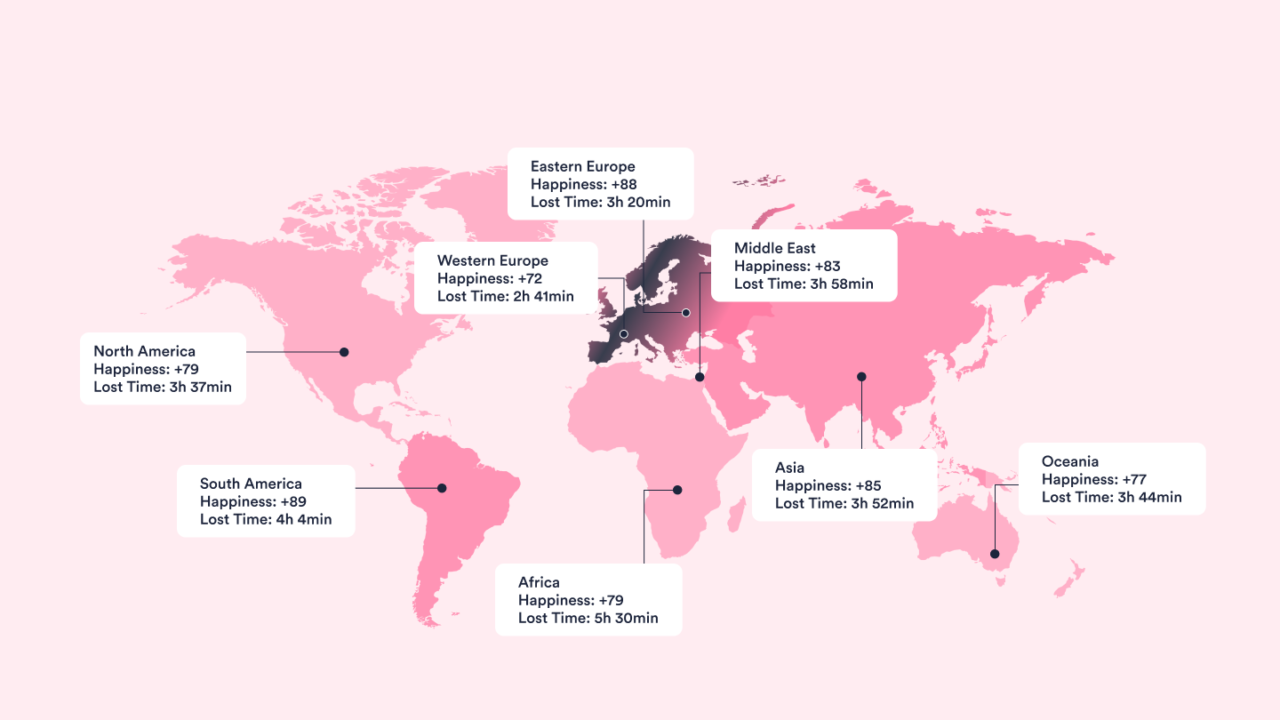
As shown in the graphic below:
- Western European end-users are still the most critical of their IT service providers’ incident handling (scoring +72) despite losing less time (2h 41min) than the end-users in other regions.
- South American end-users are the happiest with their IT service providers’ incident handling (+89) despite losing more time than end-users in all the other regions except Africa.
- The spread of the happiness score between regions is higher with incidents than service requests (which is covered in the next section).
These results are taken from 873,738 pieces of end-user feedback provided in 2022.
The regional experience differences with service request provisioning
As shown in the graphic below:
- North American end-users are the least happy with service requests and report losing over twice as much time with service requests as end-users in Western Europe.
- Western European and African end-users have very similar levels of happiness with service request provisioning, despite African end-users losing more than 4x as much time with their IT requests.
- The spread in happiness scores is lower with service request provisioning (+77 to +88) than incident handling (+72 to +88), but the perceived lost time varies much more across geographies (1h 47m to 8h 16m).
These results are taken from 503,173 pieces of end-user feedback provided in 2022.
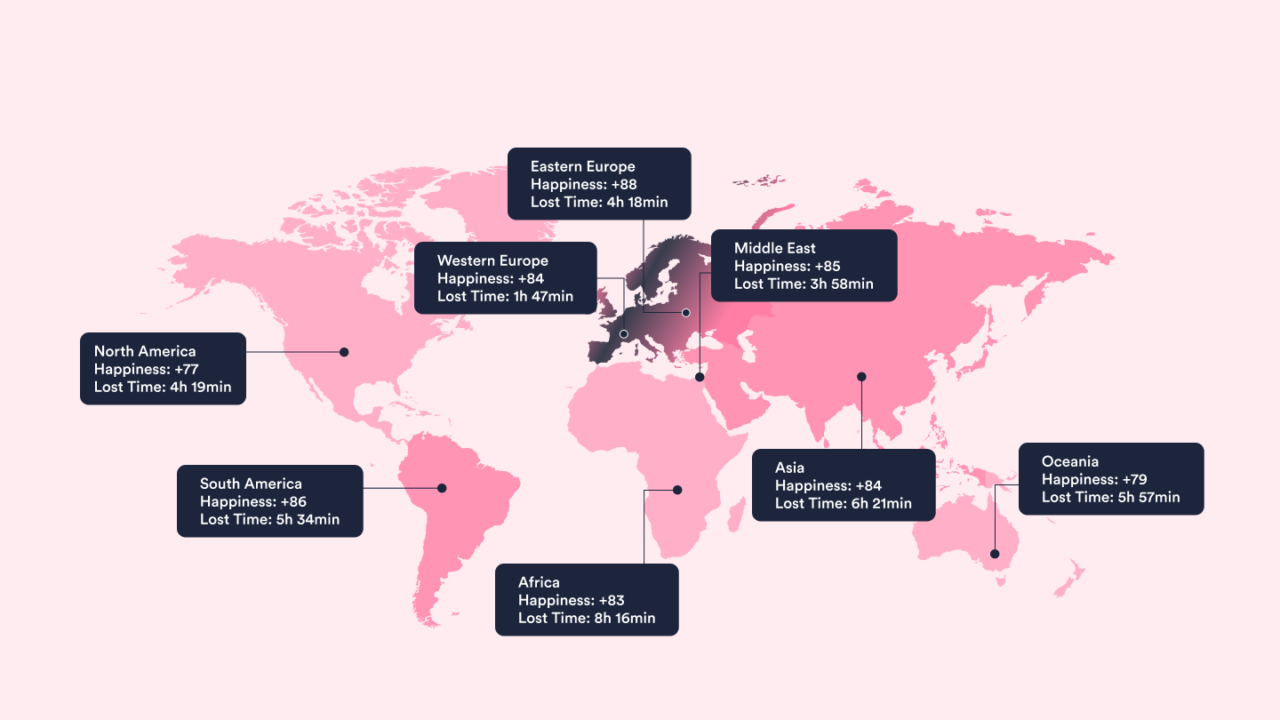
Putting the differences between incident handling and service request provisioning to one side for a moment, the fact that Western European end-users report less than two hours lost time with service request provisioning versus four hours upwards for the rest of the world (3h 58m to 8h 16m) is interesting and something that requires further investigation to understand why. Especially as Western Europe also has the lowest level of perceived lost time for incidents (2h 41m). But is this caused by service level agreement/priority targets, staffing levels, self-help and automation, something else, or a combination of these? It could also be that the end-users’ perceptions of lost time differ by region relative to the elapsed time.
Comparing the incident and service request experience data rankings
The comparison of the incident and service request data is probably best viewed via ranking rather than the source data. This analysis is shown in the table below.
| Region | Incident Score | Incident Time | Request Score | Request Time |
| North America | 5 | 3 | 8 | 4 |
| South America | 1 | 7 | 2 | 5 |
| Western Europe | 8 | 1 | 4 | 1 |
| Eastern Europe | 2 | 2 | 1 | 3 |
| Africa | 5 | 8 | 6 | 8 |
| Middle East | 4 | 6 | 3 | 2 |
| Asia | 3 | 5 | 4 | 7 |
| Oceana | 7 | 4 | 7 | 6 |
This analysis shows that:
- Western Europe end-users have the lowest perception of lost time for incidents and service requests but are still happiness low scorers.
- Eastern Europe end-users look to be “doing well” in happiness and perceived lost time terms for both incidents and service requests.
- South American users seem happiest (along with Eastern European end-users) for both incidents and service requests.
- North American end-users seem to have the highest expectations for service requests, given they have the lowest happiness score.
We’ll continue to track these experience scores and report in more depth in future Benchmark reports.
What this all means
This latest experience data confirms there’s no “one-size-fits-all” with experience management, at least from a region-based perspective, and differences in incident handling and service request provisioning. Differing practices might cause it, but it’s more likely caused by differing perspectives – not only related to the expectations of service per se but also the context, i.e. whether it’s an incident or a service request.
Of course, this data is regional averages, and your organisation’s perspectives could differ in one or multiple regions. The only way you’ll truly know – as with all views of employee experience – is to get feedback from your employees.
To freely access the full report, please visit: https://www.happysignals.com/global-it-experience-benchmark
By Sakari Kyrö, HappySignals

The ITAM Forum launches the world’s first ISO/IEC 19770-1 certification scheme
The ITAM Forum today announced the launch of the world’s first ISO/IEC 19770-1 certification scheme for IT asset management and celebrates the first two organizations to ever receive certification – Softline Group Northern Europe and HDI Group.
As a management system – similar to ISO 27001 and 9001 – ISO/IEC 19770-1 specifies the requirements for an IT asset management system – the people, processes, and technology necessary to manage IT assets throughout the lifecycle. Until today, organizations could not demonstrate the quality of their ITAM practices in a consistent, uniform and globally accepted way. Now, ITAM teams can receive unrivaled recognition for their work.
Goal achieved: Global ITAM certification is here
The ITAM Forum launched in May 2020 with the aims to promote the business benefits of ITAM and to create the world’s first, globally-recognized and accepted certification scheme for ISO/IEC 19770-1.
Speaking during its launch, Martin Thompson, founder of the ITAM Forum, commented, “ITAM is rapidly ascending in significance. By benchmarking an ITAM department or team against a globally recognized ISO standard, internal and external stakeholders, including the Board, will be assured of the highest-quality processes.”
Speaking today, Thompson remarks; “Today marks a major milestone for the global ITAM industry and for the ITAM Forum. We have achieved one of our key objectives with help from the world-wide ITAM community. This wouldn’t have been possible without the continued work of several ITAM leaders, such as David Bickett, who have championed ITAM for decades, long before the ITAM Forum came into existence.”
First two organizations to be certified
Ash Dharas, Managing Consultant and Practice Manager ITAM at Softline Group Northern Europe commented, “We’re thrilled to be the first organization to achieve certification. This was an important milestone for us, and I’m incredibly proud of this achievement. We’re also now well prepared to help our clients with their certification journeys, and hopefully, many will follow in our footsteps.”
Patrick Milas, License Manager for HDI Group commented, “Today is great day for HDI. We are the first end-user organization to gain ISO ITAM certification, a fantastic achievement. I would like to thank all of my colleagues who helped make this happen and TIMETOACT Group for its support and guidance. I encourage all companies that engage in ITAM to explore the business benefits of ISO certification.”
Closing remarks
Martin Thompson, founder of the ITAM Forum comments, “I would like to personally thank Softline Group Northern Europe and HDI for their leadership and vision and for helping to bring this certification scheme to life. Without their hard work in going through the extensive certification process, we wouldn’t be able to share this great news today. More companies are undergoing the certification process right now, so we hope to soon announce more certifications.”
Attend the upcoming ISO/IEC 19770-1 Practitioner Course
The ITAM Forum and Brand Compliance (the certification scheme auditor) will host a live, expert training course for ITAM professionals in Florida, 23-24 March 2023, immediately following Wisdom NA 2023. This brand-new course focuses on the skills needed to help end-user organizations successfully navigate the ISO/IEC 19770-1 audit and achieve certification. For more information, and to register, visit https://www.eventbrite.co.uk/e/wisdom-north-america-2023-tickets-458303095897
Organizations interested in exploring ISO/IEC 19770-1 certification can now register their interest.
By ITAM Forum
The 5 Key Capabilities you need from a SMART service desk solution
Traditional ITSM tools no longer cut it. They’re not capable of meeting current enterprise expectations and they’re not future ready. What does now look like?
- 61% of support organizations saw an increase in ticket volume and related costs over the past year.1
- 47% of business leaders prioritized revenue growth, cost reductions, and customer experience improvement. 2
- Business-aligned organizations are more likely to spend money on technologies such as artificial intelligence (AI), predictive analytics, service automation, and virtual agents over the next twelve months.3
- 74% of business-aligned IT organizations use an ITSM solution outside of IT.3
- 52% said they would consider new applications pre-packaged in containers in the short term.4
Sources:
- HDI: 2018TECHNICAL SUPPORT Practices & Salary Report
- Forrester webinar: Enterprise Service Management: The New System Of Engagement
- HDI: State of Today’s IT: Process Maturity, Business Alignment, and Digital Transformation
- IDG Research: Quick Poll Research: CONTAINER TECHNOLOGY
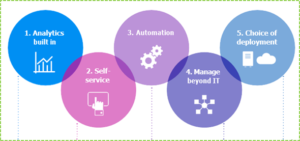
What does SMART look like?
| Smart analytics and machine learning for automated ticket categorization, hot topic identification and other insight | Service portal for one-stop shopping for goods, services, and support – with smart search and 24x7 support via chatbot | Task, workflow automation and orchestration to remediate incidents, execute and verify changes and more. | Smart service desk extension into business departments and processes like HR portfolio and facilities management. | Flexible deployment model based on container technology to run the solution on premises, in the cloud or SaaS. |
Micro Focus SMAX is the only container-based management solution offering this level of SMART capability. Hosted on-premise, on private-cloud or on public-cloud and delivering IT Service Management (ITSM), IT Asset Management (ITAM), and Enterprise Service Management (ESM), it is easy to use, easy to extend, and easy to run anywhere.
For more information, visit www.wmpromus.com.
140 - 144 High Street, Bromley BR1 1EZ, United Kingdom
Tel: +44 (0) 20 3948 6226
Email: [email protected]
Information sources: Micro Focus SMAX

Meet the brand: Opensource ICT Solutions B.V.
Kicking off the first installment of our 'Meet the brand' series is 'Opensource ICT Solutions, a truly international company based in The Netherlands, United Kingdom and United States. They provide worldwide training, support and consultancy for Zabbix and other IT Services. They are proudly the first and only Premium Zabbix partner in the BeNeLux. The Premium Partner status is assigned by Zabbix only to those partners that meet a special benchmark in providing Zabbix services.
Get to know a bit about them before visiting their stand at the show...
What do you do?
We provide services (training, consultancy and support) on an open source product called Zabbix. Zabbix is a universal all-in-one solution which offers monitoring of your entire IT infrastructure. Zabbix is our core business, and not a side gig or something like we see at a lot of our competitors. Since it's open source we do not have a product to sell, but only our services. In the past years we've trained hundreds of people, provided full implementations of Zabbix all around the world and built many custom integrations.
How did you get started?
Well, 10 years ago I started working at a company that used Zabbix as their monitoring solution. At first I did not like the product at all but after a few weeks I started to see the potential and embraced the product. 5 years ago Opensource ICT Solutions B.V was founded, as I loved the product so much that I wanted to work with it on a fulltime basis. 3 years ago we started a subsidiary in the United States and 1.5 years ago we opened a subsidiary in the United Kingdom. This means that me and my team are basically 24/7 working with the product nowadays, all over the world.
What are you looking forward to most at SITS?
We are looking forward to meet our potential customers, Zabbix users and especially people that have never heard of us, or Zabbix before. Also, it's great to wonder around at an event such as SITS to meet people, see the newest technology and learn about what people are looking for in regards of monitoring solutions.
Why should visitors come to your stand?
We do not have a product for sale, yet can offer the best monitoring solution you can imagine. That means we are open for just a 'hi!', a technical discussion, quick introduction/demo to the product, a sales talk, etc. Our guys at the booth are all technical, with a broad knowledge of both the product and many different technologies - we're up for a challenge!
You can meet the Opensource team at stand 185 at SITS, The Service Desk & IT Support Show, on 10-11 May 2023 at ExCeL London. You can now register for your free ticket here.
E-Waste 101: Everything You Need to Know
Key Facts
- E-waste is the fastest-growing waste stream in the world; between 50 and 60 million tons are produced every year.
- The e-waste discarded in 2021 alone weighs more than the Great Wall of China: the heaviest man-made structure in the world.
- 75-80% of e-waste is shipped to countries in Africa and Asia, where poor and marginalized communities suffer health and environmental consequences.
- Electronics contain hazardous materials like lead, mercury, and cadmium, which leach into the surrounding environment when placed in landfills, or when the products are burned by “backyard recyclers” in Global South trying to extract valuable materials like gold and copper.
- Less than 20% of e-waste generated each year is properly recycled.
- E-waste contains valuable materials that can be extracted through proper recycling. It’s estimated that unrecycled e-waste contains $57 billion worth of recoverable precious metals.
- Only 25 US states and Washington, D.C. have some kind of e-waste legislation, either mandating the recycling of e-waste, banning disposal in landfills, or prohibiting export to other countries.
What is E-Waste?
E-waste – also called electronic waste, e-scrap, end-of-life electronics, or WEEE (Waste Electrical and Electronic Equipment) – is electronics that have been discarded, donated, or recycled. The term “waste,” however, is somewhat misleading; many items still have value in that they can be repurposed or recycled to extract desirable materials inside them.
Six waste categories are included under the umbrella term of “e-waste:” Temperature exchange equipment (like heating/cooling devices), screens and monitors, lamps, large equipment (like washing machines, dishwashers, copying and printing machines, etc.), small equipment (vacuum cleaners, microwaves, electronic toys and tools, radios), and small IT and telecommunication equipment (cell phones, GPSs, personal computers).
Unlike most general municipal waste, e-waste is extremely hazardous and contains toxic materials like beryllium, cadmium, mercury, and lead, so recycling these products requires intensive sorting and handling. E-waste – in part due to the complex requirements for disposal – is often exported to countries in the Global South, where it poses health and safety hazards for local people who mine valuable materials from end-of-life electronics.
Generation of E-Waste
E-waste is a growing waste stream: the fastest-growing in the world, according to Green Alliance, increasing by 21% between 2014 and 2019. Between 50 and 60 million tons are generated each year, which amounts to about 2-3% of annual global waste. While it might seem like an inconsequential percentage, the consequences of runaway e-waste production are extreme.
Why is There so Much?
When the iPhone was released in 2007, 1.4 million units were sold that year. Now, the same amount of phones are sold every 2.5 days. This growth is representative of our greater dependence upon electronics in all facets of the economy and daily life, from which our mounting e-waste stream arises. It’s estimated that 63.3 million US tons of electronic waste were discarded in 2021 – that’s heavier than the Great Wall of China, the heaviest human construction in the world – and it’s only expected to grow. In 2030, e-waste is projected to hit 81.6 million US tons: an amount that could fill more than 100 Empire State buildings.
Planned Obsolescence
Does it ever feel like new, updated cell phones and computers are coming out much faster than they used to? Not only is this true, but it’s a tactic intentionally employed by technology companies so that older models become outdated faster and faster. Even if a product works perfectly well, sometimes just the perception of it as “old” will drive replacement (called “perceived obsolescence”). On average, a person now only keeps a cell phone for about two to three years. Each new product release also comes with new chargers, adapters, and compatible products, making their older counterparts unusable and trash-bound.
But, some manufacturers will also deliberately design products to last for only a certain amount of time: a phenomenon known as “planned obsolescence.” Sometimes, the cost of repairing a failing phone or computer is actually more expensive than buying a new product: another intentional tactic to drive up purchasing. Oftentimes, new software updates are incompatible with older models, and as the world is upgrading to 5G, entire generations of cell phones will soon become obsolete.
E-Waste Recycling
Because of the many toxic chemicals present in e-waste, discarded electronics must go through a complicated recycling process that involves separating their plastics, metals, and internal circuitry. E-waste recycling provides an alternative to throwing waste in landfills, where it leaches and causes a hazard to both human and environmental health. Recycling services are provided by some local and state governments – or federally, in some countries outside of the US – or by private recycling businesses.
Benefits of Recycling E-Waste
Along with hazardous toxins, e-waste also contains valuable materials that could be reused in future products. According to the EPA, recycling one million cell phones recovers over 35,000 pounds of copper, 772 pounds of silver, 75 pounds of gold, and 33 pounds of palladium. Extracting these materials has economic benefits; a 2018 study found that mining aluminum, copper, and gold is 13 times more expensive than collecting it from properly-recycled electronics
Lithium, for one, is used in many industries and is crucial for making the batteries of electric cars. Because of the huge demand for these vehicles paired with the slow extraction of the element, lithium is in short supply. Mining it from recycled e-waste will supply more to the market, keeping the price of electric cars from skyrocketing due to scarcity.
How is it Done?
The e-waste recycling process entails many steps in order to separate valuable materials from non-valuable and hazardous ones. First, the waste is sorted manually into different types and models and examined to see what can be reused either as parts or to form new products. What is left goes through a demanufacturing process whereby products are disassembled and hazardous material is removed. Photocopying machines, for example, contain toner that is very flammable and could cause explosions in later stages of the recycling process. The remaining non-hazardous waste is shredded in a machine, and from the shreds, valuable materials are removed; a giant magnet captures ferromagnetic materials like iron and steel. This process of finding and removing metals and other desirable materials is what makes the recycling industry profitable. Lastly, water is used to separate the remaining materials (plastic will float, while heavier items will fall).
Why is Recycling E-Waste so Complicated?
In 2019, only 17.4% of global e-waste generated was collected and properly recycled, due in part to the complexity of the process. Each of the six e-waste categories is different – different amounts are generated, they have different economic values, and they pose different threats to human health and the environment – so, the way they must be collected and recycled is very different and requires varied technology. Many products also aren’t designed to be easily recycled, like our ever-slimmer smartphones that resist removal of their batteries. Recycling machines must constantly be upgraded to keep up with changing technology, and manual sorting exposes workers to low levels of chemicals over a long period of time. Regardless, 10/60 elements in most e-waste can’t be recycled through mechanical processes, including aluminum, cobalt, copper, gold, iron, lead, platinum, silver, and tin.
Lack of Regulation
Lack of proper regulation surrounding e-waste in the US also makes disposal more complicated. While other countries have more stringent laws around e-waste, only 25 states and DC have some kind of e-waste legislation, either mandating the recycling of e-waste, banning disposal in landfills, or prohibiting export to other countries. Some states partner with companies to institute a state-wide collection system, and some also impose recycling targets on manufacturers. The US, however, lacks comprehensive federal laws that require manufacturers to provide recycling options for products bought by customers. Ultimately, manufacturers and consumers alike are left to figure out how to deal with waste on their own, which can be costly and lead to improper recycling.
E-Waste Trade and Impact on Human Health
While e-waste recycling has many benefits, recyclers do not all handle the waste in the same way. Rather than adequately recycling materials – which is complicated and costly – some companies merely export the waste to other countries. Herein lie some of the largest humanitarian and environmental concerns regarding e-waste.
E-Waste Dumping
We know that 17.4% of e-waste was formally collected and recycled in 2019, meaning that more than 80% was not. According to the EPA, an undetermined amount of these end-of-life electronics are shipped from wealthy, western nations to less-wealthy countries that don’t have the capacity to either reject or handle the materials properly. In high-income countries, it’s estimated that nearly a quarter of all e-waste is exported. Some e-waste is shipped with the intention of bringing digital technology to countries without sufficient access, but this official reason is often used as a veil to hide illegal exports as well. In all, it’s estimated that 75-80% of e-waste is shipped to countries in Africa and Asia; China, Ghana, India, Nigeria, Pakistan, and Vietnam are major targets. Thus, poor and marginalized communities end up paying the health and environmental price of western e-waste.
Backyard Recyclers
In many countries that are the targets of these exports – like India, Indonesia, the Philippines, and Thailand – the extraction of materials from e-waste has become an important source of income. In Guiya, China – considered the e-waste capital of the world – 75% of households are engaged in informal recycling.
These “backyard recyclers” make money by recovering precious metals and other valuable materials from inside e-waste. Items like circuit boards are literally gold mines; the gold in e-waste in 2016 equaled about 10% of what is mined every year. Open-air burning and baths of mercury and hydrochloric, nitric, and other acids are used to melt non-valuable materials away. Once they’re corroded or exposed to radiation, the toxic chemicals in electronics are then released into the atmosphere.
Many of the people engaging in this work are women and children; some 12.9 million women and 18 million children and adolescents work in the informal waste sector and are exposed to more than 1,000 harmful substances, according to the WHO. This exposure to chemicals like lead, mercury, cadmium, and arsenic, among others – especially when coupled with a lack of safety gear – is extremely detrimental to these workers, and is directly linked to cancer and other health problems. Exposure to e-waste toxins can lead to miscarriages, low birth weights, spontaneous abortions, stillbirths, and other adverse birth outcomes in mothers, and neurocognitive issues and decreased lung function in children, who also have a greater chance of developing cancer or cardiovascular disease later in life.
Not only are workers impacted, but also communities nearby these open-air burning operations. EWMs (e-waste related mixtures) are highly toxic combinations that can spread very far from the site of their release and are encountered through inhalation and contact with contaminated soil, food, and water.
It should be noted that not all e-waste accumulated in the Global South is from exports. In Ghana and other parts of West Africa, for example, a sizable percentage of e-waste is produced locally.
Other Adverse Impacts of E-Waste
Environmental Impact
Through both informal backyard recycling and leaching from landfills, the toxins in e-waste have a very detrimental environmental impact, especially regarding water pollution. Rain dissolves the chemicals in e-waste, which then runs off into other waterways, acidifies rivers, poisons wildlife, and contaminates drinking water supplies.
Cancer-causing Persistent Organic Pollutants (POPS) – which include industrial chemicals like PCBs (polychlorinated biphenyls) and DDT (a pesticide) – resist environmental degradation, and can leak into waterways and the air. These pollutants can bioaccumulate in seafood, contaminate dust particles in the air, and even increase the greenhouse effect when exposed to the atmosphere. Temperate exchange equipment like refrigerators and air conditions also contribute directly to climate change by slowly releasing greenhouse gases. It’s thought that 98 million metric tonnes leak from scrap yards every year, according to The Conversation, which equates to 0.3% of emissions from the energy sector.
Loss of Resources
When e-waste is not recycled and its valuable materials extracted, huge amounts of money and resources are lost. It’s estimated that unrecycled e-waste contains $57 billion worth of recoverable precious metals like gold, silver, and platinum – that’s more than the GDP of most countries. Losing out on these existing resources means that more mining is necessary to extract more metals and rare materials, which leads to acid mine drainage, other pollution, and alteration of the landscape. Some materials like cobalt are also found mainly in areas experiencing dangerous conflict.
E-Waste Solutions
Besides legitimate e-waste recycling (and emerging e-waste recycling technologies), solutions to our growing e-waste problem do exist.
Electronics Repair
In the absence of more durable products, “Right to Repair” laws are being dealt with at the state level, and would require companies to provide consumers with pieces needed to perform simple repairs on their products. Groups like iFixit also provide do-it-yourself solutions to consumers; they list free repair guides for most common products ranging from phones, to tablets, to gaming systems, to hand tools.
Policy Change
To meaningfully address e-waste production and disposal, proper legislation is crucial.
At of the end of 2019, 78 countries that contain 71% of the world’s population had implemented policies, legislations, or regulations to manage e-waste, or had a plan to do so – but in most places, these are not legally binding. Some countries have taken meaningful action against e-waste, like the EU, which has very tough enforcement of their e-waste laws. EU citizens have guaranteed access to free recycling programs for e-waste, a ban has been placed on exports to less-wealthy countries, and manufacturers must play a part in recycling: all policies which help the EU maintain an electronics recycling rate of about 35%.
In the US, however, there is no federal law requiring that e-waste be recycled or prohibiting the export of it to countries in the Global South, and recycling rates are much lower. The country is also not party to the Basel Convention on the Transboundary Movement of Hazardous Waste (1989), of which 187 UN Member States are parties to and control the international movement of hazardous waste. The US does participate in the International E-Waste Management Network (IEMN) – where governments come together to exchange best practices around e-waste, but it is non-binding and doesn’t represent an official government position – and some states have passed Extended Producer Responsibility (EPR) laws, which require that manufacturers of electronics must have systems in place for collecting and recycling old products.
Change From Producers
Some companies are taking action against e-waste themselves. Apple, for example, now offers credit for iPhones that are traded in, and like some other companies, they are now mining materials from end-of-life Apple products to create new ones. Apple also introduced a recycling robot named Daisy in 2018, which can dismantle 200 iPhones every hour – but, this still does not keep pace with the rate at which products are produced and thrown away.
Takeaway
The growing production and harmful disposal of e-waste is a complicated issue: one that transcends borders and is tied to human, environmental, and economic health. But, there are both macro- and micro-level solutions, beginning with individual action to combat the production and improper disposal of electronics.
How You Can Help
- Buy less. Minimizing the electronics you purchase also has an economic incentive: you won’t be out a grand every couple of years when a new iPhone comes out! Instead, take care of electronics – from computers to phones, to kitchen appliances – so they last for as long as possible.
- Repair. When products do fail, work to repair them yourself. Visit iFixit to find repair guides, or use other online resources to learn how to safely and effectively fix what’s broken. If you’re unable to do so on your own, take the product to a professional for repairs.
- Resell. Even if you no longer want a product, someone else might. List used electronics on Facebook Marketplace, eBay, Poshmark, or other online retailers.
- Recycle. When you do have to recycle products, do so correctly. Delete all personal information from your devices, and remove batteries to be recycled separately. Use these online search tools from Call2Recycle, Earth911, and the Consumer Technology Association to find places where electronics recycling is accepted (including batteries). After you find a recycler, find out whether they are legitimate. E-Stewards will help you find vetted recyclers that don’t just export the waste they collect.
- Advocate for better policies. Become involved in the fight for better, comprehensive legislation around e-waste that prioritizes human health and the environment over profit.
By Linnea Harris

Biomni strengthens Tenjin with GPT-3 capabilities
Software provider Biomni, an expert in building corporate virtual assistants, has announced the integration of GPT-3 capabilities into Tenjin, its multi-platform solution facilitating access to shared business knowledge.
The potential of AI and its impact on our lives is undeniable, as the increased number of advanced solutions proves. One of these is OpenAI's GPT-3 technology, which made the headlines with the public launch of ChatGPT in November 2022.
Recognising the potential of large language models, Biomni has integrated some of their capabilities into Tenjin. This means that Tenjin users can benefit from additional advantages and make even better use of their corporate virtual assistants delivered by Biomni.
Tenjin, built on Microsoft Azure and Cognitive Services, combines AI with a crowdsourcing approach allowing companies to migrate existing internal business knowledge onto a single platform where it is easily accessible and searchable for teams. In addition, it provides employees with a virtual assistant able to answer frequently asked questions or redirect them to the right source. As Microsoft invests in OpenAI, leveraging their solutions is a natural progression for Tenijn.
ChatGPT's natural language capabilities are one of its greatest strengths. The integration of large language models into Tenjin enhances the quality and variety of user interaction, making the experience of searching for knowledge more 'human-like'.
Similarly, the GPT model can add to Tenjin's already strong knowledge management capabilities. For instance, when supplied with large quantities of source material, GPT-3 can create digestible summaries, draft emails, readback text, or pull-out specific requested information.
Additionally, Tenjin will act like a consultant, using the GPT model for creative thinking prompts. When looking for 'blue sky thinking' on various topics, GPT-3 will suggest solutions to consider and encourage internal brainstorming whilst Tenjin knowledge moderators will be able to oversee the responses.
Biomni is also keen to recognise and manage the current GPT limitations. Trained on massive amounts of data from the internet, ChatGPT can generate incorrect information or create biased content, as OpenAI warns. Human moderation, management and context are vital. With the supervision of knowledge moderators, GPT's capabilities are controlled and knowledge is not drawn from the internet, but from the client's internal knowledge banks.
“GPT-3 technology has demonstrated the power and potential of emerging AI. Incorporating elements of GPT into Tenjin will make it more accessible and engaging, whilst always being overseen by humans. With over 20 years of experience in the sector, we understand how to incorporate large language models in an enterprise. GPT-3 integration with Tenjin delivers the corporate usefulness of something like ChatGPT but most importantly, using your specific business knowledge and data.” Angus Gregory, CEO of Biomni.
To provide more information on how to embrace and control ChatGPT in business, Biomni will host a virtual masterclass on GPT-3. Their experts will also explain how to maximise the capabilities of GPT while using Tenjin. More details will soon be available on Biomni's website.
5 ITSM Trends for 2023
As the new year starts, many of us turn our eyes to planning the future. We at Efecte certainly do the same. Taking time to discuss where the industry is going is especially important during these extraordinary times. Today I’d like to share some of our thoughts and trends we see on the Service Management market for 2023 and beyond!
1. The need to do more with the same
CIOs are faced with the mounting challenge of managing increasing IT complexity and support needs - while keeping the cost levels in check. No wonder IT teams are trying to find ways to increase productivity with automation. This isn’t a new thing and often the low-hanging fruits are exercised already. At the same time, the big productivity leap that digitalization promised has not yet fully materialized, which is leading many IT teams to look for new approaches to automate.
One such approach will be to “left-shift”. Traditionally, ITSM automation has mainly focused on processes after the request capture from the end user. Going forward, IT teams need to actively left-shift the automation in the support chain to increase end-user self-resolution rates. Every left-shifted resolution helps to improve key metrics like cost per ticket and average resolution time – while reducing the load of busy agents. This requires IT support that comes closer to end users, like mobile and collaboration platforms, equipped with more intelligent AI-powered capabilities, like AI & voice bots, smart search, and self-help tools.
Agents will also still have plenty of work on their hands. That’s why we will continue to see a fast-paced evolution of intelligent tools to help their evermore complex work. This calls for the power of AI - and in particular ability to operationalize AI into agent processes. A good example is augmented intelligence - where virtual assistants will be increasingly assisting human agents with deep contextual insights, recommendations, and automated actions.
We will also continue to see increased adoption of lean work practices and collaboration methods as ways to do more with the same. DevOps approach helps to improve time-to-value and eliminate process waste. IT teams will also look for ways to enable collaborative teams to attack problems together, e.g. with better swarming support.
2. Employees are the new customers
One consequence of an increasingly complex working life is the deterioration of employee well-being. There’s even a talk about a "big wave of resignations". Addressing risks is particularly topical in Europe, where well-being is an important competitive factor to get the best talent.
IT has an increasingly important role to play here. Clumsy digital services reduce employee motivation and satisfaction. That’s why IT leaders have started to pay more attention to the user experience of business applications their employees are using. While this is a good trend, there is still a long way to go. Bigger and more sustainable changes in employee experience will not happen with a single application or interface, but will require systematically consistent experience, aligned across all touch points where IT services are consumed and managed.
As an example, think of an employee who was happy to find an immediate workaround to a Wi-Fi issue by interacting with a bot in a self-service portal. But then struggles, when an email to check the status for a more permanent fix goes unanswered for days. Result: inconsistent experience - where typically the worse part of the chain is what the employee will remember. Such inconsistency undermines any past successful experiences and will likely prevent any bigger leap in overall employee experience and NPS.
To serve employees as new customers, IT teams will need to broaden their focus from individual applications' user experience to user journeys that interact with multiple applications and services. Consistency and aligned experience are the keys to success. IT teams need clear strategy, capabilities, and measurements (like XLA’s) to deliver uniformly good experience in an omnichannel manner.
3. Platforms are back!
Platforms are back - and they need to be evermore agile! Lightweight ITSM solutions have been trending for some time. While the need for quick-to-deploy systems is still there, many organizations are starting to feel their limits when facing increasing needs to expand. Such needs aren’t limited anymore to support processes like HR, finance, facilities, etc, but cover increasingly processes at the core of organizations' value chains. For retail chains, this can mean business processes like store operations and reclamations, whereas for a financial company, processes like know-your-customer checks or new customer onboarding.
Going forward, the need for a platform approach will accelerate as businesses look for ways to ensure flexibility to react and optimize their business processes. This is why IT teams will be increasingly looking for multi-purpose service management platforms that combine the best of both worlds: can be deployed quickly with core process ready-made, while also having agile software architecture and continuous deployment (CD) models for flexibility to grow.
4. Cloudification takes a new turn
Cloud and SaaS have been the megatrends shaping the IT industry for years. Now we are seeing cloudification taking on a new turn. Earlier, cloud was seen predominantly through lenses of scale and efficiency. While these continue as important drivers, organizations are paying increasing attention to data control, transparency and security aspects of their solutions.
The requirements of the GDPR and the limitations of data transfers outside the EU mean that more and more organizations want to host their software in their own data center of choice. The European energy crisis and various cybersecurity threats have further increased concerns that cloud services outside Europe could be disconnected. Simply put, organizations need to know exactly where their data is, who is hosting it and how they can maintain control of it in all situations. This requires infrastructure that meets both criteria: high efficiency of cloud-based delivery, with full control and transparency for own data.
5. Focus on essentials – Security, Business Continuity, and more
News of data breaches and threats have ensured that data and system security have become top of mind for the C-suite. This has been exacerbated by COVID-19 and the slow shift back to the office, as organizations must take further steps to train people and protect their devices and connections. IT teams will look to strengthen their InfoSec processes with certifications like ISO 27001 and with solutions like Identity Governance & Administration (IGA) to help protect critical assets such as digital identities.
The unpredictable macro environment has also raised another essential process to the focus list of IT leaders: business continuity. IT teams will pay more attention to alternative systems that can take over operations, if necessary. Also, topics previously considered a little dusty, such as backup, recovery, and performance management will play an increasingly important role. We anticipate high demand in 2023 for continuity management solutions that can be used to securely manage corresponding replacement infrastructures and access corresponding data and resources.