


AI Ops… ready or not, it’s here!
All too often we get excited by the technology and try to jump straight into an AI Ops project without a solid plan or data check. This blog is a recap of a recent itSMF UK AI Ops webinar by all-round rockstar and fellow itSMF UK board member Val Wilson.
Why do we have to transform?
Val opened the ‘lunch and learn’ session by talking about the importance of taking the time to plan and organise so that our AI Ops implementations go well. The key message was that, before organisations implement AI successfully, they need to get ready for it.
She used the BT Group’s journey with AI Ops as the basis for her session. In the case of BT, they had a new CEO who was completely focused on transformation. The reality is that it’s 2026 and customers and markets are demanding AI and innovation; if it’s not the current offering the question becomes “why not?”. For BT, it became not just about a nice to have – it became about surviving and indeed growing in the current market.
The current landscape
BT has a large and complicated service ecosystem (or as Val put it, “it’s quite the beast”). To add to the pressure of the situation, many customers are critical national infrastructure customers who are the heartbeat of UK and therefore failure is NOT an option. This infrastructure is supported by over 2.5 thousand colleagues making up the service desk, technical teams and all the wider ITIL teams. BT have been migrating to ServiceNow for the last 18 months and are in the latter stages of what has been a long migration to this strategic tool.
The organisations that succeed with AI won’t be the ones that move fastest. They’ll be the ones that prepare properly.
Val continued by talking about how having a solid business case will set you up for everything you know and love when you go into delivery mode. BT partnered with Accenture to ensure their AI Ops journey had the best possible start, and one of the key areas of focus was getting the vision right. As Val put it, what vision do you want to achieve, what problems do we want to solve, and how will we get there? The business case should be a living, breathing document with referenceable documentation that will help people go back and review.
Understand patterns, performance and pain points using trusted data.
Before introducing AI Ops, it’s essential to understand the reality of your current service ecosystem. This means building a picture from trusted data rather than assumptions. Look at the fundamentals: your addressable support base, staff locations, ticket volumes, technology landscape, recurring incidents, closure codes, alert volumes, MTTR, MTBF, customer feedback, user sentiment, running costs, architecture, and even future revenue forecasts. The goal is not simply to collect data, but to understand the patterns, performance trends, and operational pain points that exist today.
Even in highly mature environments like BT, there is often more complexity than we expect. In Val’s case, BT were not starting from scratch as there was extensive automation and zero touch ticketing, yet there was still work needed to understand how services worked at a component level, service mapping and what operational friction existed, and what incidents were generating the biggest pain points.
Start with high impact, achievable use cases that deliver value.
Now we’re going to use those data insights to focus our use cases. In the case of BT, knowledge came from lots of different places, for example, service management tools, monitoring platforms, documentation, support teams, and business stakeholders. A key priority is to understand your workflows, broken down by tasks so you know exactly how they work before you try to automate them. Working with ServiceNow, BT employed a sandbox environment with different use cases to demonstrate proof of value for one customer, and used practical guidance from ITIL 5 and visualised how AI would work with the SXP platform.
Engage the right people, align priorities across the organisation.
With AI Ops there are lots of different stakeholders and we need to look after them all:
- Strategic; there are many doors to get through and the right stakeholders will help you open them
- Operational; the colleagues that will help you figure out what works in real life
- Technical and delivery; the people who do the day-to-day work so it’s really important to keep them close.
It’s important to set expectations early on. AI isn’t a quick win ‘one and done’ exercise. It’s typically a 2 to 3 year programme so when we introduce AI Ops we need to get some quick wins so that we can deliver some value quickly. Some prerequisites for success are:
- Trusted, accurate, connected data for mature processes is essential for AI to work
- Service mapping so you can understand events and how they correlate
- Incident and problem resolution information. Do a refresh of your knowledge and check to make sure it is up to date and ready for AI.
- Measure value, outcomes and operational impact continuously
- Look at getting the revenue right – will implementing AI Ops get you more business?
- Get feedback from customers and insights such as NPS to help drive you forward
- Pragmatism is needed so we can demonstrate value – let’s just move forward and finesse it as we go
- Do your programatics – what are the big tech things that you do that give you the best outcomes? We need to do this to grow and be competitive.
Build a culture that embraces change
Adoption and early life support can wreck your digital implementation because, if people think they won’t have a job, then adoption will stop so we need to have the important conversations first. To this end, BT runs AI apprenticeships which are supported by the government, helping colleagues who could be displaced by AI move into different roles. This can give people different pathways in a secure environment.
How can we derive more value from AI Ops?
Here are Val’s top tips:
- From greenfield to RFP, it’s 6 to 9 months
- Do the prep work, for example making sure your data is solid and you have the right people engaged
- Make your service catalog modular
- Train your sales guys to talk about AI Ops
- Look at where we have adjacencies and where we can deploy AI in the wider business.
Written by Vawns Murphy, originally published on itSMF UK.


Microsoft Audits Hosting Providers Every Other Year Now, and Most Have No Governance Plan
Microsoft audits its hosting providers far more often than the market assumes. In SAMexpert’s State of SPLA 2026 survey, 45% of respondents reported that their last SPLA audit or license verification took place within the previous twelve months. That is nearly half the sample inside a single year, and a higher rate than SAMexpert expected to find.
Just under half of respondents describe themselves as managed service providers or systems integrators, and around a third as hosting providers running IaaS or PaaS. SPLA is the Services Provider License Agreement, the route Microsoft offers providers who host its software for customers and report usage monthly rather than buying entitlements up front.
Key takeaways
- Nearly half of service providers surveyed were audited or verified within the past twelve months, putting SPLA audits on a biennial cycle rather than treating them as rare events.
- Only 15% run SPLA as a dedicated function. For everyone else, it sits with software asset management (SAM), licensing, or IT operations, alongside a larger job, or with no one in particular.
- 47% have no audit governance plan, and a further 17% are working from an out-of-date one.
- Half lack a purpose-built reporting tool, and a governance plan without a way to measure deployment does not provide defensible confidence.
- The largest SPLA budgets sit with the least controlled providers, and manual billing hides both unbilled revenue and unreported usage until an audit surfaces them.
The rest of the survey describes what the SPLA audits find.
SPLA ownership sits with whoever is closest to it
Only 15% of respondents have a team dedicated to SPLA. A third place it with the software asset management or licensing team, and almost as many with IT operations, both of which carry it on top of much larger remits. The remaining fifth describe ownership as shared or ad hoc, with no single function accountable.
Alexander Golev, SAMexpert’s founder and CEO, reads that as a rational choice rather than negligence. SPLA is a specialist field, and most providers cannot justify a full-time team for something sitting at the edge of the business, so it gets handed to whoever is closest. The arrangement works, in his words, “until the complexity of SPLA outgrows the attention anyone can spare for it,” which is usually the point at which something has already gone wrong.
Daryl Ullman, SAMexpert’s chief negotiation officer, puts the same finding against what providers say about strategy. Elsewhere in the survey, most respondents call SPLA either a strategic enabler or a core business driver. Very few staff it that way. When responsibility is shared or parked with a team whose real priorities lie elsewhere, audit readiness belongs to no one until an SPLA audit forces the question. Daryl’s remedy is a single named owner with authority across both the commercial and technical sides, which he calls the cheapest structural improvement that most providers can make.
Anyone who has watched an ITAM function assembled from goodwill and part-time attention will recognize the shape of the issue. License compliance results in several contributors and no owner.
Nearly half the market has no governance plan at all
47% of respondents handle SPLA audit governance on an ad hoc basis without a plan. A further 17% have an out-of-date plan. 28% maintain one that is current and tested.
Whether a provider keeps a plan aligns with two other survey answers: how confident it is in its compliance position and whether it can measure its own usage. Providers with a current, tested plan report strong confidence almost without exception, and providers operating in an ad hoc manner account for nearly all the reported doubt. Providers with no purpose-built reporting tool are, with very few exceptions, the same providers with no plan. Where a tool is present, governance varies widely. Where no tool is present, a current and tested plan is seldom documented.
Alexander’s point is that the plan and the tool work together or barely at all, because a plan that cannot be checked against real deployment can only take a provider so far. The providers with a tested plan and no way to measure usage are about as likely to doubt their position as to trust it. Defining who owns the plan and how often it gets tested is standard ITAM best practice.
Managed service providers come out of this section worst. Among managed service provider and systems integrator respondents, outdated governance plans are more common than in any other business model, and reported compliance confidence is the weakest among the two main provider types. Hosting providers, whose licensing exposure is more obviously central to what they sell, report a stronger position on both counts.
Owning a tool is not the same as having visibility
Half of respondents have no purpose-built SPLA reporting tool. 32% have built their own, which is the largest single group, and only 17% use a commercial third-party product. The rest work from raw virtualization or operating system platform data, or consolidate everything by hand.
Whether a tool helps depends less on owning one than on what it was built to do and how it is configured. Platform data was never designed to answer licensing questions. An internally built tool covers the situation it was written for and sees less of whatever falls outside that as the estate grows. A purchased tool left half-configured carries the same weakness. What determines whether usage is measured correctly is whether the tool and the process around it account for everything the provider has deployed.
Daryl calls tooling the clearest divider of compliance confidence in the survey. Almost every provider using a commercial tool reported strong or moderate confidence in its SPLA compliance position, with a single exception reporting lower confidence. Among providers with nothing purpose-built, confidence spread much more widely, reaching into outright uncertainty. Daryl stops short of calling this “cause and effect,” though it matches what he sees in client work, where nobody feels secure about a position they cannot measure.
The providers who should worry are the confident ones
Alexander’s concern is not with the providers reporting doubt. It sits with the small group reporting high confidence, yet with no way to measure what an SPLA auditor would find. Their confidence has nothing behind it they could show anyone.
At the audit frequency recorded in this survey, this group is likely to be asked for evidence it cannot provide. Daryl frames the cost of that. A provider that cannot produce its own numbers has nothing to put against the auditor’s findings, and arguing after the fact is expensive.
The SPLA gap has a price attached
SPLA is a substantial monthly cost for most of these providers. Around a third spend $150,000 or more a month, and only 17% spend under $10,000.
SAMexpert also cross-checked that group against the governance answers. Among respondents spending $150,000 or more each month, most conduct audit governance on an ad hoc basis and have no purpose-built reporting tool. The largest SPLA budgets are held by providers with the least control over them.
Where the money leaks is visible in how providers bill. A third bill customers on contracted capacity at a fixed fee. Among those billing on measured usage, manual reporting and spreadsheets together account for more than automated tracking does. Both routes depend on data pulled from the IT department, which may be incomplete or out of date, and on someone interpreting it correctly, which requires specialist knowledge that is uncommon.
Under a fixed-capacity contract, anything deployed beyond the agreed ceiling is delivered without charge. On a contract meant to flex with usage, consumption that goes untracked is never invoiced. Alexander’s warning covers what happens after that. The same people usually produce both the customer’s bill and the figure reported to Microsoft, so the two agree. Nothing looks wrong until an audit reconstructs what was deployed, and the usage nobody recorded shows up as a penalty.
None of this is unique to SPLA
The survey looks at one Microsoft licensing program, though the pattern it describes is not confined to SPLA. Any asset or licensing obligation bolted onto a team with a bigger remit ends up with diffuse ownership, an aging plan, no reliable measurement behind it, and the first proper test comes from outside the organization. Vendor audits are a predictable demand on an IT function, and they can be planned for like any other recurring demand, with an owner, a tested process, and data that somebody trusts.
SPLA FAQs
SPLA stands for the Services Provider License Agreement, the route Microsoft offers to providers who host its software for customers and report usage monthly rather than buying entitlements up front.
SAMexpert’s State of SPLA 2026 survey found that 45% of respondents had their last SPLA audit or license verification within the previous twelve months, putting audits on a close-to-biennial cycle, a higher rate than the researchers expected to find.
Only 15% of respondents have a dedicated SPLA team. About a third place it with software asset management or licensing, almost as many with IT operations, and the rest describe ownership as shared or ad hoc, with no single function accountable.
Alexander Golev, SAMexpert’s founder and CEO, describes it as a rational choice that works only until SPLA’s complexity outgrows the attention anyone has left to give it, usually the point at which something has already gone wrong. Daryl Ullman, the firm’s chief negotiation officer, points out that most providers call SPLA a strategic priority but rarely staff it that way, so audit readiness belongs to no one until an audit forces the question.
47% handle governance on an ad hoc basis with no plan at all, a further 17% work from an outdated plan, and 28% maintain one that’s current and tested.
Not on its own. Providers with a current, tested plan report strong confidence almost without exception, but a plan without a way to measure real deployment only goes so far. Alexander Golev found that providers with a tested plan and no measurement tool are about as likely to doubt their compliance position as to trust it.
No. Half have none. 32% have built their own tool, the largest single group, and only 17% use a commercial third-party product. The rest rely on raw platform data or manual consolidation.
According to Alexander Golev, it’s not the providers reporting doubt about their position. It’s the smaller group reporting high confidence with no way to measure what an auditor would actually find, since that confidence has nothing behind it they could show anyone.
Around a third spend $150,000 or more a month, and only 17% spend under $10,000. Among the highest spenders, most conduct governance on an ad hoc basis and have no purpose-built reporting tool, meaning the largest budgets are held by the providers with the least control over them.
No. The survey covers one Microsoft licensing program, but SAMexpert notes the same pattern shows up wherever a licensing obligation gets bolted onto a team with a bigger remit: diffuse ownership, an aging plan, no reliable measurement, and the first real test coming from outside the organisation.
Written by Sophie Danby, originally posted on ITSM.tools.

The ITSM Reset: Why AI Can’t Scale Without Strong Service Management Foundations
In 2026, artificial intelligence (AI) is mainstream in IT service management (ITSM) (as long as you don’t look too closely). Autonomous workflows, predictive operations, and conversational experiences are already in production across many organisations. Sounds fancy, right? Now, the more important question is whether the operational foundation underneath those AI initiatives is capable of supporting them. Or do we need an ITSM reset?
AI Adoption in ITSM Has Reached a Tipping Point
Our latest global research suggests that many organisations still have work to do. I know. Here we were thinking, “The AI is going to do all the work for us!” Well… not quite, as it turns out. While AI adoption in ITSM is nearly universal, the maturity of the underlying frameworks on which ITSM operates is still lacking. In fact, ITIL maturity is – candidly – rather low, globally. This is creating a gap between what organisations hope that AI will achieve and what their underlying service management environment can realistically support.
Let me just come out and say it: work must be documented digitally for AI to do the work.
Great AI outcomes require strong data and process rigor, and those are two things ITSM orgs have struggled with for 3+ decades. The struggle didn’t magically go away because “We’ve integrated ChatGPT”.
This is why I believe 2026 is shaping up to be the year of the ITSM reset.
The AI Adoption Question Has Already Been Answered
Based on our research, it’s abundantly clear that AI is no longer an emerging technology in ITSM. It’s now part of everyday operations.
Among the more than 1,000 IT professionals we surveyed, 95% reported using AI to improve ITSM processes. Organisations are applying AI across a wide range of activities, and the use cases with the highest adoption rates include IT asset tracking and reporting (41.5%), AI-powered chatbots (39%), task automation (38%), trend analysis (38%), and incident prediction and prevention (37%).
Importantly, these IT leaders say they are generally satisfied with the results. Across the 11 use cases referenced, AI is largely meeting or exceeding expectations. Respondents gave the highest satisfaction scores to translating service responses and knowledge articles (54.5%), and to task automation, IT asset tracking and reporting, and incident prediction and prevention (all at 53%). The dissatisfaction scores reported are relatively low (less than 10% in most cases); however, there don’t seem to be any known answers across the industry about what value is being achieved and how it is measured.
These results are encouraging for service management teams and signal that AI is delivering. But that’s only part of the picture. One that hides the need for an ITSM reset.
The Hidden ITSM Maturity Gap Behind AI Initiatives
While AI adoption is widespread, our research also shows that relatively few organisations describe their service management practices as mature. Only 12% of respondents say their ITSM approach is proactive and fully mature. By comparison, 31% report operating in partially structured environments, while 11% describe their approach as ad hoc and reactive.
In other words, more than four in ten organisations are still working in environments where processes, workflows, governance, and operational consistency are largely absent, or still a work in progress. This creates a notable contradiction. It means that organisations are moving ahead with AI while underlying service management issues, probably ones that they have struggled with for years, go unresolved. Importantly, do they know they need an ITSM reset?
It’s also understandable. AI is hard to ignore. New capabilities are appearing in the platforms organisations already use and are increasingly present in the tools people use outside of work. When technology is advancing this quickly, it’s easy for attention to shift to new capabilities before longstanding operational issues are fully addressed. So, I understand why we’re here, but it also makes the incoming challenges pretty easy to predict.
Why AI Amplifies Process Issues Instead of Fixing Them
While AI can support teams in many useful ways (automating tasks, surfacing insights, improving the end-user experience), it cannot compensate for fragmented processes, disconnected systems, or inconsistent data. If your knowledge articles are still providing steps to resolve the issue on Windows XP, the answer the LLM retrieves will still be stupid.
In many cases, AI reflects the environment in which it operates. If the underlying process is efficient, AI can help scale that efficiency. If the process is inconsistent, AI can make those inconsistencies more visible and spread them faster. AI isn’t creating these issues, but it is revealing them very quickly, conveniently, and fluently. AI is showing up the need for an ITSM reset.
The Operational Challenges Holding Back AI Success
One of the most interesting findings in the research shows that AI deployment challenges closely mirror broader ITSM challenges.
When asked about the biggest obstacles to deploying AI, respondents cited data privacy and security concerns (23%), integration challenges (18%), a lack of expertise (14%), and costs (13%). When asked about their biggest challenges in delivering IT services effectively, the same areas topped the list: ensuring secure and compliant IT operations (39%), budget constraints (38%), a lack of skilled personnel (36%), and a lack of integration between IT tools (35%).
These are not separate challenges. The same operational issues that make service management difficult also make it harder to scale AI successfully.
This matters because many organisations continue to view AI as a technology initiative. In reality, the factors that limit AI are often operational. The challenge is often less about finding the right AI capability and more about creating the conditions, the environment where it can deliver consistent results. Those same conditions would also have helped the team of humans perform better.
You can choose the most advanced or sophisticated AI technology on the market, and that won’t be able to compensate for the friction that disconnected tools, poorly documented workflows, fragmented data, and inconsistent governance will create.
What an ITSM Reset Looks Like in 2026
For many organisations, the next phase of AI success will not come from deploying some leading-edge new AI tool. Instead, the next phase of AI success will come from strengthening the operational foundation on which AI relies.
ITSM Reset #1 – Simplify and Standardize Core Processes
It’s only natural that service management environments accumulate clutter over time. Unnecessary approvals, overlapping workflows, disconnected tools, and redundant steps are really inefficiencies that create complexity for employees and make automation less effective.
ITSM Reset #2 – Reduce Tool Sprawl and Improve Integration
It’s no surprise that integration is one of the most persistent challenges organisations face. AI works best when it can access reliable information across connected systems. Information spread across disconnected tools and data sources makes this much, much harder.
ITSM Reset #3 – Strengthen Governance for AI-Driven Operations
As organisations expand their use of AI, they need confidence that processes are documented, decision-making responsibilities are clear, and data is being managed properly. Governance is sometimes viewed as bureaucracy, but it provides the structure that enables innovation to scale safely and responsibly.
ITSM Reset #4 – Build Security and Compliance into Workflows
Given that security and compliance is the top operational challenge cited by respondents, organisations cannot afford to treat them as separate initiatives.
ITSM Reset #4 – Measure AI Outcomes Consistently
While many respondents report positive experiences with AI, organisations need consistent ways to evaluate its business impact over the long term. Without clear measurement, it will be difficult to understand where AI is delivering results and where adjustments are needed.
Building Agentic Readiness Through ITSM Maturity
But this is a list of needs and constraints… which can feel a bit overwhelming. So let me be clear: The single most useful thing IT teams can do is think LEAN. Simplify down. Get back to the basics.
Identify the core processes and focus on getting them right. Find SIMPLE, obvious use cases for AI, and deploy it for one specific use case at a time. Then check back on it, see how it’s going, and make improvements. From there, when solving issues, seek out the single bottlenecks and tackle them one at a time.
Every day, we do slightly better than the day prior. This is how the whole industry is moving forward with AI.
The Next Competitive Advantage: Operational Excellence Before AI Scale
The next challenge is no longer about whether AI can improve service management. We are already seeing evidence that it can. The question now is: Do organisations have the operational maturity to expand those improvements across the enterprise?
The organisations that get the greatest value from AI over the next several years may not be the ones that deploy the fastest. I suspect they’ll be the ones that spend time strengthening their service management practices first. I’m referring to this as investing in “agentic readiness” instead of buying AI tools, crossing your fingers, and hoping for the best.
For IT leaders, service desk managers, and ITSM practitioners: it’s time to take a hard look at the fundamentals. Consider process design, integration, governance, security, and measurement. AI cannot create operational maturity on its own. It depends on the system of record it is placed on top of. As organisations pursue larger-scale automation and more autonomous service experiences, the strength (or weakness) of that foundation may prove to be the most important differentiator of all.
ITSM Reset FAQs
Why can’t AI scale effectively in ITSM without strong foundations?
AI in ITSM depends heavily on structured, consistent, and well-governed operational data. In ITSM environments where processes are fragmented or poorly documented, AI struggles to deliver reliable outcomes at scale because it simply amplifies the quality (or lack of quality) of existing systems.
What is the “ITSM maturity gap” in relation to AI adoption?
The ITSM maturity gap refers to the difference between high levels of AI adoption and relatively low levels of operational maturity. Many organisations are actively using AI in ITSM, but still operate with inconsistent processes, limited governance, and fragmented workflows, which prevent AI from reaching its full potential.
Is AI actually delivering value in ITSM today?
Yes. Many organisations report that AI is meeting or exceeding expectations in areas such as chatbots, task automation, asset tracking, and incident prediction. However, while satisfaction is generally high, many organisations still lack consistent methods for measuring the true business value delivered.
What are the most common use cases for AI in ITSM?
The most widely adopted AI use cases in ITSM include IT asset tracking and reporting, AI-powered chatbots, task automation, trend analysis, and incident prediction and prevention. These are typically focused on efficiency, speed, and improved end-user experience.
Why does AI amplify existing ITSM issues instead of fixing them?
AI does not fix broken processes or poor data quality. Instead, it reflects and accelerates what already exists. If ITSM processes are inconsistent or poorly documented, AI will replicate and scale those inconsistencies rather than resolve them.
What operational challenges most affect AI success in ITSM?
The biggest barriers include data privacy and security concerns, integration challenges, lack of skilled personnel, and budget constraints. These are the same challenges that already impact ITSM effectiveness, showing that AI issues are often symptoms of broader operational weaknesses.
Why is ITSM integration so important for AI?
AI relies on access to accurate, connected data across multiple systems. When tools and workflows are disconnected, AI cannot reliably interpret or act on information. Strong integration is essential for enabling consistent automation and decision-making.
What does an “ITSM reset” mean in practice?
An ITSM reset involves simplifying and standardising processes, reducing tool sprawl, improving integration, strengthening governance, embedding security into workflows, and establishing consistent outcome measurement. It focuses on operational maturity before scaling AI initiatives.
What is “agentic readiness” in ITSM?
Agentic readiness refers to the ability of an organisation’s ITSM environment to support autonomous or semi-autonomous AI agents. It depends on clear processes, reliable data, strong governance, and integrated systems to ensure AI can safely execute actions across the service landscape.
How should organisations start improving ITSM maturity for AI?
A practical starting point is to adopt a lean approach: simplify core processes, focus on high-value use cases, reduce complexity, and improve one area at a time. Incremental improvements in process design, integration, and governance lay the foundation for scalable AI success.
Written by Keith Andes, previously published on ITSM.tools.

DON’T IMPLEMENT AI AGENTS WITHOUT A STRONG ITSM AND ITOM FOUNDATION
Organizations are shifting rapidly to implement AI in the enterprise to improve operational efficiency, productivity, and the customer experience. In 2024, organizations invested $252.3 billion in AI, yet the impact is mixed. While most organizations see positive financial impacts, most reported cost savings of less than 10 percent and revenue increases below five percent. Forward-looking leaders aren’t asking if agentic AI will reshape their business, but how they can prepare their service operations environments to deploy it safely and effectively.
Agentic AI relies on continuous, high-quality context and predictive and casual AI insights. Collectively, these capabilities enable agentic AI systems to observe and explain system behavior in real time, and recommend remediation plans effectively. This in turn helps human IT teams make better decisions.
Context in agentic AI
For an agentic AI agent, context is far more than just the user input. It is the full operational environment that the AI agent uses to reason and coordinate and execute complex workflows. Context allows AI agents to make decisions that go beyond simple rules.
An AI agent triaging an application performance issue, for example, will use context about the relationship between the application and the supporting infrastructure, log insights, recent deployments, and knowledge articles before acting. This requires reconciliation of application,network, and infrastructure topology, which is very difficult to do. Starting with a strong service modeling strategy—the practice of creating a service infrastructure model that stays up to date in real time—provides teams with a single source of truth for end-to-end observability. The first step is to ingest topological data from sources across your environment, including third-party monitoring tools such as AppDynamics for application topology discovery and mapping.
Our world-class BMC Helix Discovery product continuously identifies and catalogs all hardware, software, and services in your environment. This includes servers, storage, network devices, container platforms like Kubernetes, and cloud services from providers like Amazon Web Services (AWS) and Microsoft Azure. Next, the topology reconciliation capability merges all of your ingested data into a single, unified model of your service environment. Reconciliation identifies differences in topology reports and standardises element names and relationship representations. What began as a group of disconnected topology reports is merged into a unified model that clarifies dependencies and relationships.
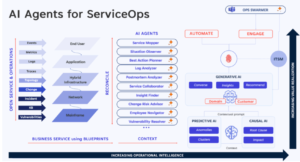
Figure 1. BMC Helix’s multi-agent system approach for reducing service downtime in ServiceOps environments.
After reconciliation, dynamic service modeling uses blueprints to build the data structure of the services, including information about configuration items (CIs) and their relationships. These modeled services provide critical context for AI to perform root cause analysis, continuous optimization, and continuous compliance. Service models also allow site reliability engineers (SREs) or DevOps engineers to pinpoint an application performance degradation to the network interface flapping.
Building on predictive and causal AI
Building on the predictive and causal AI capabilities of BMC Helix AIOps extends its foundation of historical data and machine learning (ML) to generate advanced insights, simulations, and recommendations. Integrating causal reasoning limits or eliminates hallucination and the use of outdated information. This helps agentic AI systems deliver consistent, precise, and reliable outcomes that are easier to trust, explain, and verify in real-world applications.
Causal AI is a branch of ML that emphasizes the understanding of cause-and-effect relationships versus solely processing patterns in data. Causal AI integrates knowledge-graph-based and transformer-based AI techniques to understand and model relationships across telemetry data variables. Casual AI can reason about casual relations or patterns using topological data. A knowledge-graph–based causality analysis analyzes how causal relationships change, depending on how the variables influence one another. This is crucial because, without causality, AI agents will not perform well in dynamic environments.
On the other hand, predictive AI uses historical data, ML, and statistical algorithms to forecast potential issues like performance bottlenecks and capacity shortages before they disrupt services. By integrating with predictive AI, agentic systems can use forecasts to act, often correlating a series of actions to complete the task, like optimizing cloud capacity based on resource shortage prediction.
Context and a composite AI approach
The next step in AI requires a composite AI approach that complements agentic AI with predictive, causal, and generative AI. We expect enterprises to deploy ecosystems of large language models (LLMs), knowledge graphs, and predictive and causal models that architecturally augment each other to create capable agentic AI systems.
Enterprises looking to deploy AI agents must have strong IT service and operations management (ITSM/ITOM) capabilities and accurate data to extract value from AI agents, including:
- CMDB: Make sure your configuration management database (CMDB) is accurate.
- Reconciliation: Ensure your reconciliation rules are protecting your CIs.
- Service models: Provide domain-specific knowledge as input to the AI pipeline.
It’s also important to have enough surrounding information to understand why systems are behaving the way they are, like knowing that high latency in service A happened right when service B released a new version. Without that context and a composite AI approach, AI agents won’t be effective digital partners.
Written by ServiceOps.
HappySignals’ Global Benchmark 2026: Employees Lose More Than Three Hours of Productivity Per IT Incident
New analysis of 1.77 million employee responses reveals that resolving tickets doesn’t necessarily make people happy, and that a small percentage of support cases create the majority of productivity loss. Solving IT issues is just the baseline. What drives satisfaction is how the ticket is handled.
HappySignals has released its Global IT Experience Benchmark 2026, the world's largest continuous dataset on employee IT experience, based on almost 2 million employee responses collected across more than 130 countries. The findings challenge several long-held assumptions about IT support and reveal high hidden costs in employee productivity.
According to the report, employees lose an average of 3 hours and 18 minutes of productive time per IT incident. The findings suggest that while organizations continue to invest heavily in AI, automation, and digital transformation, workplace productivity is still significantly impacted by unresolved friction in day-to-day IT services.
"The AI era is forcing organizations to rethink how they measure IT success," said Sakari Kyrö, Product Strategy Lead at HappySignals.
"Traditional operational metrics tell us whether systems are working. Experience data tells us how people feel about IT."
The Global IT Experience Benchmark 2026 analyzes employee feedback collected directly after IT incidents, service requests, and digital workplace touchpoints, providing one of the most comprehensive views of how employees experience enterprise technology.
Key findings
Employees care less about ticket resolution than IT leaders think
One of the report's most surprising findings is that only 6.6% of positive employee feedback directly addresses the technical issue itself. Instead, employee experience is more strongly influenced by communication, empathy, speed, and ease of getting help.
"The technical fix is only part of the experience," commented Kyrö. "Employees remember how support was delivered just as much as whether the issue was resolved."
A small number of tickets causes most productivity loss
The report found that 13.3% of support tickets involve multiple reassignments, with each handoff increasing employee frustration and productivity loss. Previous benchmark analysis has shown that a relatively small proportion of tickets accounts for the majority of lost work time, suggesting organizations may achieve outsizedgains by focusing on the most disruptive cases rather than average performance metrics.
Experience differs dramatically between employee groups
The research highlights substantial differences in how employees experience IT support depending on their role and work style. For example, the proportion of "Doers" — employees focused on completing tasks quickly and efficiently — varies significantly between regions, from 62% in Western Europe to considerably lower shares elsewhere.
The finding challenges the idea of a universal benchmark for employee experience. "The same IT service delivered in two organizations can generate very different outcomes because employee expectations differ," said Kyrö. "Context matters more than many organizations realize."
Human interactions continue to outperform digital channels
Despite years of investment in self-service and automation, employees continue to rate direct human support highly. The report found a substantial experience gap between support channels, with walk-in support achieving significantly highersatisfaction scores than portal-based interactions. The findings raise important questions as organizations increasingly rely on AI agents and digital support models.
Why this matters in the AI era
As enterprises push forward with AI transformation programs, HappySignals argues that employee experience will become an increasingly important business metric.
Organizations can deploy AI tools at scale, but productivity gains will only materialize when employees can successfully adopt and use those tools in their daily work. The report suggests that understanding employee experience may become one of the most important leading indicators of successful digital transformation.
Written by HappySignals.
SITS Celebrates its 30th Edition at Excel London
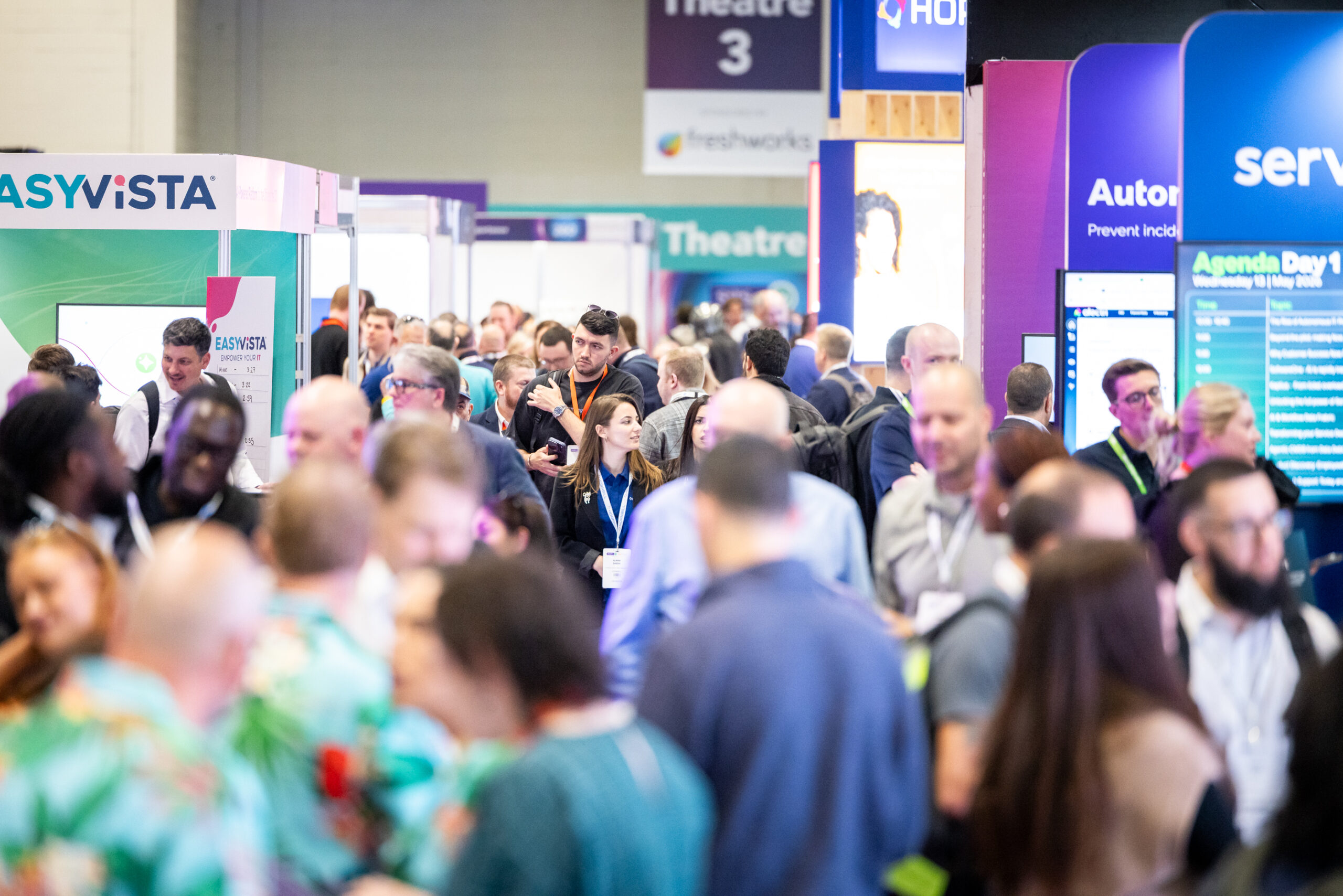
SITS – The Service Desk and IT Support Show, and the MSP Show returned to Excel London on the 13-14 May 2026 with a fresh wave of new exhibitors, and two days of high quality connections that left the community already looking forward to next year.
‘It’s always valuable to spend time with fellow ITSM professionals discussing best practices, emerging trends, and the challenges we’re all navigating’
SITS remains the only event in Europe offering a completely free ITSM education programme, spanning seminars, panels, Breakfast Briefings and Hot Topic workshops.
The largest ITSM-focused event in Europe, this year’s show brought together 140 vendors showcasing the latest in the IT service management, service delivery and support.
‘The energy at this show never disappoints. Neither does the community’
Event Director, Alice Fulton said: “Walking the show floor this year, the energy was hard to miss. People were genuinely engaged, having real conversations and finding real answers. That is what SITS is all about.”
Alice said “Reaching 30 editions is a milestone we are incredibly proud of. SITS has always been about serving this community, and the fact that it keeps growing tells us that the need for a dedicated space like this is as strong as ever.”
‘Everywhere I turned, there were conversations about automation, service operations, integrations, AI, security, ITSM, and data quality… I was genuinely in my element’
Exhibitors ranged from household names to emerging start-ups, including Alvao, Xurrent, NinjaOne and SysAid. Solutions covered everything from managing AI risk and leadership to employee experience and autonomous ITSM.
Beyond the sessions, the show floor had plenty to keep attendees entertained. This year's highlights included a KITT car and a McLaren on display, the Mandalorian and Grogu roaming the floor for photos, a dedicated photo wall. There was something for everyone between sessions.
“Nothing replaces a conversation with a real IT pro who looks you in the eye and tells you what they think. About the product. About the marketing. About the people. That feedback loop is worth every square meter on that show floor.” Comments David Protzmann, VP Marketing at NinjaOne.
The seminar programme ran across three theatres and a keynote and packed in 60+ sessions over two days. Speakers from across the industry tackled topics ranging from managing AI risk and leadership to employee experience and autonomous ITSM.
‘The programme was full of insights, my brain was so full of ideas afterwards!’
'The MSP Show is the perfect addition to SITS’
The third edition of the MSP Show took place alongside SITS, and by every measure it was the strongest edition to date. Attendance grew to 1,800+ MSP professionals, while exhibitor numbers increased by 10%. The response from attendees and vendors alike has been overwhelming, with feedback consistently describing it as the best MSP Show yet.
SITS Netherlands returns for the second year
SITS and the MSP Show Netherlands return to Jaarbeurs, Utrecht on 22 September 2026. Both events will be bringing the best of the London show to a Dutch audience, with a full programme of technology, education and networking built for the ITSM and MSP communities.
SITS, The Service Desk & IT Support Show and the MSP Show are back 19-20 May 2027 at Excel London.
Join the mailing list to find out more.

Why Your Service Desk Is Flying Blind Without ITAM
The cost of operating without full visibility
Endpoints, applications, and devices multiply across distributed networks faster than most IT teams can track. They can’t secure what they can’t see, and relying solely on agent-based tools means unmanaged devices and unpatched systems go undetected, widening security exposure.
When asset records are incomplete:
IT teams run through generic troubleshooting steps with no visibility into recent device changes.
Service disruptions take longer to resolve, and ecosystem policies may vary.
Tangible costs from untracked assets increase, including hardware expenses, software license overages, and maintenance costs.
IT teams and MSPs need unified visibility for every IT asset.
How ITAM changes issue resolution
IT Asset Management (ITAM) covers the processes an organization uses to manage IT assets, including all hardware and software. It centralizes every asset, managed or unmanaged, into a continuously updated inventory that replaces static spreadsheets with an accurate record of what exists, where it is, and what state it is in.
When asset data is connected and current, IT teams and MSPs spend less time gathering information and more time resolving issues.
Tickets are automatically populated with critical asset information, and endpoint health alerts help create, route, and escalate tickets. Root cause can be traced to a specific device or configuration, and asset dependencies can be reviewed before an update is pushed, reducing the risk of cascading failures.
Why ITAM and ITSM are stronger together
Many IT teams treat asset management and service delivery as separate workflows. Asset records live in one system; tickets get handled in another. The data exists, but it never reaches the person resolving the issue. The gap between the two is where resolution slows down.
Closing the gap starts with understanding what each discipline contributes. ITAM tracks every asset across its full lifecycle, from procurement to decommission. IT service management (ITSM) governs how IT services are planned, delivered, and improved to meet business goals.
The difference becomes tangible in an incident. Without asset context, a technician starts from scratch: standard questions, generic troubleshooting. With ITAM connected to the service workflow, the ticket surfaces that the device is three patches behind, disk usage spiked two days ago, and a configuration change was pushed last week. The technician instantly knows where to look.
For IT teams and MSPs, that connection means fewer handoffs and faster resolution. It's the most immediate efficiency gain available to teams already running ITAM.
Building the practice
ITAM is a process, not a one-time project. Every new device should be added to the inventory at deployment, with monitoring software installed immediately. Periodic scheduled scans and automatic alerts keep asset records current without manual effort. Connecting ITAM with an RMM or endpoint management tool makes the practice more impactful and scalable.
The result is an IT operation that can see its entire environment and act on what it finds: lower resolution times, fewer repeat incidents, and better control over cost and risk.
For a practical guide to building a stronger ITAM foundation, read Fixing IT Asset Chaos.
Written by Amanda Kaza, NinjaOne.
Find NinjaOne on stand 451.

Why Automated IT Distribution Is Becoming a Service Desk Essential
As organisations support hybrid working, mobile staff and shared device models, IT distribution has become a critical, and often underestimated, service desk challenge. Laptops and peripherals are no longer static assets issued once and forgotten; they move continuously between users, locations and support teams. For service desks and MSPs, this has increased pressure to deliver devices quickly, securely and with minimal manual effort.
The Growing Complexity of Device Logistics
Many organisations still rely on traditional methods such as scheduled device collection, manual handovers and decentralised storage. While familiar, these approaches do not scale well. They often require staff to travel to collect or return equipment, reduce visibility of assets and place additional strain on already stretched support teams.
Industry insight consistently shows that poor asset visibility and inefficient lifecycle management contribute to longer resolution times, duplicated effort and unnecessary device purchases. In environments where staff depend on timely access to technology, such as healthcare, education and large enterprises, delays in device availability can directly affect service delivery.
Automation as a Practical Response
To address these challenges, service desks are increasingly treating IT distribution as an integrated operational process rather than an isolated task. Automating device distribution through service management, asset and identity systems enables organisations to standardise how equipment is issued, returned and redeployed.
This approach reduces manual handling, improves auditability and creates a more consistent user experience. For MSPs managing multiple customers or sites, automated distribution models also provide repeatability and control, helping teams scale services without increasing complexity.
Evidence from the Front Line: RDaSH
The experience of Rotherham, Doncaster and South Humber NHS Foundation Trust (RDaSH) illustrates the measurable impact of modernising IT distribution. Supporting more than 155,000 patients annually across 128 sites, the Trust faced significant inefficiencies in how devices were issued and maintained for its geographically dispersed workforce.
During a proof of concept, RDaSH distributed over 1,000 laptops through automated locker based distribution and reported savings of more than 2,000 clinical hours, the equivalent of a full time nurse. The Trust also eliminated regular on-site visits across three major sites, reducing travel time and face to face dependency for both clinicians and IT staff. Device swaps that previously took hours were completed in less than an hour, directly improving staff productivity and service continuity.
Turning IT Distribution into a Measurable Service Outcome
Rather than being a logistical afterthought, IT distribution is increasingly recognised as a strategic service desk capability. When distribution is automated, measurable and aligned with wider service workflows, it supports faster onboarding, better asset utilisation and improved user satisfaction. For service desks and MSPs alike, modern IT distribution is becoming a key enabler of scalable, resilient and user focused services.
Contact email: [email protected]
Contact phone: 0800 130 3456
Written by Kay Tilbury, LapSafe.
Find LapSafe on stand 560.

Meet the Brand: SysAid
SysAid is on a mission to put AI to work for organisations and their people. Built on a robust ITSM platform, SysAid's Agentic AI automates repetitive tasks and frees teams from reactive work. AI Agents take the first action, so IT pros intervene only when truly needed. Organisations can go live in weeks with rapid onboarding and no heavy migrations, with security and governance built in by design.
What does SysAid do?
SysAid is an AI-native Enterprise and IT Service Management platform built for organizations that are ready to move beyond reactive IT.
At the heart of SysAid's platform is Agentic Service Management, in which autonomous AI Agents take the first action throughout the full service lifecycle. Incidents, requests, workflows, asset management, remote support, and AI Agents handle it end-to-end, across the tools your teams already use, without waiting to be told. IT professionals step in only when genuinely needed, freed to focus on the work that actually requires human judgment.
With over 100 prebuilt AI Agents available across platforms, including Microsoft Teams, Jira, and Splashtop . and an AI Agent Builder that lets teams create and deploy custom agents in days, SysAid makes agentic ITSM practical, not theoretical. Security and governance are built in by design, and organisations go live in weeks with no heavy migrations required.
With over 5,000 customers, SysAid partners with organizations from small businesses to Fortune 500 enterprises across 140 countries.
How did you get started?
SysAid's current chapter represents a fundamental shift in what service management can be.
Rather than adding AI at the edges of an existing product, SysAid rebuilt its vision around autonomous operations. In March 2025, a full Agentic AI Platform with ready-to-deploy AI Agents became generally available, making SysAid one of the first ITSM vendors to put true agentic capability directly in the hands of IT teams. By late 2025, SysAid went further, introducing fully agentic coding into its AI Agent Builder: the AI autonomously interprets requirements, generates production-ready code, and validates its own outputs, dramatically accelerating how quickly teams can build and deploy custom agents.
Recognition has followed. SysAid was named in the 2025 Gartner® Magic Quadrant™ for AI Applications in IT Service Management, achieved the highest overall score in the Gartner® Peer Insights™ Voice of the Customer report, and was named AI Company of the Year at the 2025 Globee® Awards for Artificial Intelligence.
What are you looking forward to most at SITS 2026?
SITS is where the real conversations happen. where IT leaders talk frankly about what's working and what's still a struggle. We're especially looking forward to discussing:
- What agentic ITSM looks like running live in production, not in a sandbox
- How organisations are governing AI Agents at scale, safely, and with confidence
- The practical path from reactive service management to truly autonomous operations
- What IT team roles look like when AI Agents handle first response by default
We're most excited to meet leaders who are ready to stop evaluating AI and start running it.
Why should visitors come to your stand?
Booth 211 isn't going to feel like a booth. We're doing something different at SITS this year, bringing the energy, the fun vibes, great swag, an unforgettable experience, and even the chance to win a trip for 2 to the Canary Islands
Come to see Agentic AI running live. Stay for the atmosphere. Here's what you'll find
- Agentic ITSM in action: Live demonstrations of AI Agents autonomously resolving tickets, orchestrating workflows, and executing tasks end to end across your existing tool stack.
- Honest, experience-led conversations: Talk to SysAid practitioners about where to start, what governance looks like in practice, and how to build a roadmap that delivers measurable outcomes.
Find SysAid on stand 211.
SITS - Service Desk & IT Support Show, taking place at Excel London 13-14 May 2026.
For further information, please visit www.servicedeskshow.com.

The hidden cost of institutional knowledge in IT
There’s a person on almost every IT team who just knows things.
They know why the integration between the CRM and the billing system behaves strangely on the last day of the month. They know which server can’t be patched yet because of a dependency no one properly documented. They know that when a particular error code appears, you don’t follow the runbook; you call Dave.
This person is invaluable. They’re also a ticking clock.
What is institutional knowledge, and why is it dangerous?
Institutional knowledge is the informal expertise that lives inside people’s heads rather than in documented systems. It builds up naturally over time in any IT environment. A workaround gets implemented under pressure and never properly written up. A vendor issue gets resolved through a conversation that no one thought to log. A configuration decision gets made for good reasons that were never recorded anywhere.
None of this feels dangerous in the moment. In fact, it often feels like efficiency. Why document everything when the person sitting next to you knows the answer?
The problem is that IT environments are in constant flux. People get promoted. People leave. Teams grow. And every time one of those things happens, a piece of that invisible knowledge either walks out the door or gets stretched too thin trying to cover too many gaps.
What this actually looks like in IT
It’s worth being concrete about what institutional knowledge looks like in practice, because it rarely announces itself. It tends to accumulate in a handful of recurring places:
Undocumented workarounds. A specific script gets run manually every Sunday night to prevent a downstream reporting failure. It’s not in any runbook. The engineer who wrote it left eighteen months ago. The person currently running it learned it from them informally and isn’t entirely sure why it works.
Vendor and integration quirks. The API connection between two SaaS platforms occasionally drops authentication tokens under a specific load condition. The fix takes thirty seconds if you know it, and hours to diagnose if you don’t. That fix exists in one engineer’s head, not in the documentation.
Patch and update exceptions. Certain servers can’t be updated on the standard cycle because of a dependency introduced years ago during a rushed migration. No ticket captures this. It’s kept alive purely through institutional memory, and each time a new team member nearly triggers the issue, someone catches it in the nick of time.
Access and permission logic. In many environments, the actual permission structure in production diverges significantly from what the diagrams show. Shadow admin accounts, legacy groups, role exceptions granted during incidents, someone knows how these work. The org chart doesn’t.
Read the full blog here.
Written by Oded Moshe, SysAid.