

Speaker Q&A: Mark McGinn, MarXtar
Introducing Mark McGinn, Chairman & Founder of MarXtar Group. Mark is a seasoned professional with over 25 years’ experience of delivering Systems & Service Management across the full spectrum of Senior Management, Marketing, Product Management, and Technical roles. Mark has been referred to as the Yoda of the IT world.
On 18 April at 10am, Mark will be taking to the stage at SITS, Theatre 2, to present 'Black Holes in Asset Management.' In this seminar, he will discuss some common problems in IT asset management and how rectifying them requires a holistic approach, with a focus on accuracy, and compliance.
- How did you get into the profession?
‘Constructive laziness’ as I prefer to call it; that, and an aversion to getting wet. I started out in a particularly rainy corner of the north of England supporting PCs and networks. Getting to some of the systems meant crossing open areas of the sites I worked at, so a desire to be able to do things remotely, stay out for the rain, and to minimise the steps required to deliver repetitive tasks so that I could spend more time on things that were more interesting led me to endpoint management tools and integrating them into early service management tools.
- What advice would you give young people looking to get into the industry?
At the beginning of your career, the thing that you love and are best at might not even exist yet, which is something I’ve always loved about being in IT. Look around you and learn what you can about what you can see. Be flexible by building your knowledge and understanding how different aspects of IT come together so that whatever comes your way you can adapt and excel.
- What’s your most memorable work moment?
At a previous company we would often do fancy dress and thought it highly amusing to dress up for the evening event of our main vendor’s partner conference in Munich, Germany. Unexpectedly, I found myself the recipient of an award for engineer of the year, so had to head up on stage in full Bavarian mode wearing knee-length lederhosen with a particularly fetching feather in my cap. The American CEO presenting the award didn’t even crack a smile.
- What are the key points you’ll be covering in your seminar session at this year’s SITS?
“Black Holes in Asset Management’ will cover a range of areas, but I suppose the main part is that often we see a gap between the people that want to use the information and the people responsible for the provision of that data. With the proliferation of data sources, a lack of understanding of where data comes from, and what data is used for, can lead to some challenging situations.
- What are you looking forward to the most at SITS?
For me, SITS is an opportunity to catch up with people I don’t otherwise get a chance to see. This can be people at the various vendors as well as people I’ve known over the years.
Meet Mark at SITS, The Service Desk & IT Support Show, on 17-18th April 2024, ExCeL London. You can now register for your free ticket here.

Unlocking the Power of WhatsApp Business: A Pro's Guide to Secure Client Communication
WhatsApp Business is a secure communications app aimed at helping business professionals over and above the traditional WhatsApp platform. IT can be a very helpful secure communication system that allows you to create a professional profile, showcase your products and services, and connect with your customers in a more personal and convenient way.
You can also use the WhatsApp Business Platform, a cloud-based API that enables you to send and receive messages at scale, automate responses, and integrate with other systems.
But how secure is WhatsApp for business communications? Can you trust it to handle sensitive data and protect your privacy? Here are some of our top tips for WhatsApp Business including how it works and how to get the best out of the app for secure communications.
Why use the WhatsApp Business API?
WhatsApp Business API is a tool specially designed for businesses to power secure communication with customers all across the globe safely and effectively. It is an advanced and scalable solution that allows businesses to communicate with customers at scale. Businesses can create a business profile, manage their catalogue, and chat with their customers directly on WhatsApp.
What are the benefits of using WhatsApp Business?
Reach a large and engaged audience: WhatsApp has over 2 billion users who spend an average of 195 minutes per week on the app. By using the WhatsApp Business API, you can tap into this massive and loyal user base and deliver personalised and relevant messages that can drive engagement, loyalty, and conversions.
Provide fast and convenient customer service: Customers today expect quick and easy solutions to their problems, and WhatsApp can help you meet their expectations. With the WhatsApp Business API, you can provide instant and automated responses to common queries, such as order status, delivery confirmation, appointment reminders, and more. WhatsApp allows you to respond to customer queries, feedback, and requests in real time, and provide a more human and friendly touch to your communication.
Increase sales and conversions: WhatsApp can also help you generate more leads and sales for your business. With the WhatsApp Business API, you can send proactive and timely messages to your customers, such as product recommendations, offers, and payment links, to encourage them to take action. You can also use the API to create interactive and conversational flows that can guide your customers through the purchase journey, such as product discovery, basket abandonment, upselling, and cross-selling.
Send feature-rich and interactive messages: WhatsApp Business lets you send more than just text messages. You can also send images, videos, documents, voice notes, and locations to enhance your communication. You can also use interactive buttons and menus to enable customers to take actions such as making a purchase, booking an appointment, or confirming a delivery.
Measure and improve your performance: WhatsApp Business provides basic metrics such as the number of messages sent, delivered, read, and received, which can help you monitor and optimise your communication strategy.
Is WhatsApp for business a secure communications system?
End-to-end encryption in WhatsApp Business
Privacy and security are often the top concerns when it comes to choosing to use this communications app or not. However, WhatsApp Business is designed with security and privacy in mind.
All WhatsApp messages, including those between people and businesses, are protected by end-to-end encryption, which means that only the sender and the receiver can read or listen to them. WhatsApp describes it as if ‘your messages are secured with a lock, and only the recipient and you have the special key needed to unlock and read them. All of this happens automatically: no need to turn on any special settings to secure your messages.’
How to make WhatsApp Business more secure for your client communications
End-to-end encryption is likely not enough to ensure the security and privacy of your business communications. Therefore, there are other factors and risks that you need to consider, such as:
The consent and preferences of your customers: WhatsApp requires businesses to obtain explicit and verifiable consent from customers before initiating any messages to them. This consent can be obtained through various channels, such as your website, app, email, or SMS. You also need to respect the preferences and choices of your customers, such as opting out, blocking, or deleting your messages.
The security and compliance of your systems and processes: WhatsApp provides a secure and reliable platform for your business communication, but it does not guarantee the security and compliance of your own systems and processes. You are responsible for ensuring that your devices, networks, servers, software, and personnel are properly secured and trained to handle your business communication. You also need to implement appropriate policies, procedures, and controls to prevent and respond to any security incidents or breaches. You should also conduct regular audits, reviews, and tests to evaluate and improve your security and compliance posture.
Data protection and privacy laws: every jurisdiction will have its own data protection and privacy laws and with WhatsApp Business it is your responsibility to ensure you meet these requirements for secure communications. For example, the European Union is subject to the General Data Protection Regulation (GDPR) in the European Union and it generally considers WhatsApp to be compliant in most cases (subject to a recent ruling by the Irish Data Protection Authority).
Are there any drawbacks to WhatsApp Business security?
Even though WhatsApp Business uses end-to-end encryption, it is important to note that after a message has been received by the chosen business, it is subject to the business’s own privacy practices and not WhatsApp’s. The communication will also still be subject to any industry specific regulation. This can create challenges that may lead businesses to look for alternatives to WhatsApp, like ClientWindow, which solve these problems. For example, whilst WhatsApp Business may be a communications app focused on business messaging, it will still often be hosted on personal devices. Therefore, these messages can easily be deleted, lost if that person decides to leave or lead to general confusion with client messages being siloed and forgotten about.
ClientWindow solves all these problems by providing a secure platform where message history cannot be deleted, all relevant team members have access to it and, best of all, your customers don’t see anything different because they can continue to use WhatsApp just like they always have.
This means ClientWindow acts as a safe WhatsApp alternative, where your business gets all the benefits of using WhatsApp whilst ensuring secure communications, greater levels of compliance to industry regulations and excellent customer service.
Meet the ClientWindow team at the MSP Show on 17-18th April 2024, ExCeL London. You can now register for your free ticket here.
By ClientWindow

SITS unveils the lineup for the only free ITSM programme in Europe
The countdown to SITS – The Service Desk & IT Support Show is on, as the exhibition returns to ExCeL London on the 14-15 May 2025.
SITS is proud to offer the only free ITSM education programme in Europe. Over the two days, there will be a Keynote theatre, Breakfast Briefings and Hot Topic workshops, including sessions on everything from AI, automation, ITIL, customer and employee experience, enterprise service management and self-service.
The programme has been curated to include top speakers from the ITSM world and beyond, as well as big industry names, including Freshworks, GoTo, Atlassian and Manage Engine.
‘Super intuitive technical sessions with top innovators!’
Zoe Thompson from Phoenix Life and Wellbeing Coaching will be hosting the session ‘Thriving together: Building a resilient team for success.’ The seminar will explore how to cultivate resilience in your team and how to provide the tools they need to thrive in any challenge.
“Shift Left” is a classic industry buzz word, but it can be hard to implement. Phil Payne from Bidvest Noonan will be hosting the seminar ‘Making ‘Shift Left” a reality,’ where he will share tips and tricks as well as an example where the implementation of a new operating model meant this was a necessity and not just an aspiration.
Another huge theme that has been dominating the headlines this year is AI. Gustav Elveros from Ebbot will be presenting ‘Generative AI in ITSM: Exploring benefits and mitigating risks.’ The seminar will explore the highs and lows of integrating generative AI, providing insights into what to expect, how to ensure a secure implementation, and most importantly – how to avoid the risk of automating the wrong tasks.
‘The seminars provided valuable insights into the industry’
The MSP Show, co-located with SITS, is a new trade exhibition dedicated to the rapidly growing Managed Service Provider sector. The show will have a dedicated theatre full of sessions specifically aimed at MSPs and improving their businesses. Expect sessions on everything from marketing to AI. More details on the programme will be announced soon.
You can view the full programme here.

How IT can leverage AI for incident management
The consumer credit rating giant Equifax was fined $13.4 million on October 13, 2023, for its role in one of the most significant cyber-security breaches in history by the Financial Conduct Authority (FCA), Britain’s financial watchdog.
The fine was imposed on Equifax for failing to protect the data of nearly 14 million UK customers. The exposed data included names, dates of birth, phone numbers, addresses, and some credit card details of UK consumers.
The FCA called the incident “entirely preventable”.
To set some context, in 2017, Equifax suffered one of America’s largest data breaches that exposed the personal information of 147 million US citizens.
That’s roughly 40% of the country’s population.
The reasons for the hack – a known server vulnerability issue, an outdated email list, and an expired digital certificate.
Equifax had notified its sysadmins to patch the issue, but the person responsible did not get the message because Equifax’s email list was out of date. Additionally, an expired digital certificate allowed malicious network activity to stay hidden. The attack lasted about 76 days before it was discovered.
The result?
$1.7bn in legal settlements and other costs.
Equifax lost $5.3 billion in market valuation as its stock price fell by 31%.
Entirely preventable.
While it’s easy to speculate, one can only imagine if this incident could have been averted with the help of AI.
AI is increasingly playing a crucial role in shaping and modernizing IT Service Management (ITSM). The integration of AI in ITSM processes like incident management is not just about enhancing efficiency but also about genuinely revolutionizing how ‘traditional’ IT services are delivered.
How can AI help with incident management?
Incident prevention
By analyzing historical data, ML algorithms can predict and even prevent incidents before they occur. Without human intervention, these ‘self-healing’ systems can detect and resolve incidents automatically. Self-healing systems are designed to identify anomalies, errors, or failures and initiate corrective actions autonomously. This reduces downtime, enhances system reliability, and minimizes the need for continuous human monitoring and intervention.
Conversational IT support
AI can comprehend users’ queries in natural language without needing the usual keywords or phrases that traditional systems need. This helps understand the user’s actual needs and issues and, most importantly, on the platform of their choice instead of one specific portal.
Once the user’s query is understood, a GenAI assistant can tap into the right resource: a knowledge base, chat history, or even transcripts from past support calls and provide a natural language solution.
The thing to note is that the AI assistant is constantly learning. Over time, it will be to handle and deflect trivial and repetitive issues that IT support agents often find monotonous and time-consuming. The AI agent thus frees up human agents to focus on more complex and challenging problems.
24/7 support
We recently conducted a study across IT professionals and end users to understand how they feel about their IT teams. One of the things we asked end-users was what they’d like their IT team to start, or stop, doing. One of the most popular answers was “Provide 24/7 support”.
Another noteworthy insight from the study was that “Let me fix IT issues myself” ranked among the lowest. So, if driving self-service is in IT’s best interest, it would benefit them to give employees a natural and human-like experience. AI can help do this at scale while being available around the clock.
Faster resolution
The AI assistant can quickly solve L1 issues and route the problems that require a human agent’s involvement, thus resulting in faster resolution. Even if the issue is escalated, the bot can be used for incident triaging and routing, thereby ensuring that the incident is rightly categorized and prioritized. The bot can also determine the best-suited agent to handle the issue. This streamlining results in faster resolution.
The AI bot can provide human agents with detailed insights and relevant information by analyzing past instances of similar issues and suggesting potential solutions. This speeds up resolution and also enhances the quality of support provided to the user.
Finally, the bot can also summarize call transcripts or text-based conversations into concise notes, significantly reducing the time agents spend on the task. The AI can highlight key issues discussed, steps taken, and solutions provided, making the documentation process more efficient and accurate.
Upskilling IT teams with AI
AI can analyze vast amounts of data, identify emerging trends, and provide insights. These insights include identifying new threat patterns, technology trends, or operational efficiencies and will help IT teams foster a culture of continuous learning.
Furthermore, AI can help create personalized learning pathways for IT professionals by analyzing an individual’s current skills, past learning history, and the evolving needs of the IT landscape. This learning can be further accentuated with a hands-on approach by generating realistic simulations and scenarios that mimic emerging challenges in the IT landscape.
Finally, as incident management practices evolve with new technologies and methodologies, AI can help IT professionals stay updated on best practices by assisting them to understand new security protocols and learn about innovative technologies.
Conclusion
AI can make a world of difference for the IT team, especially incident managers, to not only improve efficiency, but also enhance the quality of the IT services and user experience.
It’s important to approach things with a user-centric mindset while focusing on the outcomes that AI can help you achieve, rather than sticking with traditional processes and tacking on AI as an afterthought.
By Sajeesh Sahadevan, Atomicwork
Meet the Atomicwork team at stand 595 at SITS, The Service Desk & IT Support Show, on 17-18th April 2024, ExCeL London. You can now register for your free ticket here.

How AI Enhances Problem Management Capabilities and Results
If problem management has been a tough nut for your organization to crack, using artificial intelligence (AI)-enabled capabilities offers help with what might have previously been seen as a labor-intensive IT service management (ITSM) capability. Or you might not have tried to create and benefit from ITIL-espoused problem management capabilities yet. Either way, this blog describes how problem management, aided by AI technologies, will be a helpful weapon in your ITSM-capability armory.

A quick introduction to problem management
ITIL 4 defines a problem as the “cause, or potential cause, of one or more incidents.” While the problem management practice helps organizations to “reduce the likelihood and impact of incidents by identifying actual and potential causes of incidents and managing workarounds and known errors” (source: Axelos, Problem Management ITIL 4 Practice Guide (2020)).
The benefits of problem management can be far-reaching and include the following:
- Quicker incident resolution
- Reduced service downtime and employee lost productivity
- Reduced incident levels because incident root causes are addressed
- Reduced IT support costs, thanks to the faster resolutions and reduced number of incidents
- Reduced service and operational disruption
- More time for IT staff to focus on higher value-add work
- Improved perceptions of the IT organization.
The current state of problem management adoption
Understanding the current level of problem management adoption and success is difficult because there are differing views as to what problem management is. For example, there’s the ITIL 4 defined practice outlined above versus only using problem management techniques to undertake major incident reviews.
The Axelos 2022 ITSM Benchmarking Report found 80% of organizations state that they “do” problem management, but what this entails versus the ITIL definition of problem management is unknown. For the organizations with problem management capabilities, 31% stated their problem management capabilities work well, while over two-thirds (69%) said they need improving.
In many ways, problem management has been a tricky ITIL capability for organizations to adopt successfully, starting with funding problem management as a business-as-usual (BAU) capability rather than an ad hoc event. But even with funding, there are still often execution-based issues such as:
- The people in problem management roles also have other ITSM priorities
- Insufficient skills or technological enablement.
However, a critical barrier to problem management success is often the effort required, where the discipline is potentially viewed as labor-intensive with an imbalance between the effort needed and the value delivered. The use of AI-enabled problem management capabilities helps to overcome this latter issue.
Using AI capabilities and RPA for problem management
Using AI-enabled capabilities and robotic process automation (RPA) allows organizations to benefit better from problem management. These benefits relate not only to how problem management is undertaken but also to the improved insights and outcomes it delivers.
However, it’s essential to understand the difference between the two technology types before appreciating how they will help with problem management:
- RPA is software robots mimicking humans’ screen-based actions to perform tasks. The software robots follow defined processes and interact with corporate applications just as people would. Traditional RPA is not AI. However, it can be combined with AI for intelligent automation.
- AI is described by ITIL 4 as “Highly advanced automation that demonstrates capabilities of general reasoning, learning, and human-like intelligence; a branch of computer science and engineering focused on simulating intelligent behavior in computer systems.”
A simple way to distinguish between RPA and AI is that RPA replicates actions, while AI replicates thinking (and potentially actions when combined with automation technologies).
RPA and problem management
RPA can be used for:
- Data gathering – with the RPA collecting and consolidating data from various sources. This speeds up problem and trend identification.
- Root cause analysis – RPA can automate routine tasks in root cause analysis, such as running diagnostic tools, querying databases, and analyzing logs.
- Knowledge management – RPA can automate creating, updating, and maintaining knowledge articles, including workarounds.
- Communication – RPA can automate communication between ITIL processes, such as incident management, change enablement/management, and problem management.
- Reporting: RPA can automate problem management report and dashboard generation.
AI and problem management
AI can be used for:
- Intelligent automation – with AI driving automation tools to automate problem management tasks, such as data collection, communication, and report generation.
- Advanced data analysis for proactive problem management – where AI can analyze larger volumes of structured and unstructured data than humans (and more quickly) to identify patterns and trends. This opportunity includes real-time problem detection.
- Text analysis using natural language processing (NLP) – for example, the content of incident tickets, chat transcripts, and knowledge articles can be used for categorizing incidents and identifying relationships.
- Root cause analysis – AI can also assist in automatically determining the root causes of problems by analyzing various data sources, such as configuration data, log files, and performance metrics.
- Predictive analytics – where AI algorithms predict potential problems before they occur (and their root causes) based on historical data and patterns.
Whether your ITSM tool vendor introduces RPA, AI, or both into its problem management capabilities, the result is “better, faster, cheaper” capabilities that increase the efficiency and effectiveness of your problem management operations. Advanced technological enablement can make a significant difference to your problem management success.
Meet the IT Care Center team at stand 480 at SITS, The Service Desk & IT Support Show, on 17-18th April 2024, ExCeL London. You can now register for your free ticket here.

The MSP Show launches alongside SITS 2024
Diversified Communications is delighted to announce the launch of The MSP Show, a new trade exhibition, dedicated to the rapidly growing Managed Service Provider sector.
The event will launch at ExCeL London on 17-18 April 2024 and will be held alongside the highly successful SITS – Service Desk & IT Support Show. SITS is recognised as the leading event in Europe for IT Service Management, attracting over 3,000 decision makers every Spring.
Dedicated to MSPs who want to provide exceptional service for their customers, the exhibition will include a diverse list of leading MSP suppliers alongside a comprehensive conference programme.
The exhibition will feature key suppliers from the following sectors: Cyber Security, Helpdesk/Service Desk, Cloud hosted telecoms, Business Continuity and Backup, RMM/Endpoint Management, Audit/Data & Analytics, Unified Back up – Communications & Collab, Network Solutions/Infrastructure. Exhibitors include HaloPSA, ThreatLocker, NinjaOne, ConnectWise, Kaseya, Techno Global, Uptime Solutions and Manage Engine.
The seminar programme will be free to attend and offer invaluable training opportunities, inspiration and insight into current technological developments, case studies and real-life business journeys of MSPs.
David Maguire, Group Event Director at show organiser Diversified Communications, commented: “We are incredibly excited to announce the launch of the much-anticipated MSP Show, which is in direct response to requests from the industry. With the sector set to reach USD 283.90 billion in 2023, the timing is perfect for this exciting new launch.
We have been overwhelmed by the enthusiasm from the industry and are confident that the MSP Show will establish itself as the most informative event in the industry calendar.”
Michelle Coombs, The Tech Leader Network agrees – “As a previous attendee to SITS, I have always seen the value of this event and have hoped that MSPs would attend. So, the launch of the new MSP Show, taking place alongside SITS, makes complete sense. I will definitely be attending.”
The MSP Show is taking place on the 17-18 April 2024 at ExCeL London. Registration is free, you can book your free ticket here.

Will 2024 be the breakout year for AI in IT?
It feels like using artificial intelligence (AI)-enabled capabilities in IT has been a “given” for nearly a decade (and my first sight of corporate AI research plans was in 1999). But as with many new opportunities, it can take time for new concepts and innovations to move from “talked about” status to “production reality.”
Your organization might already be experimenting with or piloting the use of AI-enabled capabilities in IT, but what about the rest of the IT industry? Don’t worry; we have some data on this. And when will AI break out of its “most talked about” status to become a mainstream IT staple?
Personally, I think 2024 will be AI’s breakout year, and this blog explains why based on the following six indicators and factors.
1. The results of a recent “State of AI in IT, 2024” survey
Atomicwork and ITSM.tools recently started a series of surveys examining AI adoption in IT organizations. The results of the first of these, looking at the State of AI in IT, 2024 report, showed that most IT organizations were already focused on AI opportunities in 2023. Only 11% of the 250 IT professionals who responded stated that their organizations had no plans to use AI.
This data point is likely related to creating bespoke AI applications that benefit the IT organization (and the wider business as a result). After all, many “off the shelf” business applications already include AI capabilities, so it will be difficult for IT organizations not to use AI capabilities to some degree. This “backdoor” to AI adoption is covered next.
2. The addition of AI-enabled capabilities to corporate software
Whether IT organizations want to use AI-enabled capabilities or not, the software products/services they use and provide for other business functions are adding them at pace, especially generative AI capabilities on the back of the ChatGPT media hype (covered next). For example, IT service management (ITSM) tools, where ITSM.tools AI-focused research in 2023 found that nearly three-quarters of the organizations with an ITSM tool already have access to AI capabilities.
It doesn’t mean that all organizations will use the capabilities, especially when paid-for options, but it increases the opportunity to do so.
3. The media hype around ChatGPT and generative AI
2023 saw ChatGPT elevate AI, and not just generative AI, from a technology-focused opportunity to a boardroom discussion area. So many people “played” with ChatGPT on the back of the media hype, and the aforementioned State of AI in IT, 2024 survey found that three-quarters of employees already use free AI tools in the workplace to help with tasks such as creative ideation or problem-solving, email drafting or editing, and content creation or editing. This might be more of an “It’s making my life easier” approach than “It’s going to improve our business,” but it’s already showing the employee demand for AI-enabled capabilities across the enterprise.
So, even if an IT organization has yet to “use AI in anger,” it’s likely that the business’s employees have (and likely without the IT organization’s knowledge or assistance). For any seasoned IT professional, this gap between what the IT organization currently provides and what employees feel they need (to work) is similar to the rise of “Shadow IT” for devices and applications that then extended to personal and process-enabling cloud services. The question is, “How will your IT organization tackle this immediate employee demand for AI-enablement?”
4. The demand for AI adoption help
At the end of each year, ITSM.tools polls its readers to understand the ITSM areas they’d like to read about in the year ahead. The previous content polls showed high interest in AI-related articles before it dropped down for 2022. Interest then started to rise again, with the 2023 level shown in the image pre- “ChatGPT media explosion.”
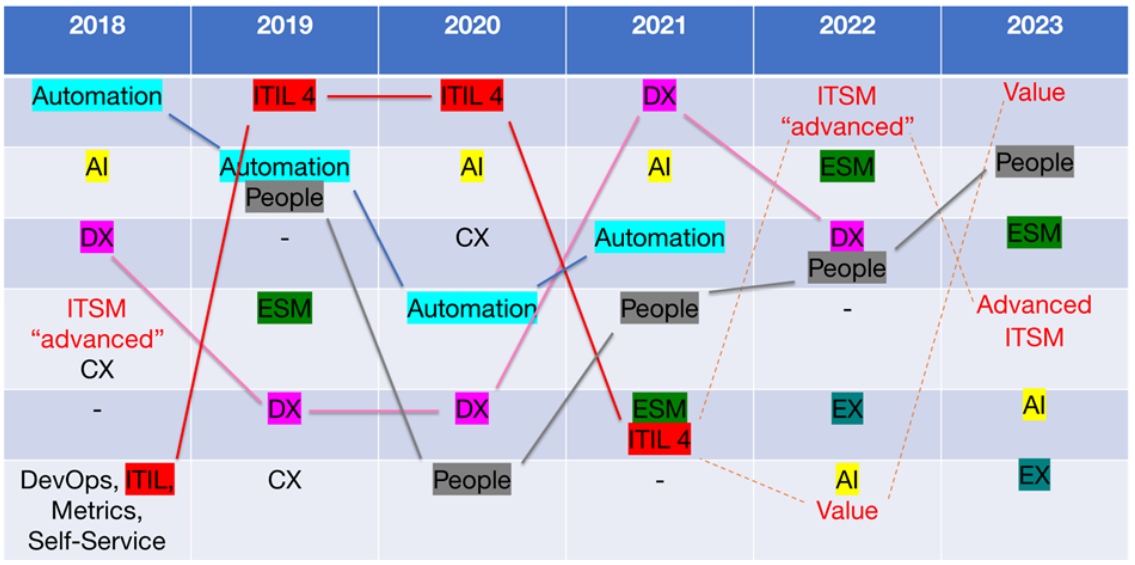
Source: https://itsm.tools/hottest-itsm-trends-2023/
In the 2024 poll, reader interest in AI content has jumped again. While the poll is ongoing, the initial results show AI as the most-wanted content area, selected by 44% of respondents (who could choose five of 25 options) and 10% higher than the second-placed area.
While the insight isn’t captured in the poll, logic suggests that the drop and then rise of AI is a sign of IT professionals moving from wanting to understand “the art of the AI possible” to now needing help and guidance on moving their AI planning, exploration, and pilots on into production use cases that benefit IT operations and business outcomes.
5. The Gartner AI Hype Cycle and 2024 generative AI expectations
I’m not a Gartner Research customer, but there’s usually access to some of its most popular research on the internet via tool-vendor licensing or Gartner’s public-facing content. A good example of the latter is the Gartner “Top of Mind” YouTube videos, with this 2024-focused video including the 2023 Gartner AI Hype Cycle and the expectation that organizations will move from experimenting with generative AI in 2023 to full-scale implementation in 2024 (sliding down the Hype Cycle’s Peak of Inflated Expectations to the Trough of Disillusionment as organizations realize that implementation is harder than they expected).
So Gartner predicts 2024 will be a turning point for generative AI, with organizations needing to meet the many challenges its adoption into production brings. This might be interpreted as the largest of organizations speeding ahead with generative AI, but based on other ITSM.tools research related to experience management and enterprise service management, there no longer seems to be the traditional “waterfall effect” of new idea and capability adoption flowing down from the largest organizations to mid-sized organizations and then finally to smaller organizations. I’d be willing to bet that the same will be true for generative AI, with the largest and smallest organizations going neck-and-neck regarding adoption, with mid-sized organizations the relative “laggards” but still focused on adoption.
6. The global economic climate
While different from the previous five indicators and factors, this is hopefully the primary one that will drive IT organizations to move their AI ambitions into production-affecting actions, i.e. meeting business needs.
While the mantra of “better, faster, cheaper” has long been prevalent in the IT space, there’s no doubt that most businesses are looking for ways to reduce operating costs in what has been a period of high inflation that delivered the double bottom-line whammy of increased costs and customer spending barriers.
Businesses will look to their IT organizations to help, with elements of the overall corporate solution involving greater technology and data exploitation and generative AI leveraged to speed up processes, increase productivity, reduce costs, and improve experiences.
Joining the dots on (generative) AI adoption
No matter the indicator or factor, it’s hard to bet against 2024 being the breakout year for AI. The combination of factors, such as the rising AI inclusion in corporate software, the state of the global economic climate, and the media hype around ChatGPT, mean that IT organizations will be focused on AI adoption whether they had planned to or not.
In the same way that the global pandemic accelerated digital transformation strategies for 80% of organizations (and the uptake of enterprise service management for business process digital enablement), there’s now another “perfect storm” heading into IT. This time, it’s AI, and as with all new technologies, it will start as a race for competitive advantage before becoming a necessary staple of IT.
There will, of course, likely be many mistakes made by organizations as they try to make AI a production reality. In fact, AI has probably already predicted this based on historical technology adoption data. However, this time, technology can help organizations to learn from these mistakes. In my opinion, it won’t be long before AI helps with AI adoption. It might sound crazy, but why wouldn’t it?
By Stephen Mann, Principal Analyst and Content Director, ITSM.tools
Image credit: https://claudeai.wiki/


What if? Your catalyst for transformation...
Imagine waking up tomorrow with a clean slate. No predefined roles, no expectations, and no well-trodden path to follow. Ask yourself – in that liberated state, what would you truly want to do? In the hum of our daily lives, most of us are ensnared in routines, often forgetting the dreams we once harboured.
We’re playing roles, ticking boxes, and quite frankly, many of us are simply going through the motions. But every so often, something stirs within – a fleeting thought, a niggling question: “If I wasn’t doing this, what else might I be embracing?”
This isn’t about discarding everything you’ve built or dismissing where you currently stand. It’s more about harnessing the power of ‘What if?’. It’s the gentle prod in the ribs, reminding us that we’re not merely products of our circumstances but powerful beings capable of change and growth.
We’re often conditioned to seek external validations – the perfect job title, the growing business, or academic accolades. But strip all of that away, and what’s left? It’s your core, your passion, your innate drive. Your ‘why’.
Corporate climbers, entrepreneurs, students – we’re all guilty of sometimes getting caught up in the narrative that society expects us to play out. But here’s a gentle nudge from someone who’s been there:
Don’t get so caught up in the race that you forget what you’re racing for.
Students, are you studying a course because it’s what’s expected, or is it what fires you up?
Entrepreneurs, are you building a business that aligns with your passion, or have you become a slave to trends and balance sheets?
Corporate climbers – are you on your own personal mission, or have you picked up somebody else’s mission along the way?
Here’s my challenge to you: Take a moment, breathe, and think. Reflect on those shelved dreams or that alternative path you might have once considered.
I’m not asking you to upend your life. I’m merely suggesting that you entertain the ‘What ifs’. Sometimes, even just acknowledging them can lead to small shifts that bring about significant changes.
Remember, our lives are not just the sum of our experiences, but also the culmination of the choices we make.
So, with 2024 kicking off, are you ready to give those shelved dreams another look?
Maybe it’s time to shift from autopilot to intentional living.
Embrace the ‘What ifs’, let them stir your soul, and set the stage for a year where you’re not just existing but truly living.
Stay curious, always!

ITSM and ESM System for Business Process Improvement
IT service management (ITSM) and enterprise service management (ESM) are essentially the ways organizations manage their services for internal customers. Through a framework, the most popular of which is ITIL, ITSM and ESM enable the internal teams to deliver services throughout the organization. From solving problems to changing existing processes and introducing automated actions, ITSM and ESM help keep businesses functioning smoothly.
Why Your Business Needs ITSM and ESM
In today’s pandemic-impacted work culture, ITSM and ESM are demonstrating their strengths as businesses deal with unforeseen technical challenges. Working from decentralized home offices rather than office buildings has added complexity to securing networks, troubleshooting and servicing problems, rolling out new software, tracking expensive company assets, and a host of other issues.
ITSM and ESM introduce processes and best practices throughout the organization. They enable businesses to manage these changes, and keep the company functioning even while working from great distances.
Even those businesses that have been able to maintain a centralized workspace find themselves needing service management tools. Modern practices now include artificial intelligence (AI) tools, which enhance service management functionality in many ways.
AI is also being deployed in chatbots, assisting in both trouble tickets and self-service attempts, while some conversational AI tools can provide assistance over a call. Companies are using AI technology to identify opportunities for automation and to take existing automated processes and improve them.
Organizations that may have looked into service management tools in the past and decided against it should take another look. The changing landscape coupled with new technologies have made ITSM and ESM “must haves” for many companies.

What Is an ITSM or ESM Tool?
There are seven different ITSM and ESM tools that organizations use to deliver services. Each one focuses on a different aspect of service management, although there are some overlaps in the tools, and some tools are more effective when used in conjunction with other tools. They can be used as standalone tools, but deliver better services when deployed as a group.
The tools are:
- Incident management
- Knowledge management
- Problem management
- Service catalog
- Asset management
- Change management
- Project management
Each of these tools are used to provide services across the company. Incident management, for example, provides a ticketing mechanism that allows employees to report problems that are impacting their productivity. These could include software or hardware issues on their own computer, or issues with networks, connecting to company resources, or even using the printer.
Incident management tracks the issue from the time it’s reported until it’s resolved. Employees can check on the status of their ticket, while the service team has protections in place to ensure that they meet their service level agreement (SLA).
The teams may use other tools while resolving the incident, such as the knowledge management tool. For some issues, such as an issue with a laptop, they may update the asset management tool which will ensure that the IT team has a clear picture of the status of any hardware or software asset.
4 Tips to Help You Choose an ITSM or ESM Solution
There are a number of service management solutions available. Here are four things you need to pay attention to when making your purchase.
-
- Define the full scope of your needs – Before choosing a solution, work with internal stakeholders to evaluate the tools you need. Smaller companies won’t have the same service management needs as large enterprises, and so defining the scope, with an eye to future growth, should be the first step you take when adding a service management tool.
- During the demo, focus on the user experience – Service management involves systems that will be used in multiple departments. Employees from every department will use the knowledge base to search for self-service solutions, interact with ticket systems to report problems or request changes, and access services. For widespread adoption throughout the organization, you need a system that places the user at the center of the experience, with an easily understandable interface.
- Focus on integrations – Your system is going to integrate with a number of your existing business systems. Additionally, if you are using tools from different vendors, they are going to need to integrate with one another. Before deciding on a tool, check to ensure that the solution can integrate with existing management tools. These integrations can help provide your incident and problem management tools with data to identify the root causes of issues, auto-populate data into forms, and ensure that the system runs smoothly within your environment.
- Budget – Service management systems can be expensive, and there are different ways that they are packaged and sold. ITCC, for example, includes access to every tool, creating a powerful service management experience without increasing costs as needs change. Other services will sell each tool individually, which could present some initial savings but have steep price increases as your needs grow.
Bottom Line on ITSM and ESM Systems for Businesses
Service management tools to ensure that your systems run smoothly, keeping your teams productive. It delivers value throughout the company, ensuring the problems are resolved in a timely manner and enabling your services teams to stay atop the challenges inherent with technology.
Read more from IT Care Center here.
Meet the team from IT Care Center at SITS – The Service Desk & IT Support Show, 17-18th April 2024, ExCeL London. Register for your free ticket here.

Explore the ITSM Universe at SITS – The Service Desk & IT Support Show
Registration for SITS – The Service Desk & IT Support Show is now open, as the exhibition announces its return to ExCeL London on the 17-18 April 2024. The show is taking place a month earlier this year and is expected to welcome over 3,000 thousand visitors through its doors.
‘A must if you’re looking for an ITSM tool or just interested in the latest cutting-edge technology’
Being the largest event in Europe focused on IT Service Management, ITSM vendors will showcase the latest IT service solutions, aiming to enhance the efficiency of your IT Service Delivery. Attendees will have the chance to engage with teams from 70+ companies, as they get their questions answered, and compare service offerings. Exhibitors include Freshworks, Hornbill, Valiantys, TOPdesk and ManageEngine.

Event Director, Alice Fulton said “In the ever-evolving landscape of IT Service Management, innovation is the driving force. We can’t wait to reunite the ITSM community this spring to see how the industry has changed in the last year.”
She continued “Not only do we have a new programme with exclusive sessions and a full exhibitor list that will cater to all ITSM needs, but new networking opportunities and even a couple of surprises up our sleeves.”
‘Discover new ideas and share experiences with IT service management peers’
SITS is proud to have the only free ITSM education programme in Europe, made up of seminars, panels, Breakfast Briefings and Hot Topic workshops. Visitors can take advantage of two packed days of sessions, full of practical advice and industry updates. The programme is made up of top speakers from the UK and beyond, who will be giving talks on ESM, AI and ITIL, but also topics that affect people in the workplace, including mental health and diversity.
“I’ve been coming to this show for decades. When I first came I used to sit at the back and write copious notes. And then I became a bit more confident and started talking to a lot more people, and then I presented last year!” Commented Sandra Whittleston, Committee Member at BSI at the 2023 show.
‘A dedicated show alongside SITS for MSP suppliers is the perfect addition to an already successful show’

Co-located with SITS, is the recently announced MSP Show. The new trade exhibition is dedicated to the rapidly growing Managed Service Provider sector. It is catered to Managed Service Providers that want to enhance their business to existing and perspective clients. Exhibitors confirmed include HaloPSA, ThreatLocker, ConnectWise and Inbay Uptime Ltd. The MSP Show will also have a dedicated theatre, with two days of sessions specifically aimed at MSPs.
Michelle Coombs from The Tech Leader Network commented: “As a previous attendee to SITS, I have always seen the value of this event and have always hoped that MSPs would attend. So the launch of the new MSP Show makes complete sense. I will definitely be attending!”
‘SITS will save time and money for our company’
The upcoming exhibition aims to unite thousands of industry peers, providing a platform to explore cutting-edge innovations, exchange progressive ideas, and engage in conversations that propel their careers forward. Additionally, attendees can look forward exciting new features, post-show drinks and networking.
SITS, The Service Desk & IT Support Show is back 17-18 April 2024 at ExCeL London. Register for free here.