


It feels like using artificial intelligence (AI)-enabled capabilities in IT has been a “given” for nearly a decade (and my first sight of corporate AI research plans was in 1999). But as with many new opportunities, it can take time for new concepts and innovations to move from “talked about” status to “production reality.”
Your organization might already be experimenting with or piloting the use of AI-enabled capabilities in IT, but what about the rest of the IT industry? Don’t worry; we have some data on this. And when will AI break out of its “most talked about” status to become a mainstream IT staple?
Personally, I think 2024 will be AI’s breakout year, and this blog explains why based on the following six indicators and factors.
1. The results of a recent “State of AI in IT, 2024” survey
Atomicwork and ITSM.tools recently started a series of surveys examining AI adoption in IT organizations. The results of the first of these, looking at the State of AI in IT, 2024 report, showed that most IT organizations were already focused on AI opportunities in 2023. Only 11% of the 250 IT professionals who responded stated that their organizations had no plans to use AI.
This data point is likely related to creating bespoke AI applications that benefit the IT organization (and the wider business as a result). After all, many “off the shelf” business applications already include AI capabilities, so it will be difficult for IT organizations not to use AI capabilities to some degree. This “backdoor” to AI adoption is covered next.
2. The addition of AI-enabled capabilities to corporate software
Whether IT organizations want to use AI-enabled capabilities or not, the software products/services they use and provide for other business functions are adding them at pace, especially generative AI capabilities on the back of the ChatGPT media hype (covered next). For example, IT service management (ITSM) tools, where ITSM.tools AI-focused research in 2023 found that nearly three-quarters of the organizations with an ITSM tool already have access to AI capabilities.
It doesn’t mean that all organizations will use the capabilities, especially when paid-for options, but it increases the opportunity to do so.
3. The media hype around ChatGPT and generative AI
2023 saw ChatGPT elevate AI, and not just generative AI, from a technology-focused opportunity to a boardroom discussion area. So many people “played” with ChatGPT on the back of the media hype, and the aforementioned State of AI in IT, 2024 survey found that three-quarters of employees already use free AI tools in the workplace to help with tasks such as creative ideation or problem-solving, email drafting or editing, and content creation or editing. This might be more of an “It’s making my life easier” approach than “It’s going to improve our business,” but it’s already showing the employee demand for AI-enabled capabilities across the enterprise.
So, even if an IT organization has yet to “use AI in anger,” it’s likely that the business’s employees have (and likely without the IT organization’s knowledge or assistance). For any seasoned IT professional, this gap between what the IT organization currently provides and what employees feel they need (to work) is similar to the rise of “Shadow IT” for devices and applications that then extended to personal and process-enabling cloud services. The question is, “How will your IT organization tackle this immediate employee demand for AI-enablement?”
4. The demand for AI adoption help
At the end of each year, ITSM.tools polls its readers to understand the ITSM areas they’d like to read about in the year ahead. The previous content polls showed high interest in AI-related articles before it dropped down for 2022. Interest then started to rise again, with the 2023 level shown in the image pre- “ChatGPT media explosion.”
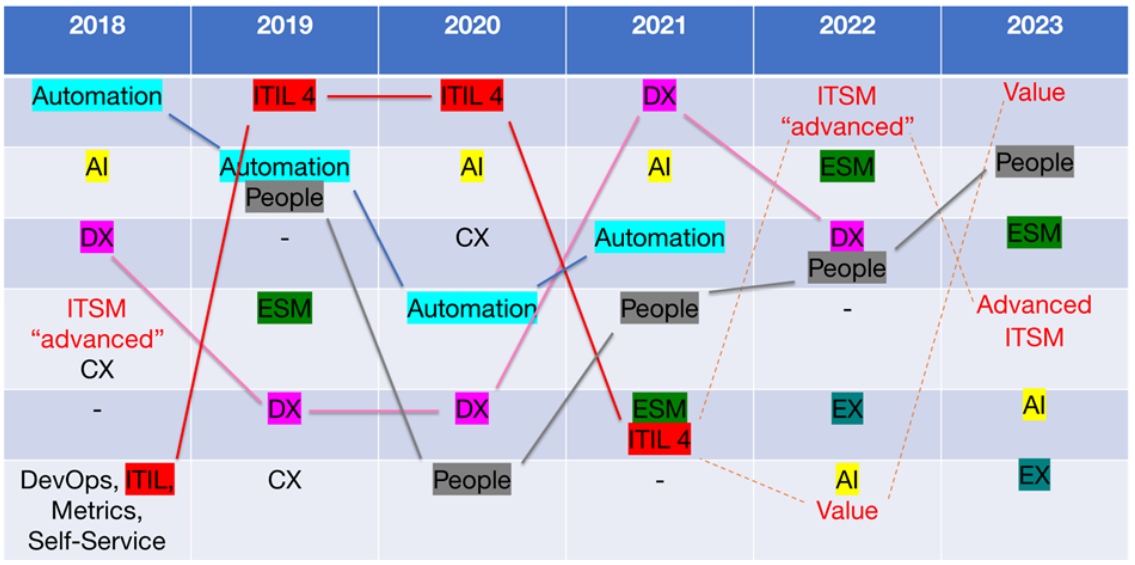
Source: https://itsm.tools/hottest-itsm-trends-2023/
In the 2024 poll, reader interest in AI content has jumped again. While the poll is ongoing, the initial results show AI as the most-wanted content area, selected by 44% of respondents (who could choose five of 25 options) and 10% higher than the second-placed area.
While the insight isn’t captured in the poll, logic suggests that the drop and then rise of AI is a sign of IT professionals moving from wanting to understand “the art of the AI possible” to now needing help and guidance on moving their AI planning, exploration, and pilots on into production use cases that benefit IT operations and business outcomes.
5. The Gartner AI Hype Cycle and 2024 generative AI expectations
I’m not a Gartner Research customer, but there’s usually access to some of its most popular research on the internet via tool-vendor licensing or Gartner’s public-facing content. A good example of the latter is the Gartner “Top of Mind” YouTube videos, with this 2024-focused video including the 2023 Gartner AI Hype Cycle and the expectation that organizations will move from experimenting with generative AI in 2023 to full-scale implementation in 2024 (sliding down the Hype Cycle’s Peak of Inflated Expectations to the Trough of Disillusionment as organizations realize that implementation is harder than they expected).
So Gartner predicts 2024 will be a turning point for generative AI, with organizations needing to meet the many challenges its adoption into production brings. This might be interpreted as the largest of organizations speeding ahead with generative AI, but based on other ITSM.tools research related to experience management and enterprise service management, there no longer seems to be the traditional “waterfall effect” of new idea and capability adoption flowing down from the largest organizations to mid-sized organizations and then finally to smaller organizations. I’d be willing to bet that the same will be true for generative AI, with the largest and smallest organizations going neck-and-neck regarding adoption, with mid-sized organizations the relative “laggards” but still focused on adoption.
6. The global economic climate
While different from the previous five indicators and factors, this is hopefully the primary one that will drive IT organizations to move their AI ambitions into production-affecting actions, i.e. meeting business needs.
While the mantra of “better, faster, cheaper” has long been prevalent in the IT space, there’s no doubt that most businesses are looking for ways to reduce operating costs in what has been a period of high inflation that delivered the double bottom-line whammy of increased costs and customer spending barriers.
Businesses will look to their IT organizations to help, with elements of the overall corporate solution involving greater technology and data exploitation and generative AI leveraged to speed up processes, increase productivity, reduce costs, and improve experiences.
Joining the dots on (generative) AI adoption
No matter the indicator or factor, it’s hard to bet against 2024 being the breakout year for AI. The combination of factors, such as the rising AI inclusion in corporate software, the state of the global economic climate, and the media hype around ChatGPT, mean that IT organizations will be focused on AI adoption whether they had planned to or not.
In the same way that the global pandemic accelerated digital transformation strategies for 80% of organizations (and the uptake of enterprise service management for business process digital enablement), there’s now another “perfect storm” heading into IT. This time, it’s AI, and as with all new technologies, it will start as a race for competitive advantage before becoming a necessary staple of IT.
There will, of course, likely be many mistakes made by organizations as they try to make AI a production reality. In fact, AI has probably already predicted this based on historical technology adoption data. However, this time, technology can help organizations to learn from these mistakes. In my opinion, it won’t be long before AI helps with AI adoption. It might sound crazy, but why wouldn’t it?
By Stephen Mann, Principal Analyst and Content Director, ITSM.tools